The Jewish Chronicle has the full eye-opening story of the closure of a Jewish-owned chain of restaurants in Belgium. It’s a dispiriting tale but one that lays bare the blueprints that anti-Semites are following around the world.
It also helps dissolve some myths.
First up is the idea that there exists any benign form of self-declared “anti-Zionism.”
“Two days after the [October 7] massacre, the first hate messages started,” recounted Boker Tov owner Tom Sas. “At first they were private but after two weeks they started spreading lies publicly — that we ‘had blood on our hands’ and that we support war — and then the calls for boycott began.”
In other words, as happened in the U.S. and elsewhere as well, the “pro-Palestinian” world responded to one attack on Jews by attacking other Jews.
Second myth: that these attacks weren’t intended as personal attacks, or meant to put anyone in danger. “The lies and bad press were spread by notable public figures on the radio, so it spread fast,” Sas told the Chronicle. “Pictures of us were shared online with hate messages, our addresses were shared, calls for fake reviews, at the peak, we were receiving 1,000 notifications an hour.”
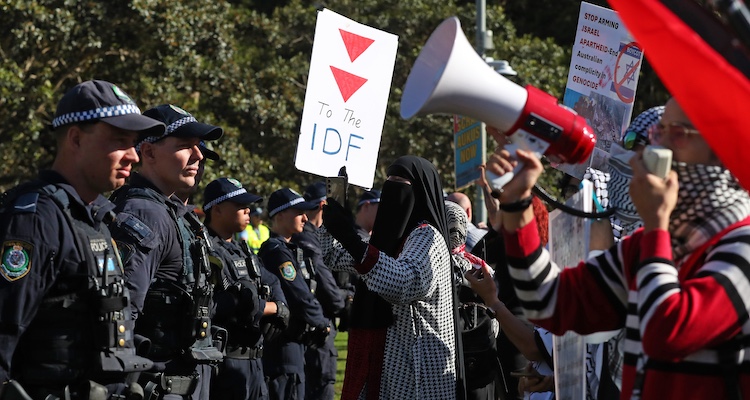
Third: that the campaign against Jewish businesses was nonviolent or law-abiding. “They spat on us, on our windows, shouted at our staff and our customers sitting on the terrace, they damaged furniture, graffitied our walls, and hung posters accusing our guests that they were also committing genocide by eating at our restaurant,” Sas explained.
Fourth: that there are only a few Hamasniks mixed in with such crowds. The Chronicle notes that Sas and his wife started speaking publicly about it, appealing to the wider community and attempting, through dialogue, to defuse the situation. “However, every attempt they made backfired as it gave more fuel to the anti-Israeli protesters in their efforts to close the business down.”
Fifth: that anti-Israel protesters care about collateral damage. Dozens of jobs disappeared when the restaurants had to close.
Sixth: that larger Jewish communities are insulated from such boycotts. “If protesters are abundant and spend a lot of time destroying the image of a place, eventually it will be at risk, as nobody, Jewish or otherwise, will want to go there,” Antwerp official Michael Freilich said.
I admit I winced when I read that last line. I had just been reading the Guardian’s coverage of Australia’s efforts to crack down on incitement. Initially the bill, set forth by Prime Minister Anthony Albanese’s Labor Party, was reportedly far too restrictive of plain speech to the point of being unsalvageable. But Liberal Party MPs were able to “gut” the overreach and pare down the bill.
Still, the Guardian made sure to quote the Jewish Council of Australia, a progressive group called upon to As-a-Jew the issue into oblivion. The legislation, they said, represented “an attempt to slander and intimidate hundreds of 1000s of Australians who have been protesting against Israel’s genocide and egregious human rights abuses.”
Of course, a publication like the Guardian would quote an organization like this, despite anti-Israel lunacy being a distinct minority opinion among Jews. It’s useful to them. But besides the political tokenization angle, it’s also a reminder that the Jewish community contains within it organizations whose entire purpose appears to be to enable state suppression of Jewish rights and Jewish security.
The Jewish Council of Australia, it turns out, was founded in the spring of 2024—meaning it was launched after the October 7 attacks in order to join the global anti-Israel pile-on.
The Jewish community has an obligation to battle, not coddle, the anti-Zionism within its ranks. It has the same obligation to mount a full-scale fight against anti-Zionism in mainstream discourse. The movement of anti-Jewish assault shutting down Jewish shops and restaurants calls its worldview anti-Zionism. So the proper response is clear: That which calls itself anti-Zionism must be defeated.