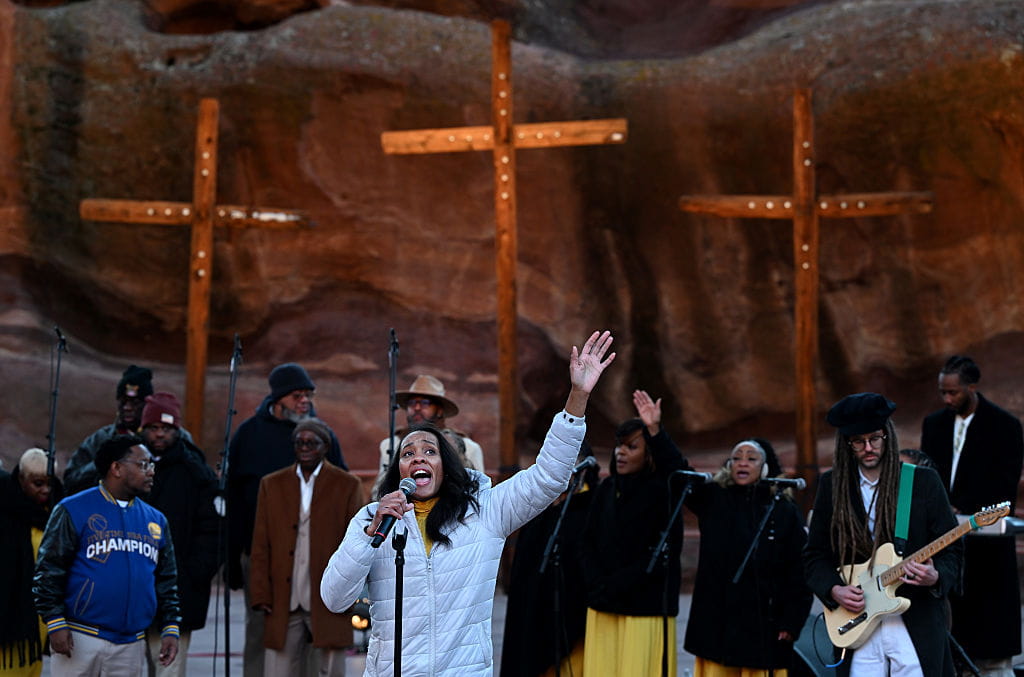
Picture this: The amphitheater is crowded with the faithful. There is scarcely an empty seat, and those who managed to find one aren’t using it; they are standing. Some have their eyes closed and are waving their hands in the air. The stage is filled with a five-piece band, including loud drums beating wildly as a praise and worship team belts out an unfamiliar tune with repetitive lyrics. Welcome to Easter 2026, brought to you by the contemporary Christian church.
Or…
The wooden pews are mostly filled. It is quiet and respectful. A sense of holiness and solemnity wafts like frankincense and myrrh through the large sanctuary. The windows are stained glass, the hymns familiar, and an overabundance of gray hair is evident with one glance from the balcony. It’s still 2026 in the Christian church, but the differences between these two worship methods are vast and largely irreconcilable.
Worship: Ch-Ch-Ch Changes
These two diverse styles of honoring the Lord reveal the changing face of Christian worship. In a way, it separates Christianity from the other major religions: Muslims don’t stand and wave to Mohammed five times a day. Buddhists don’t chant with a five-piece band in the background. Jews still greet each other with the traditional Shalom, invoking the peace of God’s love, but they don’t spend a minute or two walking through the synagogue shaking hands and hugging. These religions have maintained methods of worship that are essentially the same as they have been for centuries – or, in some cases, millennia. So why has Christian worship changed so much? And does it really matter?
An argument could be made that changing worship practices is a tradition in America – perhaps as old as, or older than, the Republic itself. Pilgrims accentuated a sense of community on Sunday in services that lasted about three hours. There were no musical instruments; only the voices of the congregation raised in somber reverence. This method of honoring the one true God was nothing like the worship services of the Church of England or the Roman Catholic Church. These changes in worship were an essential part of the early American church experience.
However, somewhere in the middle of the 20th century, the traditional Christian church experience changed, and the growth of the evangelical praise-and-worship service took off, bringing with it not just the flower children from the Jesus movement but their parents as well. These places of worship are often referred to as megachurches because of their size. As well, they aggressively market themselves as accessible and offer a sense of community, from divorce care to pickleball.

Photo credit: Liberty Nation
Meanwhile, traditional churches with pews and hymnals are struggling to make ends meet. Those who enjoy ritualistic methods of honoring God have often leveled criticism at this new, more contemporary service. Some claim the church has lost its holiness; others say they just don’t like standing and singing songs they’ve never heard before for up to 30 minutes at the beginning of every service. These churches don’t have coffee bars or cafeterias, and they eschew any notion of acquiring such things for their congregation.
Although some believe it was St. Augustine, most sources credit the seventeenth-century theologian Rupertus Meldenius with saying: “In essentials unity, in non-essentials liberty, in all things charity.” We need look no further than the book of Acts in the scriptures to determine the essentials of Christian worship. “They devoted themselves to the apostles’ teaching and to fellowship, to the breaking of bread [the Lord’s Supper] and to prayer” (Acts 2:42). How they go about these essentials may differ. Still, most Bible-based Christian churches offer these key elements in various ways during their weekly services.
In the ninth chapter of Luke, Jesus addressed religious tension when he responded to a question from John:
“Master,” said John, “we saw a man driving out demons in your name, and we tried to stop him, because he is not one of us.” “Do not stop him,” Jesus replied, “for whoever is not against you is for you (NIV).”
This may not directly speak to worship services, but it does illustrate how Jesus viewed the work of those not in his inner circle with open-mindedness. It also signals that he was not overly concerned with ritual. This takes us to the primary reason for attending Christian church services.
A key theme woven throughout the Bible is not how we worship but why we worship. Are we desperate to meet with God and to honor him? Do we desire his presence in our lives? It is our hearts that concern God, not whether we are waving our hands in the air or sitting in wooden pews surrounded by stained glass windows. As the prophet Samuel reminds us: “The LORD does not see as man sees; for man looks at the outward appearance, but the LORD looks at the heart”(1 Sam 16:7). This is not to say worship with reptiles and other deviant types of services are acceptable. There is a middle ground that must be sought in Biblical worship services.
So, whether you are standing or sitting this Easter Sunday, waving your arms or parked in a pew, belting out the lyrics to contemporary music or reading the words from a dusty hymnal – remember these are not the things that matter most to God. Rather His central message centers on salvation, sanctification, and reaching out to the world with the message of the risen Christ.