One year in the late 1990s or early aughts, when I was around 10-years-old, my mom and grandma dressed me up and swept me into the city, through the doors of the grand Pabst Theater. This is where I first learned the term “nosebleeds,” as we ascended a gilded staircase to our seats at the tippy top of the balcony.
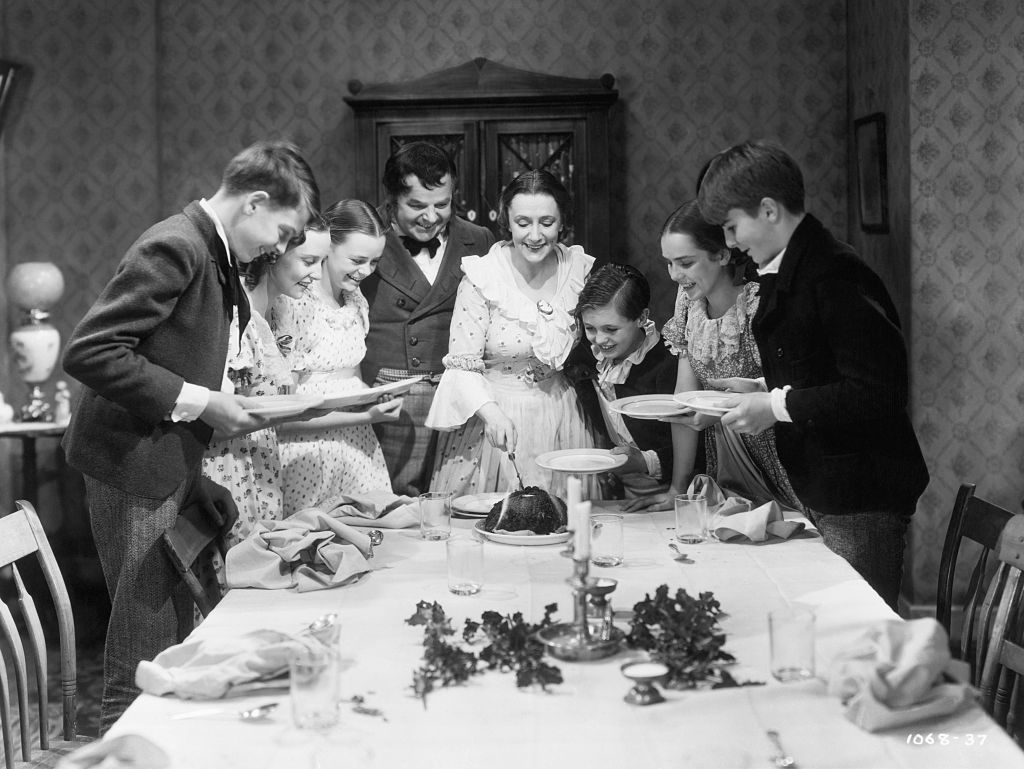
We were there to see the Milwaukee Repertory Theater’s annual rendition of A Christmas Carol, as we would do nearly every year into the future. The Pabst is a stunning venue, the kind of place that makes you think your town is special, though as I got older, I realized just about every American city has its own version of the Pabst: a local magnate’s eponymous temple to the arts, built with spoils from the Industrial Revolution.
This makes it the perfect home for Charles Dickens. In the mid-19th century, as A Christmas Carol debuted, Milwaukee was a grand city in the style of Chicago, infused with German culture and European elegance. The city’s prosperity, however, often did not extend to the laborers who produced the wealth. Humbug!
Captain Frederick Pabst immigrated from small-town Germany in 1848, marrying into the Best family and eventually growing their brewing operation into the largest in the United States. By his death in 1904, he had “left his mark on the city of Milwaukee, investing in real estate projects like the Whitefish Bay Pleasure Resort and the Pabst Theater and making financial contributions to welfare, education, and arts organizations,” according to the Wisconsin Historical Society.
Indeed, when the opera house that became the Pabst Theater burned down in 1895, the captain is said to have cabled, “Rebuild at Once!” Each Christmas, Pabst and his wife supplied 100 families with baskets of groceries to get through the harsh Wisconsin winter. Ebenezer Scrooge, he was not.
Christmastime makes the world of Dickens bearable, cozy even. And for me, a Christian, Christmas is not a holiday about trees and eggnog and piles of gifts and overspending, but about Christ, who makes our world possible — and bearable and cozy, too, if we can see his light.
Dickens was a complicated Christian: he was born in the Church of England, but later turned away, toward Unitarianism. He focused on the social good produced by Christian principles, but was a vehement critic of the church hierarchy, as well as of clerical hypocrisy and abuses. The light of true faith shines in his profound commitment to charity and the social good.
Metaphors of light and dark abound in his work, serving as a commentary on wealth and poverty, patronage and exploitation, individualism and community, and damnation and salvation. In A Christmas Carol, he contrasts Scrooge’s “gloomy suite of rooms” and his “neglected grave” with scenes of how the miser’s former employer, Fezziwig, ran his business. Fezziwig’s warehouse was “snug, and warm, and dry.” Scrooge’s nephew Fred, another of the book’s positive role models, throws a party in a “bright, dry, gleaming room.” (Light and dark are clearly delineated in Dickens — a deeply Christian concept; no moral relativism here.) Dickens describes many wonderful things as “bright” in the book, making obvious the motif of light and dark. His characteristically precise illustrations of both worlds have a jarring effect on readers, fostering the visceral appreciation for warmth that occurs when you step in from the cold.
One passage, as Scrooge and the Ghost of Christmas Present approach Bob Cratchit’s residence, is perfectly Dickensian. “The sky was gloomy,” the author wrote, “and the shortest streets were choked up with a dingy mist, half thawed, half frozen, whose heavier particles descended in a shower of sooty atoms, as if all the chimneys in Great Britain had, by one consent, caught fire, and were blazing away to their dear hearts’ content. There was nothing very cheerful in the climate or the town, and yet was there an air of cheerfulness abroad that the clearest summer air and brightest summer sun might have endeavoured to diffuse in vain.”
Scrooge finds that, inexplicably, “the people who were shovelling away on the housetops were jovial and full of glee; calling out to one another from the parapets, and now and then exchanging a facetious snowball — better-natured missile far than many a wordy jest — laughing heartily if it went right and not less heartily if it went wrong.”
This is the source of a light so bright that even the summer sun could not compete with it. And it is the reason that Christmas Carol is Dickens’ best work — in a macro sense, his stories are really all Christmas carols. Christ is the flame that lights the West, bringing comfort to the poor and a burden to the rich. Blessed are the meek.
Scrooge, who represents darkness and the other side of the equation, has replaced this light with a “golden” idol. We see this clearly in the scene where he is forced by the Ghost of Christmas Past to watch his former self part ways with a girl to whom he was once betrothed, and she reproaches him for having chosen this idol instead of their love.
The younger Scrooge replies, “There is nothing on which it is so hard as poverty; and there is nothing it professes to condemn with such severity as the pursuit of wealth!”
“Gently” the girl answers, “You fear the world too much.… All your other hopes have merged into the hope of being beyond the chance of its sordid reproach. I have seen your nobler aspirations fall off one by one, until the master-passion, Gain, engrosses you. Have I not?”
“Christ is the flame that lights the West, bringing comfort to the poor and a burden to the rich. Blessed are the meek.”
Critics might say that this detachment from the woes of the world — which are a realistic source of fear — excuses predatory capitalism. Believers who focus on the next life might be tempted to ignore the ills of this one. However, Christian apologists argue that it is precisely this kind of fear of the world that causes predation. And the fear can only be overcome by faith in Christ. The Ubermensch — the godless man who makes himself the measure of value — takes no prisoners on his way to evading material poverty, just as Scrooge stiffs Crachit. Dickens demonstrated that the great miser’s fear leads to a combination of material wealth and spiritual poverty.
Dickens’s Christian ghost stories and Victorian spiritualism were a counterargument to the other dominant philosophies of his time, those of Frederich Nietzsche, Max Weber, and Karl Marx, each of whom proposed materialist solutions to the ills of human life. Marx decried the material horrors visited upon workers by Victorian capitalism, but saw no solution, no peace, beyond more struggle. Transcendent values — the ones that might’ve justified his concern for workers — were so much, well, humbug. Weber took a more nuanced view, believing that hard work and the system of capitalist prosperity was a religious good, but acknowledging that it came with dangers.
“Today the routines of everyday life challenge religion,” said Weber. “Many old gods ascend from their graves; they are disenchanted and hence take the form of impersonal forces.” Of “religious asceticism,” he wrote that “victorious capitalism, since it rests on mechanical foundations, needs its support no longer.” The “modern economic order,” Weber believed, “is now bound to the technical and economic conditions of machine production which today determine the lives of all the individuals who are born into this mechanism, not only those directly concerned with economic acquisition, with irresistible force.”
“Perhaps,” he added, “it will so determine them until the last ton of fossilized coal is burnt.”
Coal is a theme in A Christmas Carol, as well. One of its last lines invokes the ever-important coal of 19th-century England. Scrooge says: “A merrier Christmas, Bob, my good fellow, than I have given you, for many a year! I’ll raise your salary, and endeavour to assist your struggling family, and we will discuss your affairs this very afternoon, over a Christmas bowl of smoking bishop, Bob!” he remarks. “Make up the fires, and buy another coal-scuttle before you dot another i, Bob Cratchit!” This greeting comes with “an earnestness that could not be mistaken.” Scrooge has been changed forever.
Cratchit was hardly burning the last ton of fossilized coal, nor are we approaching that landmark even now, though Dickens’s carol and the spirit of mercy persist, even in the modern world. In his showing, we may gain wealth and power, but only if we do good with it. In the modern world, we may be trying to forget about his form of charity, but we haven’t entirely. As technology companies with power that rivals great nations erect sprawling data centers, moguls like Elon Musk promise “there will be universal high income” in the near future. Shame lingers, at least for now.
Tom Holland once described “the supreme paradox of Christian history” as the existence of “a faith that became powerful by virtue of enshrining as its symbol someone utterly powerless.” The challenge for Christians in the industrial West is to find every Scrooge in our midst and make a Pabst out of him. Starting with the Scrooge inside ourselves, of course.