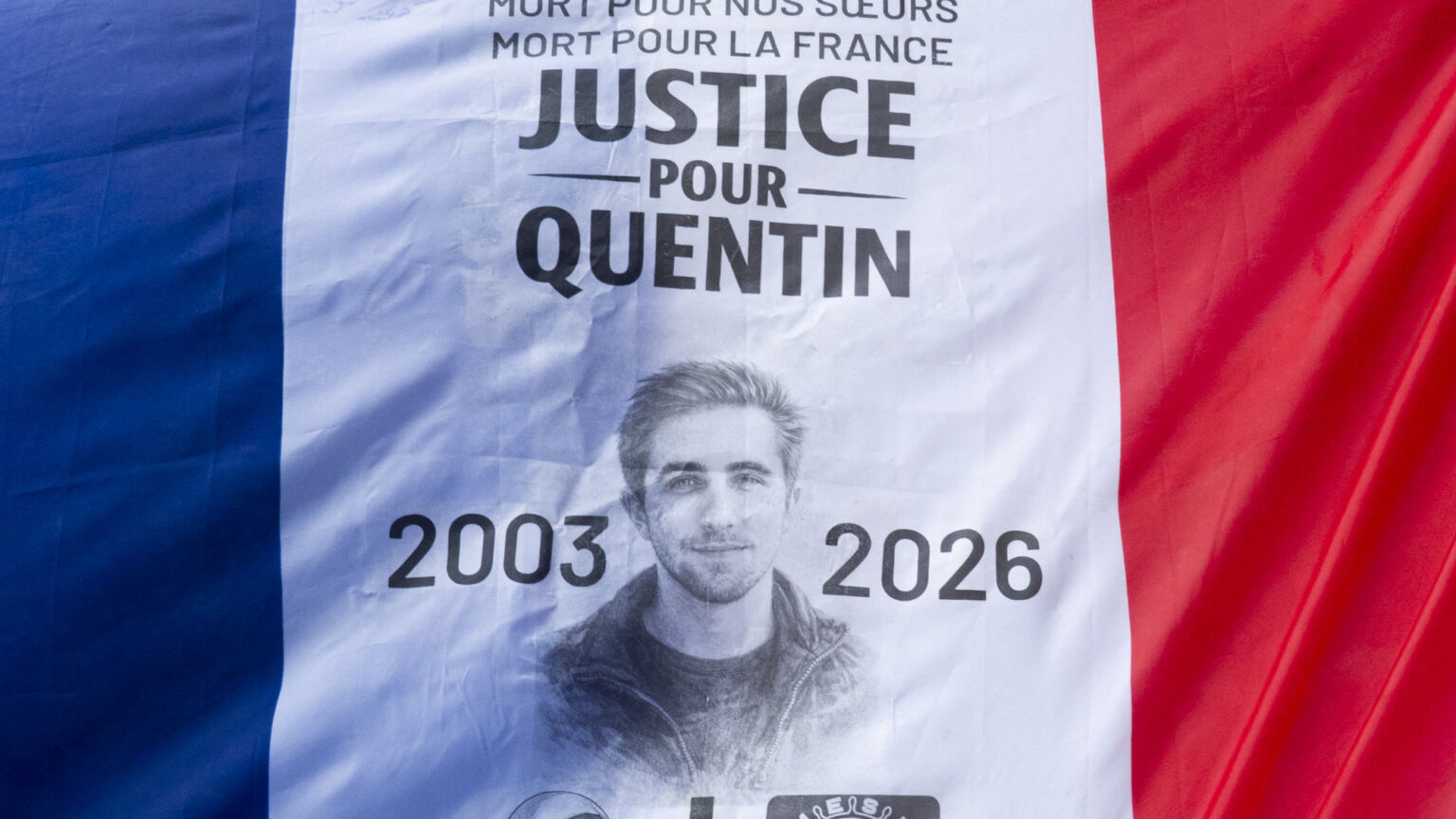
On 12 February, 23-year-old right-wing activist Quentin Deranque was brutally beaten and left for dead in the street by a group of anti-fascist militants. His death in a Lyon hospital two days later has left France reeling.
Deranque’s murder has sullied the image of the far-left party, France Unbowed (La France Insoumise), as well as its founder and de facto leader, Jean-Luc Mélenchon. Two of the ‘anti-fascists’ charged with involvement in the killing were assistants to the France Unbowed parliamentarian, Raphaël Arnault. A third had been an intern for him.
This has in turn put pressure on the New Popular Front, a broad left-wing electoral alliance uniting leftist parties like France Unbowed and the once-mighty centre-left Socialist Party. Just as there has been a cordon sanitaire erected against far-right National Front and its successor, National Rally, there are now calls for a cordon sanitaire against France Unbowed. The test of such calls will come later this month when local elections are held across the country.
To understand the alleged lynching of Quentin Deranque, one must understand the violent fringes of French political culture. Informal groups of right-wing activists devoted to various nationalist, identitarian and even neo-Nazi causes can be found in many of the big cities. Opposing them are groups of equally extreme left-wing militants claiming to be anti-fascist, and usually adopting the label ‘Antifa’.
The ideology, tactics and networking methods of French Antifa activists are precisely those described by Andy Ngo’s 2021 book on their American cousins, Unmasked. On the occasion of organised protests or fly-posting sorties, extremists of left and right engage in scuffles or even pitched battles. Their weapons are crow bars, knuckle dusters and reinforced combat gloves. Such clashes between extremist groups are on the increase with the recorded number of assaults doubling over the past decade. Currently, the authorities are in the process of banning three extremist groups of the right and one of the left.
The most important distinction between the left- and right-wing extremists is that the right-wing identitarians are considered beyond the pale by all mainstream politicians, while Antifa have connections to established parties and are treated sympathetically in intellectual and academic circles.
On 12 February, the scene was set for an outbreak of left-vs-right violence in the vicinity of the Institute of Political Science (Sciences Po) in Lyon. A student association had invited the France Unbowed MEP, Rima Hassan, to speak about Europe and Palestine. Hassan was born in a Palestinian refugee camp in Syria and, after emigrating to France, began a political career with the far left. A participant in the pro-Gaza flotillas in June and September last year, Hassan has often been accused of anti-Semitism and support for terrorism.
Némésis, a right-wing feminist collective opposed to violence against women by immigrant men or their descendants, was holding a protest against the Hassan event on the pavement opposite the Sciences Po building. Several young men with identitarian affiliations were there in support of the women – and, allegedly, to provide backup in case of violence. Among them was Quentin Deranque, who had no criminal record and no history of violence. He was associated with the traditionalist Catholic milieu.
Inevitably, fighting broke out with left-wing activists. An established tactic of street battles is to identify and surround an isolated adversary and administer a punishment beating. This is exactly what happened to Deranque, who was attacked by at least six masked thugs, knocked to the ground and repeatedly struck about the head. The whole distressing scene was videoed by local residents. Deranque was taken to hospital after the attack, where doctors were unable to do anything for him. He passed away two days later.
The death was swiftly declared an ‘intentional homicide’ by authorities, who rounded up 11 suspects for questioning. Seven were charged – six for murder, and one for assault and incitement to murder. Most of the accused had ties to a prominent Lyon Antifa group, the Young Guard.
Young Guard was co-founded in 2018 by the then future parliamentarian, Raphaël Arnault. Arnault acted as the Young Guard’s spokesman until 2022, when he resigned in order to stand as a candidate for the New Anti-Capitalist Party in a Lyon constituency. After failing to win the election there, he was subsequently parachuted by France Unbowed into a safe seat in Vaucluse for the 2024 elections. This was despite being convicted of assault in 2022 and given a suspended sentence of four months in prison. French authorities even placed him on a watch list of individuals who represent a threat to national security. In 2024, he was questioned by police over a communiqué he published on 7 October 2023, which described Hamas as a ‘resistance’ movement. Arnault is also part of international Antifa networks. In August 2024, he arrived in London to support a left-wing demonstration in response to the riots that followed the Southport tragedy.
While Arnault was pursuing a political career, the Young Guard spread from Lyon to other cities such as Strasbourg, Paris, Lille and Montpellier. It built up a membership of about a hundred people. Between 2019 and 2025, its Telegram channel celebrated over 50 violent actions. Several Young Guard members have been convicted of assault and many more have been accused of violent behaviour and having Islamist sympathies. Eight members are still awaiting trial for an alleged anti-Semitic assault on a 15-year-old on the Paris Métro after a different Rima Hassan event in 2024.
The authorities have begun moving against Young Guard. In June 2025, the Young Guard was banned by governmental decree for repeatedly provoking violent confrontations. The authorities have now ordered an investigation into the possibility of an illegal re-establishment of the Young Guard under a new name.
The profiles of four of those involved in Deranque’s murder speak volumes. Jacques-Elie Favrot, who is accused of incitement, was one of the aforementioned parliamentary assistants to Raphaël Arnault. His criminal record shows two cases of theft and one of possession of a weapon. Robin Chalendard was also an assistant to Arnault, but he was hired under a false name. Chalendard is accused of harbouring Adrian Besseyre, who is himself accused of manslaughter. The latter had been an intern in Arnault’s office, also under a false name, between October 2025 and January 2026. Alexis C is one of those awaiting trial for the anti-Semitic assault in 2024. All of them were associated with the Young Guard and appear, like Arnault himself, to have been on the national-security watch list.
The connections between the Young Guard and France Unbowed go way beyond Arnault. Young Guard militants provided campaign support for far-left parties in the 2024 elections. In April 2025, Mélenchon called the Young Guard an ‘allied organisation’ of France Unbowed. He and other colleagues attended the Antifa group’s summer camp in three successive years. Reportedly, Young Guard militants have provided security at Unbowed events and have been rewarded with posts in the party structure.
On the left generally, there is tacit approval of the group. When Young Guard was banned, far-left politicians, writers, rappers and social-media influencers signed an open letter criticising the decision while also warning of a ‘rise of fascism’ and ‘genocide in Gaza’. Young Guard activists believe that violence is legitimate when directed against so-called fascists. France Unbowed’s approval of the Young Guard shows that the party implicitly approves of such violence.
Far from attempting to distance himself from the Young Guard in the wake of Deranque’s death, Mélenchon doubled down. The Islamo-leftist firebrand, who currently has no elected mandate but maintains his presidential ambitions, characterised the killing as a street fight that went wrong and put the blame on police incompetence. Voicing continued approval of Arnault and the Young Guard’s stance of ‘resistance’, Mélenchon complained of a disinformation campaign waged against France Unbowed. All this is in keeping with his usual strategy – never admitting any wrongdoing while claiming to be the real victim.
Other leftist politicians and media outlets have tried to claim that the violence of the right is worse than that of the left. In reality, the Lyon murder remains a rare example of a militant murdered by ideological adversaries. The last case was in 2013, when Clément Méric, an 18-year-old member of an Antifa group, was beaten to death in Paris by a group of skinheads. Méric was canonised by the far left as a martyr of the struggle against fascism. However, his killers had no connections to mainstream political parties, and no politician defended their actions.
All of the above threatens to undermine one of the great achievements of the French left: the formation of an electoral and parliamentary alliance in the shape of the New Popular Front. Now, former French president François Hollande (today an influential member of the National Assembly) has called for the Socialist Party to break away from France Unbowed. Socialist leader Olivier Faure has criticised France Unbowed, but not yet dared to end the alliance. This is perhaps unsurprising, considering that Socialists’ chances of success – whether in the imminent local elections on 15 and 22 March or the presidential election of 2027 – would be greatly reduced without it. The right has already seized the initiative, calling for a cordon sanitaire against Mélenchon’s party.
This is a call which may well be gaining traction with the electorate. In a recent poll, 63 per cent said they agreed with a cordon sanitaire against France Unbowed. The traditional cordon against the far right was established and exploited by the wily Socialist president, François Mitterrand. To create and maintain a new cordon sanitaire against the far left would take an equally capable political operator. There are signs that Jordan Bardella – president of the National Rally and potential presidential candidate in the 2027 election – has understood this. On 21 February, Bardella advised his elected representatives and militants not to attend a march organised in Lyon in memory of Deranque. He did so because the march was not the idea of the victim’s family, who had asked for there to be no politicisation of his death. Above all, Bardella wanted to avoid any association between his party and extreme identitarian activists. The march, which drew 3,200 people, was ultimately peaceful, although there were a handful of arrests for racist chants and Nazi salutes.
Emmanuel Macron’s reaction to Deranque’s lynching has highlighted his inability to condemn one extreme without condemning the other. He called on parties of both far left and far right to ‘clean up their act’. Unfortunately, his perceived lack of action against extremist left-wing militancy has led to diplomatic incidents with Italy and the US. Italy’s prime minister, Giorgia Meloni, stated that the lynching of Deranque was ‘a wound for all of Europe’. Meloni’s foreign minister, Antonio Tajani, called it ‘a murder that knows no borders’. Macron, who has never had very cordial relations with Meloni, said that other countries should ‘mind their own business’.
A tweet from the US State Department blamed the rise of ‘violent radical leftism’ for incidents like Deranque’s death. When the US ambassador to Paris, Charles Kushner, reposted the remarks with his own comment, he was summoned to the French foreign ministry. Kushner did not see fit to turn up. France’s foreign minister, Jean-Noël Barrot, weighed in, saying that his country had no lessons to learn from the ‘international reactionary movement’.
Nevertheless, with Macron’s government rendered impotent in parliament with no majority, the murder of killing of Quentin Deranque only added to the impression that France is rudderless.
Jeremy Stubbs is deputy editor of Causeur.