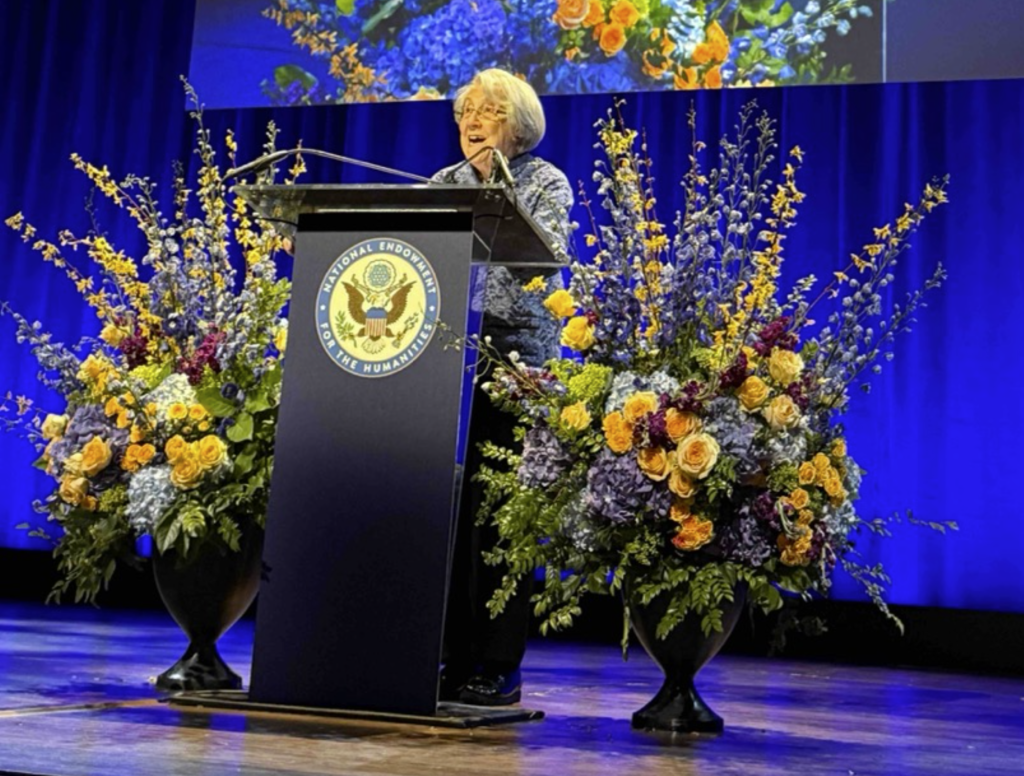
Ruth Wisse’s ‘grateful Jewish message on staying power’
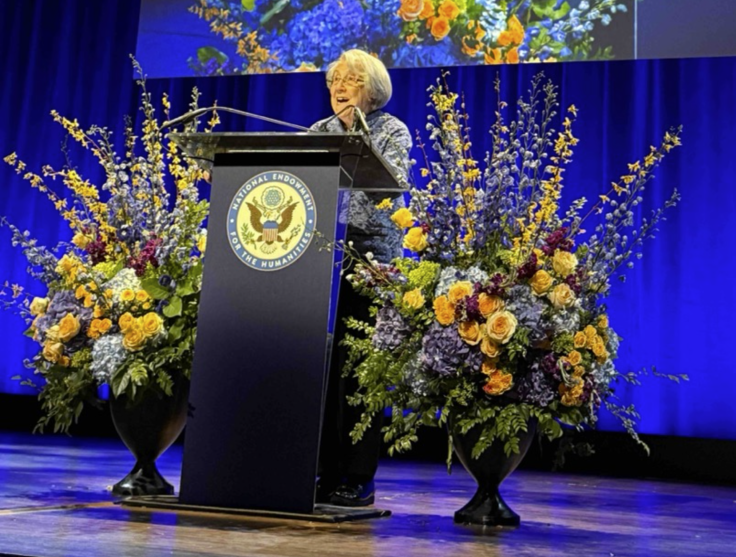
The scholar of Yiddish Ruth Wisse began her Jefferson Lecture last night at the Trump Kennedy Center in Washington with the observation that “There have been many far more distinguished speakers in this series, but I think none has been older, and no one more grateful.”
Wisse didn’t explicitly make the connection between her age—89—and her topic—”our anxieties about endurance”—but I’m old enough myself to begin to understand what she was talking about. So is America, in its 250th birthday year.
Wisse introduced her talk as “a grateful Jewish message on staying power, in three parts.”
Part one focused on a Yiddish poem by Abraham Sutzkever that asks “Who will last? And what?” It concludes “Who lasts? God abides — isn’t that enough?”
I took Sutzkever—and Wisse—to be suggesting that faith in God is one secret to endurance, and also that the anxiety about endurance is eased by the knowledge that only God is eternal.
As Wisse put it, “To find lastingness, he insisted, you must look to its source. Trust in eternity can be sought only in the eternal.” Or, as she concluded, “Sutzkever, who survived the sacrifice of his formative world—when that’s what it cost to remain a Jew—reminds us to acknowledge before whom we stand. If that secure knowledge could restore him and resurrect the Jewish people, so can it inspire this nation to reach its 2,500th anniversary.”
Part two focused on an essential Jewish prayer, the Shma, which begins, “Hear, O Israel. The Lord is our God, the Lord is One. You shall love the Lord your God with all your heart and with all your soul and with all your might. And these words which I command you today shall be upon your heart. You shall teach them thoroughly to your children, and you shall speak of them when you sit in your house and when you walk on the road, when you lie down and when you rise. You shall bind them as a sign upon your hand, and they shall be for a reminder between your eyes. And you shall write them upon the doorposts of your house and upon your gates.” As she put it, the “ratio of content to transmission is about 1:7.”
Transmission, she said, requires teachers who inspire and reinforce rather than only complain. “The absence of insistent, creative intellectual formation, particularly in the humanities, does not just leave a vacuum; it gets filled by adversarial ideas: Marx for Madison, Lenin for Lincoln, and lately the Islamist incursion for the American Revolution. … If there is to be enduring government of, by, and for the people, the people would have to be instructed and reminded to respect and confidently to perpetuate their precious inheritance.”
Part three had to do with military force—appropriate for Wisse. Michael Segal of Harvard Advocates for ROTC wrote me to say that Wisse “was one of the key faculty members supporting return of ROTC to Harvard. … the example of Israel was very much in mind for the importance of having capable people in the military. “
Wisse said in the Jefferson lecture that “the United States is still this planet’s main hope … and that hope depends on the fighting strength of its armed forces and the fighting spirit of its citizenry. … Jews who represent the principle and practice of coexistence—and who paid the highest price when they’ve tried to endure without self-defense—can testify that soldiering is the mainstay of any society that intends to protect its members.”
Faith, teaching, and soldiering—as Wisse put it, “May these messages from the Blue and White forever help to strengthen and to secure the Red, White, and Blue.”
The full text is up, paywalled, at the Free Press, and YouTube has video. For those fortunate enough to attend in person, it was a large crowd heavy with some of the most prominent American Jewish rabbis, writers, editors, professors, and philanthropists, including some who traveled from Florida, Boston, and New York. The standing ovation for Wisse even before she started speaking “to all my fellow lovers of America out there” attested to the warmth, respect, and affection for a speaker who in the teaching, faith, and soldiering departments hasn’t only lectured but has lived as an example.