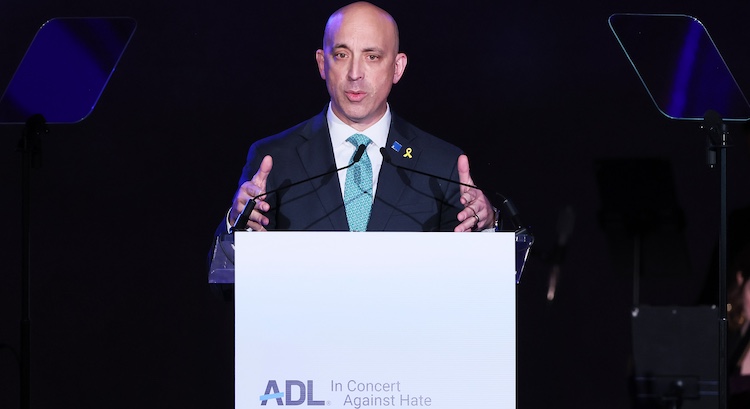
One of the Anti-Defamation League’s progressive critics has poached one of the ADL’s long-serving officials specializing in researching extremism. Both the official, Aryeh Tuchman, and his new employer, the Nexus Project, dismiss the suggestion that this hiring is in any way a repudiation of the ADL. But it is indicative of a larger challenge facing mainstream Jewish organizations in the U.S.
Nexus is representative of the revanchist, intersectional Jewish left that has become ADL’s loudest source of criticism. Yet it is likely that in the long term, American Jewish life will follow a path apart from both sides.
The main reason for that, of course, is October 7.
The ADL has been the subject of several mostly identical “investigative” articles in recent months in which former employees complain about the lack of civil rights—by which they do not mean Jewish civil rights—advocacy at the organization and its decision to focus on anti-Semitism. The latest comes from the Forward, and although it doesn’t add much to the growing pile of grumbling chronicles of the organization’s post-October 7 shift, it does contain a telling quote from CEO Jonathan Greenblatt:
“This moment has required us to be more and more focused on fighting the rise of antisemitism. And I hope when this situation abates — when there’s a cessation of hate, when the numbers start to come down — that we’ll be able to make different decisions about how we allocate our resources.”
Sorry, but that cannot be allowed to happen, and it almost certainly won’t happen. There is no going back to the old model for American Jewish organizations.
What is Greenblatt talking about when he mentions using resources in other ways? He means funding intersectional, DEI-inflected programs of Jewish self-harm. The progressive activist world required the ADL and other Jewish groups to pay into what was essentially a protection racket. But what happens when the “protection” part never materializes? That’s what happened after October 7, when the political groups to which many Jewish organizations tithed turned their backs on the Jews and joined the pro-Hamas jackals.
No one in their right mind will ever again pay into that racket. It was, in a sense, an expression of organizational decadence, mixed with complacency. Anti-Semitism was at low tide, and instead of remembering that the tide always turns, Jewish groups believed they could afford to chip in and show solidarity with fellow “marginalized communities.”
Regardless of the merits of this thinking before October 7, it is clear now that such a strategy cannot be employed again.
So where should the money go instead? A good place to look for answers remains Jack Wertheimer’s 2024 Mosaic essay on the American Jewish community’s post-October 7 philanthropy, since the overall trends remain the same even if the dollar figures have changed since then.
One area Jewish donors have turned to is groups that do nothing more than seek to combat anti-Semitism in the public square. One of Wertheimer’s sources in the philanthropy world told him: “The eyes of funders are now open in new ways; anti-Zionism is well-funded and pervasive in certain sectors. For the first time, funders realize how much those ideas have captured institutions.”
Indeed, this has only become more apparent since the essay’s publication. Anti-Zionism, it turned out, has been molded into a full-fledged ideology, more prevalent on the left than the right. That ideology has little or nothing to do with what Zionism actually is; instead, it’s a movement that sets itself in opposition to Zionists. That is, rather than participate in a debate over Zionism, anti-Zionism is a mercenary ideology that targets people who identify as Zionists—and, crucially, people the anti-Zionists accuse of harboring Zionism in their hearts.
What that means in practice is classic anti-Jewish discrimination in the professions, in academia, and the media. That’s because most Jews believe that Jews have a right to self-determination. So targeting self-identified “Zionists” is a way of targeting Jews.
Anti-Zionism is preposterously well-funded, because it has become a catchall progressive tag, and so some of the mountains of dark money set aside for progressive activism falls in the lap of any group that claims the anti-Zionist mantle. Which, at the current moment, is most of them.
So that’s one place Jewish communal resources must go toward: The battle against anti-Zionism must be joined in earnest. This also means that Jewish organizations should stop playing footsie with Jewish anti-Zionists. Even a big tent must draw the line at those who want to tear the tent down.
Where else? “At the time of the Pittsburgh shooting in 2018,” Wertheimer writes, “fewer than twenty locales supported professionally run Jewish community security initiatives. Now there are over 125. Donors resonated with the new agenda and have given accordingly. (Security also has been enhanced through government funding.)”
Quite right—and the security costs can be astronomical when one factors in the size of the American Jewish community, its geographic spread, and the number of its recognizably Jewish buildings and institutions. Let’s be clear: It is impossible to overfund Jewish security. That’s not meant as an alarmist characterization of the state of anti-Jewish threats but a comment on the reality of the market: things cost what they cost.
Relatedly, funding the study of anti-Semitism and anti-Zionism should be another priority. What works? What doesn’t? How does the community identify paths toward effective change in major industries, especially political and cultural ones? There’s much to figure out here.
Finally, another area that cannot be overfunded: Jewish life. Wertheimer quotes a Jewish Federations report that found: “Of the 83 percent of Jews who were ‘only somewhat,’ ‘not very,’ or ‘not at all engaged’ prior to October 7, a whopping 40 percent are now showing up in larger numbers in Jewish life. This group [is] equal to 30 percent of all Jewish adults and nearly double the proportion of Jews who identify as ‘deeply engaged.’”
This surge has been obvious to anyone paying attention. Throughout history, Jews have responded to the threat of annihilation by becoming stronger, smarter, and more resilient. That starts with knowing one’s history and heritage, because among all the other benefits of Jewish learning and tradition, there is the simple fact that the world’s remaining ancient civilization is by definition comprised of experts on survival.
The surge in Jewish communal interest and participation should be encouraged and embraced to the highest possible degree. The most vulnerable Jews at a time of rising anti-Semitism are those without wide Jewish support networks, those unfamiliar with how to fight back intellectually among their peers, those set adrift by their erstwhile friend groups with nothing to fall back on. We owe those Jews everything we can give them.
Let no one say “we don’t know where to put our money in the post-October 7 world.” The answers are above—and this is not a complete list. What we can say for sure is that there won’t be money left over to set alight in big intersectional piles.