OAN Staff Katherine Mosack
12:00 PM – Wednesday, March 18, 2026
Director of National Intelligence Tulsi Gabbard testified on Wednesday before the Senate Intelligence Committee, highlighting the United States’ successes amid the ongoing conflict with Iran, which has entered its 19th day.
Gabbard delivered the 2026 Annual Threat Assessment (ATA), the Intelligence Community’s (IC) evaluation of various threats to U.S. citizens, homeland and interests, before Congress on Wednesday at a hearing entitled “Worldwide Threats.”
“I’d like to remind those who are watching what I am briefing here today conveys the intelligence community’s assessment of the threats facing US citizens, our homeland and our interests,” Gabbard explained to the committee, “not my personal views or opinions.”
The National Intelligence director listed China, Iran, North Korea and Russia as countries that view the United States as a “strategic competitor,” emphasizing that these countries are most likely to cooperate with one another in situations where they believe they will gain advantages over the U.S. — posing potential threats to U.S. interests.
She also highlighted how these countries are still expanding their missile programs.
“Iran has long viewed the U.S. as an adversary and is engaged in an active conflict with the U.S.,” she asserted.
Gabbard also noted, however, that during “the current Operation Epic Fury, Iran [had] assumed that Russia, China and North Korea would provide support to Iran, and has been frustrated … that support has been very limited to non-existent.”
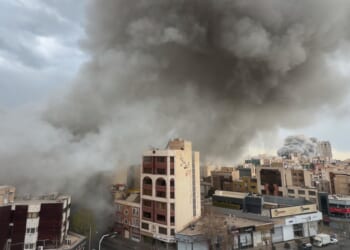
While Iran has struggled to maintain its footing against the joint U.S.-Israeli operation, the conflict has provided a strategic window for the United States to systematically dismantle Iranian military infrastructure.
This degradation of Tehran’s capabilities has been the primary objective championed by the Trump administration since the opening strikes on February 28th.
“Iran and Iranian-aligned terrorist actors—including HAMAS and Lebanese Hizballah—have been severely degraded by Israeli-led operations, U.S. intelligence and weapons support to Israel,” the 2026 assessment reported.
“Iran has proven capable of developing lethal operations against Americans at home and abroad and probably will attempt to pursue such efforts again if the current government remains in power and is able to rebuild,” the assessment read, explaining why military action was necessary in the region.
“Prior to Operation Epic Fury, Iran was pursuing increasingly capable missile systems, was non-compliant with its Chemical Weapons Convention obligations, had not abandoned its intention to conduct R&D (research and development) of biological agents and toxins for offensive purposes, was intending to try to recover from the devastation of its nuclear infrastructure sustained during the 12-Day War, and refused to live up to its nuclear obligations with the IAEA (International Atomic Energy agency),” it added.
The Department of War has already reported the neutralization of the Islamic Republic of Iran Navy, while U.S. officials highlight a marked decline in Tehran’s ballistic missile capabilities. Furthermore, Iranian air defense systems have been rendered operationally irrelevant, a shift that has effectively stripped the regime of its ability to shield its remaining military assets.
Despite her career-long skepticism of open-ended foreign interventions, Director Gabbard described the current operations as a necessary degradation of Iran’s capacity to threaten U.S. interests across the Middle East.
However, she offered a sobering caveat: the regime still appears to remain structurally intact, despite the elimination of Ayatollah Ali Khamenei and nearly 50 high-ranking officials. Beyond the kinetic impact of U.S. and Israeli strikes, Gabbard stated that the regime is facing a domestic crisis of legitimacy, fueled by a failing economy and the wave of anti-government demonstrations that have swept through all 31 provinces since December.
“Even if the regime remains intact, the IC assesses that internal tensions are likely to increase as Iran’s economy worsens, and if a hostile regime survives, it will likely seek to rebuild its military capabilities over the years,” Gabbard stated.
Stay informed! Receive breaking news alerts directly to your inbox for free. Subscribe here. https://www.oann.com/alerts
What do YOU think? Click here to jump to the comments!
Sponsored Content Below