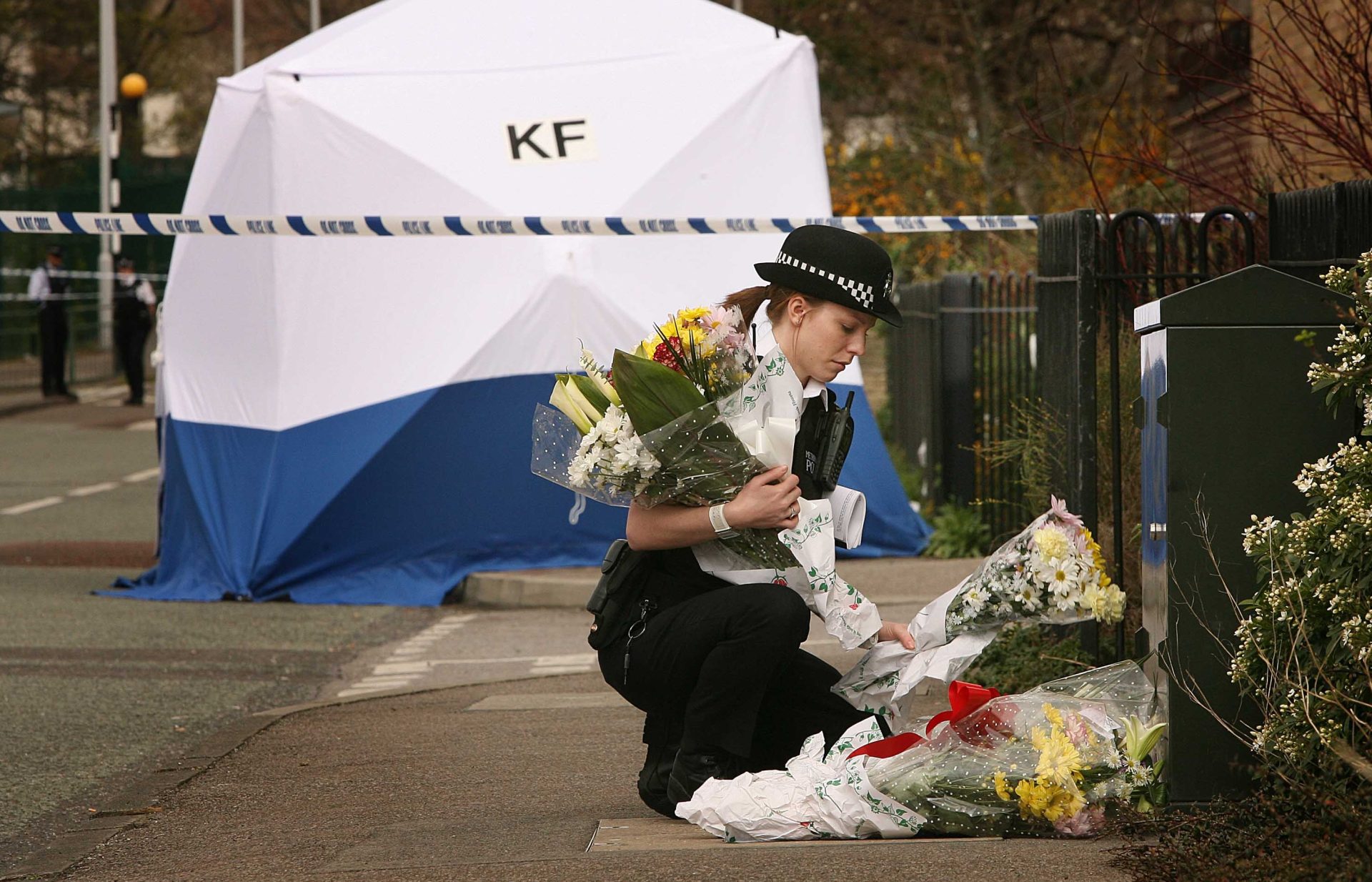
In London, it used to be that shrines for children would always mark the site of a road accident. Now they often mark the site of a murder. Most often, their killers are children too.
Another shrine has appeared in North London. On Tuesday lunchtime, Adam Henry, aged 15, was cornered down a side street off Westbourne Road, Islington, not far from Highbury Fields, and stabbed. Someone called 999. Paramedics arrived, and office workers on their lunch breaks saw them trying to save Henry’s life. He was rushed to hospital, where he died.
Within a day, the customary shrine had appeared. At the foot of a low brick wall have been laid flowers, drinks and biscuits, less than a minute’s walk from Henry’s old secondary school, St Mary Magdalene Academy, which he attended until partway through Year 8. His yearbook entry said he enjoyed skateboarding and reading the Bible. It has been reported that, after leaving St Mary Magdalene, Adam was a pupil of the Bridge Satellite School, which specialises in teaching children with autism. Laying flowers on Tuesday evening, Henry’s family told Metro that he was “quiet and respectful… very funny. Just a nice boy.”
The police have opened a murder investigation. As yet it is not known why Henry, nicknamed “AZ”, was stabbed to death one lunchtime in one of London’s wealthiest boroughs, minutes away from £8-a-pint gastropubs, a Bang & Olufsen showroom and the townhouse that was once Tony Blair’s. Like much of London’s Zone 2, Islington is an area where incredible wealth luxuriates a few doors away from poverty and strife. Beside the lawyers, celebrities and investment bankers live the boys and young men embroiled in violent street gangs.
One might assume that the violence breaks out when one drug-selling gang encroaches on the turf of another, but the truth is more prosaic: stabbings can be precipitated by social media posts and petty personal beefs. If you are spotted talking to the wrong person, or you repost the wrong video, you can become a target. There are only a small number of street gang members, but thousands of children are one misstep away from becoming a target.
And when acts of thuggery take place, they reverberate through the neighbourhood. Islington’s new youth safety strategy, which was published in November, found that even among young people in the borough unknown to police and child services, being robbed, and knowing someone who had been stabbed, was commonplace.
“As soon as you step out of your front door, you just have to be vigilant.”
The result is an atmosphere of worry and fear. “We have to stay behind [at school] until 4:20pm [when] it’s dark,” said one child, “so when I leave and have to go home, I just shit myself.”
Another said: “As soon as you step out of your front door, you just have to be vigilant; you know you can’t go to certain areas, and you don’t go out when it’s dark,” said another. “You always see young people all ballied up [i.e., wearing balaclavas]. You never know what they are going to do.”
These teenagers are rightly worried, yet they have at least been fortunate enough not to be drawn into the street gangs vortex. The more vulnerable they are — and often this involves having ADHD, autism and other mental health problems — the more likely needy children are to be sucked in, and the more likely they will be abused, brutalised or killed.
“Gangs are just another form of social extremism,” one expert told me. (Because he works with vulnerable children at risk of violence, he asked not to be named.) “These kids are lost boys, and the gangs are found-families. If you’re vulnerable, and looking to belong, you’re more likely to become exploited by these groups.”
And what does it mean to end up in those groups? You might be coerced into missing school in order to go phone snatching on e-scooters; you might be strong-armed into selling crack and heroin on a “county line” from a drug user’s council house in Colchester or Norwich for weeks on end; or you might be required to carry out acts of brutal violence on people you have never met before.
There has always been some quantity of criminality in society, but its expression and scale are in flux. Thirty years ago, in London there were a small number of large street gangs run by seasoned adult criminals. But this order has fractured, and today there are a myriad of smaller gangs, sometimes headed by kids. In Islington, the most prominent street gang are the “Cally Boyz”, who are based around the Caledonian Road, a couple of minute’s walk from where Henry died.
The Cally Boyz made the headlines in July this year when five members were jailed for stabbing to death two people, including a 15-year-old, while on a “rampage” in an Islington council estate in 2023. The gang members wrongly believed that their victims were part of a rival gang who had dared to film a music video on their turf. Mistaken identity, unfortunately, is another recurrent feature of gang violence.
In such a climate, Henry’s death does not come out of the blue, but nor is it run-of-the-mill. Two teenagers were killed in Islington in 2024; one was killed in 2023; in 2022, one 15-year-old was killed by another 15-year-old in Highbury Fields. Compared to boroughs such as Croydon and Hackney, Islington is not a hotspot for youth killings. In 2021, 30 teenagers were killed in London, the highest since the Second World War, but only two of these killings occurred in Islington. The violence is not always teen-on-teen; in March, three teenage girls were charged with killing a 75-year-old man in Seven Sisters Road. Still, the borough is less well known for its street gangs than for the original moped robbery gangs of a decade ago, and for the ageing Adams crime family. Its leader, Terry Adams, was described by the judge who jailed him for money laundering in 2007 as “one of the country’s most feared and revered organised criminals”.
Henry’s death comes at a time when the number of teenagers being killed each year on the capital’s streets is falling: that peak of 30, four years ago, fell to 12 in 2024. But behind the fluctuating death tolls, the damage is incessant. “There is harm that’s not deadly, but it can be life-destroying,” the youth expert, talking about how young people get sucked into a 24-hour existence of brutal violence and relentless crime. “These children, they are not going to have good lives. They may not die, but they’re not really living.”
By the time a teenager has been stabbed, he has probably already been badly let down in some way, be it by his family or the state. Adam was killed the day before the Government launched its new youth safety strategy, which is being framed by Labour as an attempt to right the wrongs of the previous Tory government’s regime of austerity. With youth clubs closed, goes this account, teenagers ended up on the streets; as a result, the closures were blamed by multiple government reports for fuelling youth violence.
But blaming the Tories for London’s youth murder problem is just “politicking”, says the youth expert. He says Labour could have done more themselves, and that those advising London’s Mayor Sadiq Khan on the causes of youth violence “don’t know what’s happening on the ground… they are not well-informed people”.
He adds the solution does not solely lie with more youth clubs, or the use of tired enforcement tactics such as stop and search, but in changing the school system so children with the kind of problems that can lead to involvement in gangs and violence can be helped earlier. He suggests that too many children with special educational needs are ignored or discarded from schools at an early age, so their problems go unaddressed, worsen and they become more susceptible to joining gangs.
By the same token, any school-age intervention will take years to make an impact on rates of youth violence, and politically, it is far trickier, and more expensive, to a headline-friendly quick fix. There seems little even a beefed-up police force, or a more efficient justice system, could do to stop these attacks. So far, attempted interventions have had little effect on this kind of deep-rooted youth crime. For the time being, the worried teenagers of Islington have little option other than to remain fearful.