“We’re purportedly living in a democracy. And yet we’re getting into the third week of a war that seemingly every single American thinks is a stupid idea. Republicans, Democrats, and independents — nobody believes we should be doing this.”
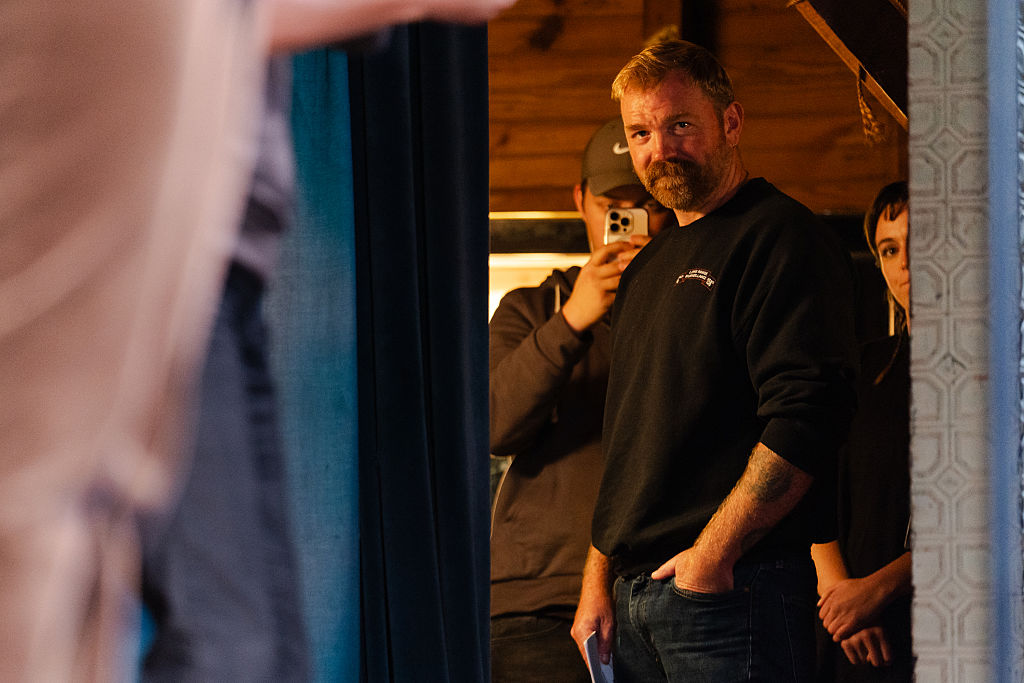
Deep in rural Maine, more than 100 miles away from the state’s verdant coastline, Graham Platner is holding court. In a state with one of the largest per-capita veteran populations, the Democratic Senate contender’s antiwar message carries a particular potency — and it shows. As of this writing, the 41-year-old Platner has raked in nearly $10 million in campaign money, mostly from small donors; signed up some 15,000 volunteers; and clinched endorsements from Sens. Elizabeth Warren, Bernie Sanders, Ruben Gallego, and Martin Heinrich — all progressive stalwarts. Even a steady drip of negative stories in recent months about his spicy Reddit history and a since-covered Nazi tattoo has barely dented him. Polls now show Platner ahead of Democratic primary rival, Gov. Janet Mills, and narrowly edging Susan Collins, the Republican incumbent, in a general election matchup.
It would be tempting, then, to cast Platner as the face of a renewed Democratic Party — a working-class tribune with crossover appeal. But the more revealing question is how deep, and how broad, his support really is. For all the campaign’s talk of winning over Trump voters and bringing back the popular classes, his coalition is composed mostly of #Resistance liberals, college students, and crunchy retirees. That may be enough to win the primary, and perhaps even the general. But it shouldn’t be mistaken for a durable re-realignment, or evidence that Democrats have rediscovered a winning formula for 2028.
“A lot of folks I know who voted for Donald Trump wanted an end to overseas wars,” Platner tells me in a husky voice. “But those people are beginning to realize that this was all nonsense, that they were lied to, and they were swindled. We have had tons and tons of Republicans come to these events to say just that.”
Here in Trump-supporting Greenville, though, I couldn’t find any Republicans in our midst. Everyone I spoke to was a lifelong Democrat, their first rally likely predating Jimmy Carter. They were less worried about finding common cause with the other side than about Trump putting them in concentration camps. Others even asked Platner, hopefully, if the army might consider mutinying. “The military is not going to save you,” Platner responded. “We are the only ones who are going to save ourselves.” (A strong answer.)
Platner likes to present himself as a gruff, no-nonsense prole who, like Cicinnatus abandoning his plow, felt compelled to enter the race by the sheer weight of national misery. After bouncing between several schools in Maine, he enlisted in the Marines in 2004 and served in Iraq and Afghanistan. A brief spell at George Washington University, a stint tending bar, and another War on Terror tour (this time with the private military company formerly known as Blackwater) followed before he returned home to become an oyster farmer. It was only after Democratic consultants “discovered” him — in a video for a local group opposing a Norwegian company’s plan to build a large salmon farm off his hometown of Sullivan — that he entered the political arena.
What tends to be omitted from this narrative is that his upbringing wasn’t quite so hardscrabble. Platner’s grandfather was a renowned architect, known for his work in modernist interior design; his father, Bronson, is an Ivy-educated lawyer and Democratic donor; his mother, Leslie Harlow, is a local activist and entrepreneur runs a restaurant in Bar Harbor, which happens to be the main client for Platner’s oysters. Thanks to the family largess, he enrolled at the elite Hotchkiss School before moving to another private school six months later — a fact he tries to play down.
Still, even some Republican operatives concede that Platner has a good story. “His introduction is quite powerful,” Steve Bannon, the podcast firebrand and ex-Trump consigliere, tells me. “He’s got an opening pitch about being in the Marine Corps. And then he’s got a punch line: ‘what was it worth?’ before getting into his populist takedown of the American ruling class.” But, Bannon adds, Platner “still carries the same cultural baggage as the rest of the Democratic Party.”
The baggage in question includes Platner’s calls for abolishing ICE and support for gender care for kids, and his dismissal of the trans-athlete debate as a “billionaire-funded distraction.” While such positions play well with the base, they remain unpopular with the state at large, which may explain why Platner is struggling to make inroads with Maine’s rural and working classes.
“Platner likes to present himself as a gruff, no-nonsense prole.”
According to a survey of likely voters by Pan-Atlantic Research, Platner leads Janet Mills 56% to 32% among those earning more than $100,000, while the race is essentially even among those below that income threshold. The regional split mirrors that pattern: he is ahead in the more urban and affluent First District, while Mills leads in the rural, working-class Second District, which has backed Trump in the past three presidential elections.
“I do not really trust polling in Maine, even when it says nice things about me,” says Platner. “We have a ton of just regular working folks showing up to my speeches. But I also think there is an access problem. The only way to actually go talk to working-class folks is to go talk to them in their communities, which is what we’re doing.”
To see how Platner’s message was landing in these communities, I drove an hour west to Jackman, a town 15 miles from the Canadian border. Once a hub of the cross-border timber trade, Jackman’s economy was hollowed out by global competition, accelerated by NAFTA and subsequent trade agreements. A former Democratic stronghold, the town abandoned the party during President Barack Obama’s second term and heavily backed Trump in the past three elections. If Platner wanted to make inroads with the state’s working class, this was a good place to start.
At Jackman’s town hall, Platner came with the same message he delivered in Greenville: the system is rigged, working people are being robbed, and the billionaire class is running roughshod over the social contract. It was the sort of populist messaging Trump himself might have shared 10 years ago. The trouble was that only about 10 people were in attendance. And of those, only a few were from the area (one attendee told me that she’d driven four hours to see him). By contrast, thousands had shown up to listen to Platner and Sanders in Portland, a much bluer (and admittedly more populous) city three hours’ drive to the south.
I ask Platner to explain this disparity. “Look, it takes time,” he says. “This is a long-term project. We have to connect with these folks directly, or else you’re just this amorphous thing. And I think as the war in Iran gets worse, and as the incompetent authoritarianism of the Trump administration gets worse — because it will — that’s going to continue alienating more folks.”
This may turn out to be true. With 13 American soldiers confirmed dead and the prospect of boots on the ground growing by the day, even the most die-hard MAGA supporters could begin to waver if the conflict spirals. But that day has not arrived. The MAGA base is still standing by its man, and there is very little to suggest that that might be changing.
It might not matter. The political landscape in Maine strongly favors Democrats, making a win likely regardless of who is on the ballot. Susan Collins is the last Republican senator in a blue state that Kamala Harris carried comfortably in 2024, and she is now facing her toughest battle yet to hold on to her seat. After five terms totaling nearly three decades, the appetite for something new is strong among the Democratic grassroots, which may be enough to push the state into the blue column. As a political neophyte, Platner will likely benefit from this enthusiasm; his primary opponent, 78-year-old Mills, challenged reporters to check her “lipid profile.”
It would be easy, then, to read too much into a Platner win. But even if the oysterman looks, sounds, and campaigns like a working-class reset, his coalition suggests otherwise. I saw as much when I visited the Four Seasons diner in Jackman, one block from the town hall, where a Platner ad flickered on the TV. “I know what it feels like to give everything to this country,” one veteran says, “and come home to feel like it’s giving nothing back,” adds another, before the shot cuts to Platner in fatigues. “Graham Platner knows that feeling, too,” the voiceover concludes.
I turn to the man beside me, who works at the logging-mill down the road, and ask what he thought. “Who’s that?” he grunted.