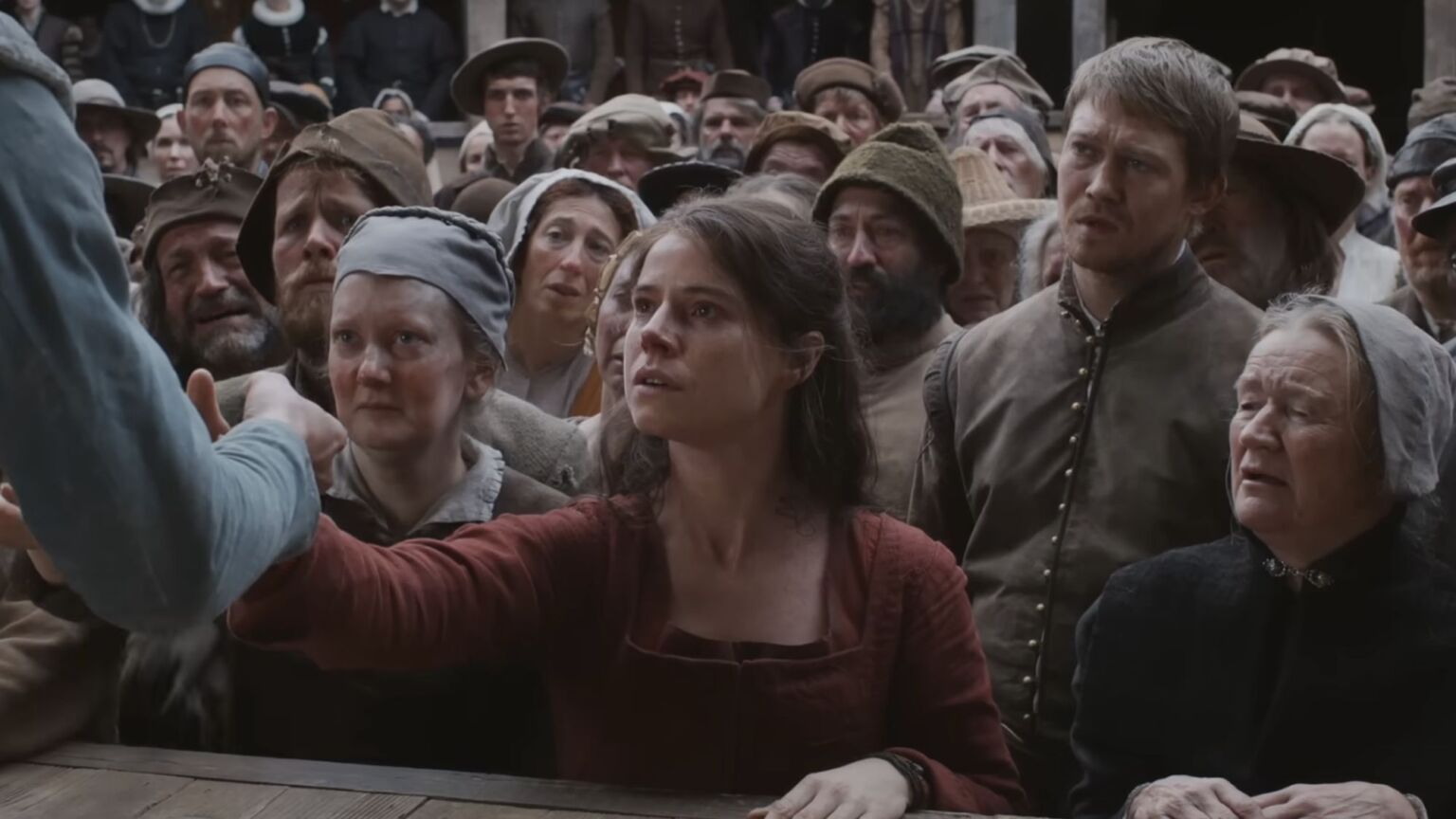
William Shakespeare has lately become a cultural battleground, pressed into service as either sacred inheritance or ideological problem. Chloé Zhao’s latest film, Hamnet, sidesteps this stale quarrel altogether. There are no attempts to shoehorn in current cultural preoccupations. There are no ahistorical attempts to depict Elizabethan England as multicultural. Instead of treating Shakespeare as a symbol or slogan, it presents him as a writer, husband and father shaped by loss. In doing so, the film quietly restores what recent debate has obscured: that Shakespeare’s endurance rests not on cultural power, but on his grasp of grief, love and human frailty.
Hamnet is a film of rare atmosphere and emotional intelligence: austere, mournful and quietly devastating. Anchored by superb performances from Jessie Buckley (Agnes Shakespeare) and Paul Mescal (William), alongside an understated but powerful supporting cast, it succeeds not through spectacle but through mood, restraint and an unsentimental attentiveness to grief. It fully deserves the garlands it has already attracted.
Set against the backdrop of plague-ridden 16th-century England, the film captures a world steeped in mysticism, fear and misery. This is a society at the mercy of forces it cannot comprehend, let alone control. Illness arrives without warning, explanation or remedy, and death is both commonplace and barbaric in its inevitability. Hamnet offers a salutary reminder of how fragile and cruel human existence is in the absence of development and medical science. It presents a pre-modern world in which survival is precarious and suffering routine.
This context gives the central tragedy its emotional power. Hamnet, William and Agnes’s son, dies from influenza while still a child. The fictionalised account of that real loss, which some say inspired William to write the tragedy, Hamlet, is handled with notable sensitivity. The film allows sorrow to unfold slowly and unevenly, mirroring the way loss is actually experienced: as confusing, disorienting and inescapable. Silence, gesture and absence speak louder than dialogue. Hamnet is not ‘grief porn’ as some film critics claim. The camera lingers not on death itself, but on its aftermath.
Yet Hamnet is not simply a film about death. It is a meditation on why Shakespeare’s writing continues to matter – namely, his ability to universalise the human condition. The private tragedy at the heart of the story becomes something far larger: a reflection on parental love and the randomness of suffering.
This stands in sharp contrast to the increasingly philistine tendency to treat Shakespeare primarily as a cultural instrument of Anglo-Saxon supremacy. That argument – most recently demolished by Patrick West – reduces Shakespeare from a great dramatist to a symbol of an exclusive tradition. Hamnet decisively rebuts this view. By grounding Shakespeare’s work in love, grief and bewilderment, the film insists that his importance lies not in power or prestige, but in our shared humanity.
The moments in which the film incorporates Shakespeare’s own lines – ‘To sleep: perchance to dream: ay, there’s the rub; / For in that sleep of death what dreams may come…’ – are among its most electrifying. Used sparingly, they land with particular force – not as literary decoration but as emotional revelation. Heard in the shadow of Hamnet’s death, these words remind us that the plays are not abstract cultural artefacts, but responses to lived experience. The Bard’s language, so often flattened by over-exposure or over-analysis, regains its urgency.
The film is not without its limitations. At times, it could have drawn more extensively on Maggie O’Farrell’s novel (on which the screenplay is based), particularly in its exploration of Shakespeare’s search for his family and his internal reckoning with absence (as a result of his growing fame, he spends more time in London rather than with his family, who remain in Stratford-upon-Avon). The film also retreats too far into suggestion, leaving potentially powerful narrative threads underdeveloped. A deeper engagement with Shakespeare’s physical and emotional distance from his family might have added further complexity to an already compelling portrait.
Nevertheless, this restraint can also be read as a strength. Hamnet resists the contemporary temptation to over-explain or to impose neat meanings on grief. Loss remains unresolved, just as it does in life. In this sense, the film trusts its audience.
Hamnet is a film that feels both intimate and expansive. It evokes a specific historical moment while speaking directly to universal anxieties about mortality, meaning and memory. It reminds us that progress – scientific, medical and social – has spared us much suffering, but not the fundamental realities of love and loss. It also reasserts why Shakespeare endures: not because he represents ‘cultural supremacy’, but because he articulated, with unmatched clarity, what it means to be human.
In an age increasingly eager to reduce art to ideology, Hamnet offers something rarer and more valuable: a humane meditation on grief that transcends the place and period. In the process, it reminds us of the force and clarity of the Bard’s timeless and universal dramas on the human condition.
Neil Davenport is a writer based in London.
Watch the trailer for Hamnet below: