Massachusetts tax-exempt bonds to pay for prayer-free Pritzker economics building
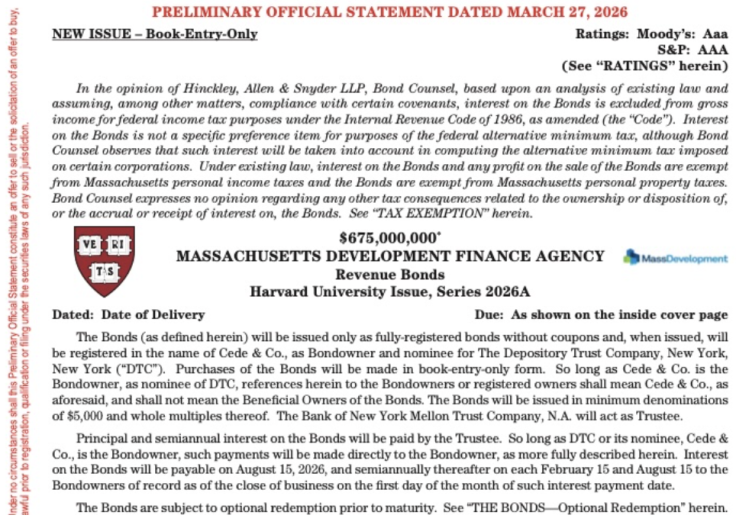
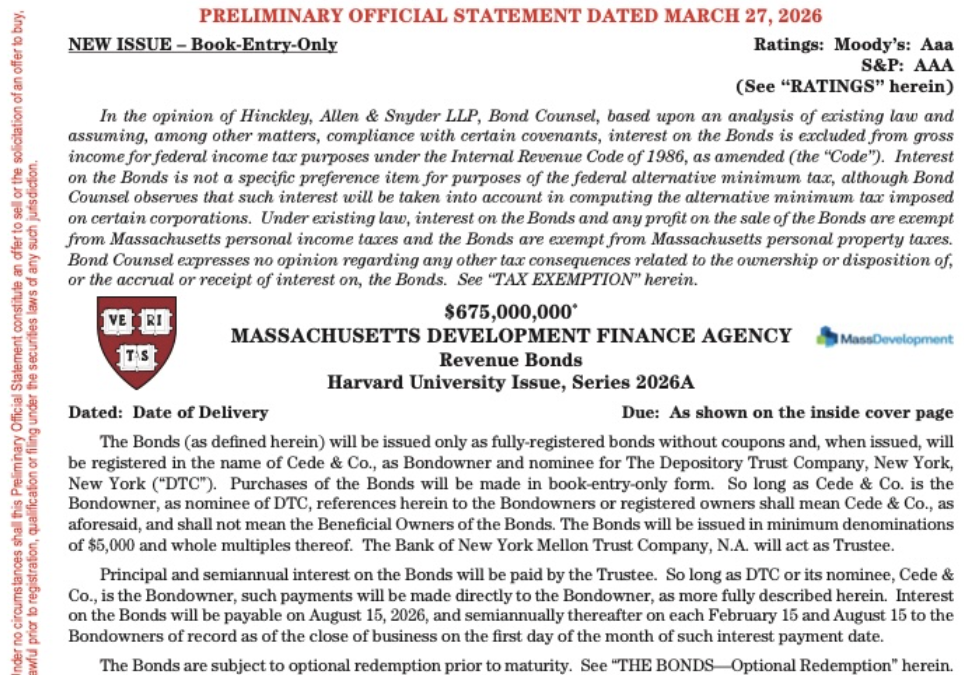
Harvard is going to try to borrow more money, issuing $675 million in tax-exempt bonds with the help of the state of Massachusetts, according to a preliminary official statement dated March 27, 2026.
The 102-page document, a draft offering document used to help line up buyers for the bonds, offers some hints at how Harvard is coping under intense pressure from the federal government, which says the university has “failed to live up to both the intellectual and civil rights conditions that justify federal investment.” The Massachusetts Development Finance Agency is controlled by Governor Maura Healey, a Democrat and former captain of the Harvard women’s basketball team; Harvard has already tapped the agency for $1,169,075,000 in bond offerings in 2024 and 2025, and if this offering is completed at the $675 million level, Healey’s helping hand to Harvard via Massachusetts’ municipal bond authority will reach a total of more than $1.8 billion.
Among the key disclosures:
— “First-year student applications received” by Harvard plunged more than 21 percent to 47,893 for the 2025-2026 academic year from a recent high of 61,221 in 2022-23. Peer institutions such as Yale reported 54,919 applicants this year, Brown 47,937 applicants, and Columbia 61,031 applications. Harvard isn’t releasing its application numbers for students entering in the fall of 2026 until it is required to by the federal government, the Harvard Crimson reported.
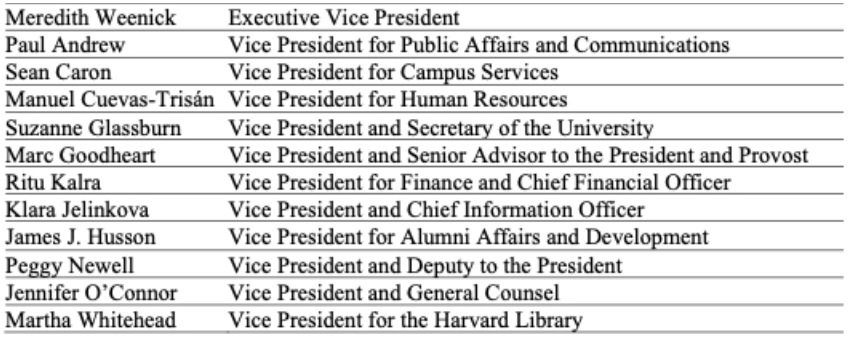
— Harvard, which has been complaining it is so financially strapped that potentially life-saving cancer research is endangered, employs 12 vice presidents. The United States of America somehow manages with just one vice president, and MIT somehow survives with a mere seven.
Harvard says in the preliminary official statement that “various legislative, administrative, and enforcement actions initiated by the federal government and its agencies against the University, some of which allege violations of law,” may have “a material adverse effect on the current and future financial profile and operating performance of the University.” It said the developments involving the federal government may reduce revenue, adversely affect the university’s tax status, or damage “the reputation or business of the University.”
Proceeds of the bonds will be used in part to refinance existing debt and also for “construction of a new 109,500 square foot … building for the study of economics.” Penny Pritzker, the senior fellow of Harvard’s key governing board, the Harvard Corporation, announced a $100 million gift for the new economics building in 2021. Pritzker served as Secretary of Commerce in the administration of President Barack Obama and as a State Department envoy in the administration of President Joe Biden. The Crimson reported earlier this month on a presentation indicating that fundraising for the project “had raised a little more than $138 million of its $175 million goal — leaving a gap of roughly $37 million with construction already underway.”
As a condition of qualifying for the Massachusetts tax-exempt financing, Harvard “agrees that no part of the Project, so long as it is owned or controlled by the Institution, shall be used for any sectarian instruction or as a place of religious worship or in connection with any part of a program of a school or department of divinity for any religious denomination.” This is supposed to be to comply with the First Amendment’s establishment clause, but the language is so sweeping that it probably infringes on the free exercise clause. If an economist says a prayer before eating a meal at his desk, does that turn his office into a “place of religious worship?” What if a Harvard Divinity School student wants to come talk with Ben Friedman, a Harvard economics professor who wrote a book titled Religion and The Rise of Capitalism. Is Professor Friedman supposed to bar the Harvard Divinity School student from the Pritzker building?
When the Trump administration tries to get Harvard not to discriminate against Jews, Harvard self-righteously declares, “No government—regardless of which party is in power—should dictate what private universities can teach, whom they can admit and hire, and which areas of study and inquiry they can pursue.” Yet when the government of Massachusetts tries to declare the entire Harvard economics department building a prayer-free zone, Harvard appears ready to say okay and take the tax-exempt $675 million.
In a “roadshow” slide presentation that goes with the bond documents, Harvard touts its “endowment valued at $56.9 billion as of June 30, 2025.” That endowment is allocated 41 percent to private equity and 31 percent to hedge funds, according to the most recent Harvard Management Company annual report, so one way to look at the situation, since money is at least somewhat fungible (not all the endowment is restricted) is that Harvard is borrowing to invest in private equity and hedge funds. The Harvard endowment has underperformed peer institutions and public markets over long periods of time, even using Harvard’s valuations, which Harvard itself has conceded, for the private equity parts, may be somewhat imprecise. “In FY24, for the second year in a row, private equity returns lagged those of public equity markets. Readers will recall that in FY22, private managers did not reduce the value of their investments in a manner consistent with declining public equity markets at the time,” the October 2024 endowment annual report said.
In a March 27 statement affirming Harvard’s “Aaa” rating, Moody’s listed among “factors that could lead to a downgrade of the ratings” “over an extended period of time, gradual erosion of brand or competitive position relative to other elite global universities.” The statement also said that “Harvard has considerable exposure to governance scrutiny. An evolving political landscape adds potential operational and financial complexities.” Moody’s saw the 12 vice presidents as a positive: “a deep bench of highly skilled administrators provide ample capacity to manage through periods of change or weaker operating performance without adverse impacts to credit quality.”
A March 26 statement from S&P Global Ratings gave the bonds its “AAA” rating and said “operating performance could be strained due to changes in federal funding.” S&P said, “We could consider a negative outlook or a downgrade with a sustained weakening of demand, the issuance of additional debt that yields balance-sheet metrics not commensurate with the rating, or if overall financial resources deteriorate. There could also be pressure if there are significant impacts related to evolving federal policies around funding for research or other policies that lead to a materially weaker financial position.”
In 2016, 2020, 2024, and 2025, Harvard quickly followed tax-exempt bond offerings with taxable bond offerings. It’s not clear if the university plans to do the same this year. The lead managers for the offering are Goldman Sachs and Morgan Stanley.