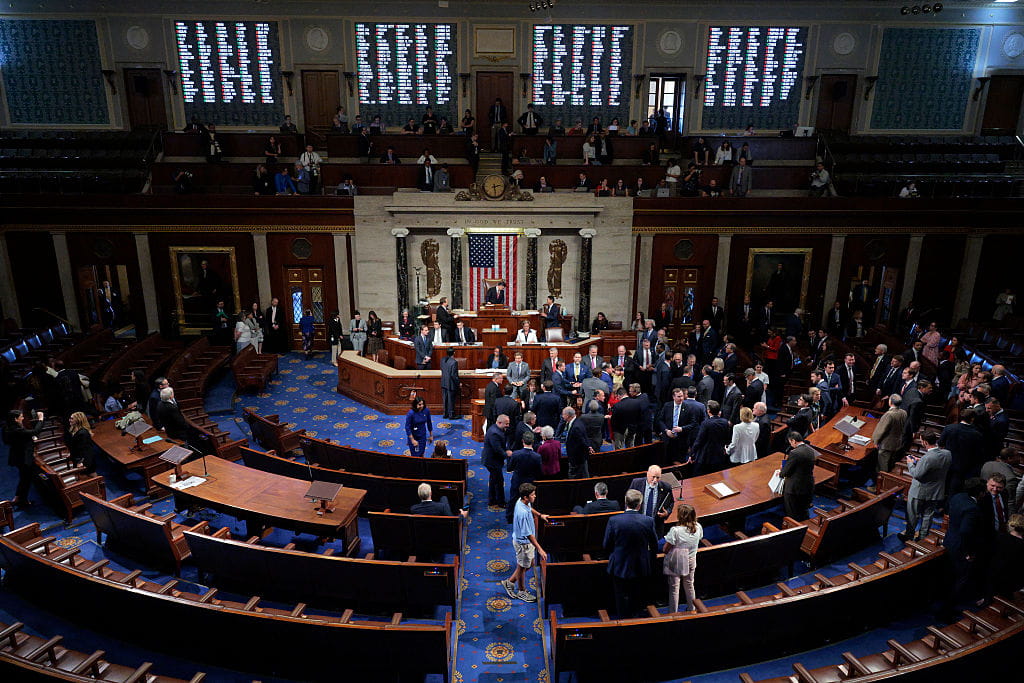
The US House failed to pass a war powers resolution on Thursday, March 5. Like the similarly flubbed Senate version a day before, this resolution would direct President Donald Trump to cease hostilities against Iran immediately.
It would, that is, if it could pass the House, the Senate, and then muster a two-thirds majority in both to overcome the inevitable veto when it reaches the Resolute Desk. But this vote isn’t the end of the story.
One Failed Vote After Another
As Liberty Nation News Editor-in-Chief Mark Angelides explained Thursday morning, the Senate held a vote on its own war powers resolution on Wednesday, but it failed to launch. The final vote was 47 to 53, with Republican Rand Paul of Kentucky and Democrat John Fetterman of Pennsylvania swapping sides.

A day later, as expected, another resolution, which took a different legal approach, failed as well – though the vote totals were illuminating. Two Republicans – Warren Davidson of Ohio and Kentucky’s Thomas Massie – joined with 210 Democrats in voting for the war powers resolution. But four Democrats – Henry Cuellar of Texas, Jared Golden of Maine, Ohio’s Greg Landsman, and California’s Juan Vargas – sided with the 215 Republicans to reject the resolution. Republican Tony Gonzales of Texas didn’t vote.
And this vote – which took less than ten minutes – came hot on the heels of another resolution that did receive sweeping bipartisan support. Just minutes before the failed war powers vote, 157 Democrats joined 215 Republicans in passing a resolution “reaffirming Iran remains the largest state sponsor of terror.” Another three Republicans and two Democrats didn’t weigh in. So, yes, Iran is the bad guy here. That’s almost universal in Congress – save just shy of 60 lawmakers – but as a nonbinding, unenforceable act, it’s effectively just for show.
The Trick About War Powers
Iran is still the world’s biggest supporter of terrorists around the globe, so sayeth the House, and the president has free rein in the sandbox – for now. You see, the trick about war powers is that there’s no limit on how many times Congress can try.
Indeed, there is already another resolution in the House, introduced Tuesday by six Democrats. Reps. Josh Gottheimer (NY), Greg Landsman (OH), Henry Cuellar (TX), Jared Golden (ME), Jim Costa (CA), and Jimmy Panetta (CA) co-sponsored the bill Tuesday, which conflicted with the then-pending resolution that failed yesterday. Rather than an immediate withdrawal, this version would grant President Trump a total of 30 days before having to pull out.
But that isn’t the only trick about war powers. There’s a famous quote attributed to Andrew Jackson after the Supreme Court’s 1832 Worcester v. Georgia decision. “John Marshall has made his decision, now let him enforce it,” Jackson allegedly declared after the Supreme Court ruled against the forced exile of native Americans by Georgia. While it seems unlikely he said that, the sentiment was genuine. Both the state’s governor and the US president chose to simply ignore the ruling.
Since the Supreme Court generally relies on the executive to actually enforce the law, it was largely powerless to force the issue. In another case, Ex parte Merryman, the Supreme Court reaffirmed the writ of habeas corpus after Lincoln suspended it during the Civil War and General George Cadwalader arrested John Merryman of Maryland on suspicion of sabotage. The Court demanded Cadwalader to produce his prisoner and explain the arrest – but he never did. Both the general and the president ignored the command of the High Court.
Much like the judicial system, the legislative branch requires the executive branch to actually enforce its laws. Along that same train of thought, it’s unclear what exactly happens if Congress never passes a war powers resolution or formally declares war and President Trump simply continues the operation past the 60-day mark.
So, can Congress – or, for that matter, the courts – force Trump to withdraw from the Iran conflict? They can certainly try, but try may be about all they can do.