OAN Staff Lillian Mann
4:35 PM – Friday, March 27, 2026
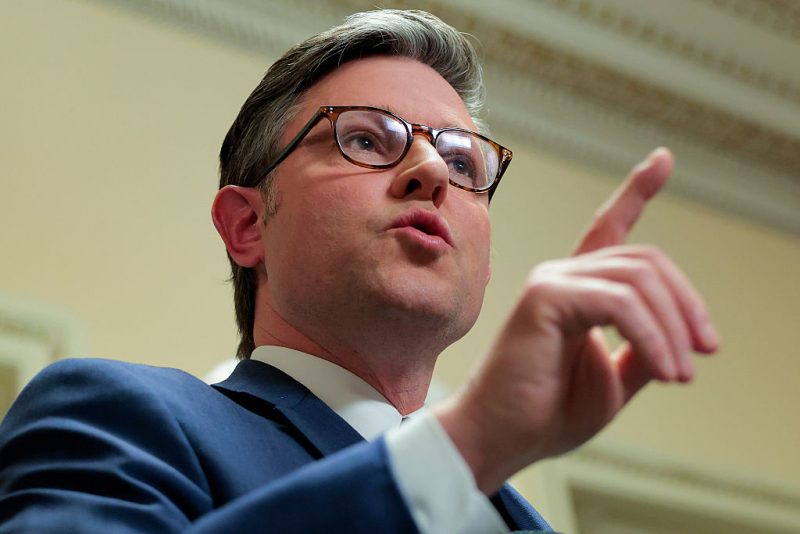
House Republicans will not accept the newly passed Senate-approved bill meant to fund the Department of Homeland Security (DHS), largely because it does not include funding for Immigration and Customs Enforcement (ICE) and Customs and Border Protection (CBP) House Speaker Mike Johnson revealed.
Early Friday morning at 2 a.m., the Senate approved the measure by voice vote, passing what some lawmakers have dubbed the “No-ICE” bill before immediately leaving for a two-week recess—effectively shifting the issue to the House of Representatives. The measure would reopen most of the DHS, but would not include additional funding for ICE or border security.
Johnson (R-La.) argued that the DHS funding bill fails to be a complete bill if it does not include the agencies responsible for immigration and border security.
“This gambit that was done last night is a joke,” Johnson told reporters at the Capitol.
Johnson told House Republicans on a conference-wide call that he is considering a plan for a clean 60-day continuing resolution that would temporarily fund the DHS and include ICE. The House will vote on a stop-gap spending bill to fund the entire DHS until May 22nd on Friday evening. The House is expected to reconvene at 8:00 p.m. ET, with final passage expected around 10:30 p.m. ET.
Johnson said he expects Republicans to pass the bill in the House leaving the Senate to take up the measure. However, it is unclear if the stop-gap could pass in the Senate. Many Senators have already left Washington and Democrats have refused to vote for any spending bill that funds ICE.
Senate Minority Leader Chuck Schumer (D-N.Y.) argued that a proposal that funds the entirety of the DHS for 60 days would go nowhere in the upper chamber, calling the plan “dead on arrival.”
House Minority Leader Hakeem Jeffries (D-N.Y.) said there is “overwhelming support” among Democrats to pass the Senate deal. He also indicated that Democrats could step in to help advance it during a procedural vote, which is typically decided along party lines.
“We’ve been clear from day one: Democrats will fund critical Homeland Security functions — but we will not give a blank check to Trump’s lawless and deadly immigration militia without reforms,” Schumer said in a statement.
In the opening hours of the standoff on Friday, the House immediately pushed back, as the bill lacked funding for ICE and CBP and did not incorporate President Donald Trump’s SAVE America Act, which includes voter ID requirements.
The Senate-approved bill also failed to include other demands that Democrats had made to limit tactics for federal immigration officers, such as such as requiring judicial warrants and ICE agents to unmask.
Trump signed a presidential memorandum on Friday to restart pay for Transportation Security Administration (TSA) officers who have continued to work without compensation since February 14th, in order to alleviate backups in airports across the country.
“If Democrats in the Congress will not act to honor the service of our TSA officers, who are now performing their critical public safety responsibilities without knowing whether they will be able to buy food for their families or pay their rent, then my Administration will take action,” the directive states. “As President of the United States, I have determined that these circumstances constitute an emergency situation compromising the Nation’s security.”
After Democrats in Congress refused to fund the DHS following the deaths of two U.S. citizens in Minneapolis who both engaged in standoffs with ICE and CBP agents, TSA agents have been going without pay, causing hundreds of workers to quit. This has lead to record breaking lines and lengthy delays at major airports across the country.
“We’ve been trying for weeks to fund the whole thing,” Senate Majority Leader John Thune (R-S.D.) said. “And, I mean, in the end, this is what they were willing to agree to. But again, it’s different that it has zero reforms in it. I mean, they got no reforms on DHS, which they could have had if they had been willing to work with us a little bit on that.”
The main argument Republicans have made is that if Schumer and his caucus truly wanted reforms, they would have agreed to fund immigration enforcement rather than focusing solely on air travel, since DHS is tasked with protecting the homeland.
Thune argued that the situation could have been avoided stating that “this could have been done three weeks ago.”
ICE and CBP currently have access to a large financial “buffer” following the passage of a major reconciliation bill in July 2025 known as the One Big Beautiful Bill Act (OBBBA). This legislation allocated approximately $75 billion to ICE and about $64 billion to CBP in advance funding.
However, this funding is supplemental rather than permanent as it is designed as a temporary “supercharge” to expand enforcement capacity—specifically to accelerate mass deportations and border wall construction—over a four-year period, rather than to sustain long-term baseline operations.
“The good news is we anticipated this a year ago. I mean, one of the reasons we front loaded, pre-loaded up the ‘one big, beautiful bill’ with advanced funding for Homeland Security was because we anticipated this was likely going to happen, and it did,” Thune said. “I still think it’s unfortunate. The Dems wanted reforms. We tried to work with them on reforms. They ended up getting no reforms.”
A small group of House Republicans pushing for increased ICE funding are expected to “block the gate,” preventing the rest of the House from voting on the measure. There is an alternative backup plan known as “Suspension of the Rules,” which allows a bill to pass quickly with a two-thirds majority. However, that option is only available on Mondays, Tuesdays, and Wednesdays. Since it is now Friday, that shortcut is effectively off the table until next week.
House Republicans are lowering expectations on what can and cannot be accomplished with the Senate bill, such as potentially letting go of the voter ID laws but most likely getting additional ICE funding.
“I think we have to set our sights a little bit lower on this reconciliation bill,” Senator Roger Marshall (R-Kan.) told Fox News Digital. “It’s got to be targeted to fund ICE for 10 years, I think that’s the number one thing to us.”
Stay informed! Receive breaking news blasts directly to your inbox for free. Subscribe here. https://www.oann.com/alerts
What do YOU think? Click here to jump to the comments!
Sponsored Content Below