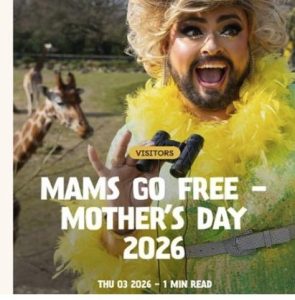
“Take one thing off before you leave the house,” sayeth the drag queen Malahide Mammy, alter ego of Irish internet personality James Patrice. A jumble of stubble, Thatcher back-comb and pink frills, Mammy tells us she “took off me knickers”. With relish, she sways her undercarriage: “Ooh, airy!”
So far, so cruise-ship entertainment — the sort of thing you could just about wince through after 10 complimentary daiquiris. But Patrice’s bimbo pisstake found a more conventional audience last week when Dublin Zoo decided to use him to front their Mother’s Day promotions, “Mams Go (Pants?) Free”. Festooned in green and yellow, Malahide Mammy gleams like an overshaken can of Sprite, presumably the perfect enticement for every actual woman who plans to celebrate another year of child-rearing by seeing a funhouse-mirror mockery of herself. Like every bizarre instance of drag acts being shoehorned into such institutions, the premise is deliciously spurious: the zoo wrote on its website that the event — part of its broader “All Things Irish” program for Saint Patrick’s Day — would be “vibrant”, filled with “warmth, humor, community and heritage” and a “strong sense of togetherness”. Nothing says solidarity like a honking set of foam breasts.
The backlash was swift and merciless. Even in the capital of the most self-congratulating, aggressively progressive country in the world, a drag act gasping his way through animal enclosures in a sordid simulacrum of motherhood went down like a can of cold setting spray. It was described as a “national disgrace”, showing Irish mothers “what Dublin Zoo thinks of you”; another bemoaned “how far we have fallen in stature to now be denigrated and codified as a mere pantomime dame”; yet another decried a “symptom of a sick Europe”.
Whatever Dublin Zoo’s campaign was, it was not as cataclysmic as all that. At most it was a misguided scramble for sodden scraps of virtue from the 2010s, an embarrassing hangover from an era which rewarded public bodies for aligning themselves with the queer omnicause. After all, the gender-critical movement has spent years making the entirely convincing case that words do not equate to violence — that verbal accuracy and reality did not “erase”, “attack” or “endanger”.
The outrage at the zoo’s campaign is not surprising, nor unjustified — but its sense of crisis (the “sick Europe”, the “national disgrace”) feels overegged at a time when Butlerian bollocks has been so comprehensively punctured. The daydream of gender performance shoved down the gullets of students in the middle of the last decade is over; the nasty stereotypes it concealed — the breathless sex-object nonsense which clearly inspires the likes of James Patrice and Andrea Long Chu — are by now plainly obvious.
Much contemporary drag does away with its good-natured, witty founding fathers. Consider music-hall prototypes such as Dan Leno, known for playing the ultimate panto dame: the joke was an inflated cartoon of femininity, later also the subject of Dame Edna Everage and Lily Savage — not women themselves. These characters were brutal, snobbish, fussy, funny; the humor centered on the dimension of their egos and not the dimension of their bosoms. Acts like the Malahide Mammy replace insight and critique with pointless pornographic jibes, double entendres robbed of primary meaning and masochistic male role-plays of female sexuality — all that’s left is writhing, moaning voracity under a hideous wig. Like other favorite progressive pastimes (porn, prostitution), drag has become yet another sacrifice to the male libido. In so doing it flattens the original radicalism of drag — its capacity to mock stereotypes — by imposing them back on its subjects.
“All that’s left is writhing, moaning voracity under a hideous wig.”
It’s a mechanism recognized by Ben Appel in his Atlantic piece about having been an “effeminate boy”. Where modern drag tends to collapse womanhood into vicious sexual caricature, well-meaning chin-strokers in activist circles, academia and the medical establishment collapse non-conformity into essential identity — you act like a girl, so you must be one. Instead of asking the more daring question — what does “like a girl” mean anyway? — genderism prefers neat taxonomies and interventionist “solutions”; androgyny is not a charm or incidental quirk but an opportunity, even a pathology, to correct as soon as possible. This must be why Mammygate struck such a nerve. No demographic is more clear-eyed than mothers about the pitfalls of gender theory, which is why Mumsnet became an intellectual vanguard in the protection of sex-based rights (to the horror of the polite media establishment).
The zoo itself has carefully sidestepped criticism, having a spokesman state that it was “disappointed that some commentary on social media has taken elements of the campaign out of context”. It would continue, it sniffed, to welcome “people from all backgrounds and communities every day” including, I presume, that embattled community of middling drag queens. The PR team, like the long-suffering wardens of the elephant enclosure, must have spent all day shit-shoveling. Shortly after, the zoo put up a mealy-mouthed post about International Women’s Day, thanking the women among its staff (none of them named, mind).
By the next Mother’s Day, all this will have blown over — it will be some other institution’s turn to put its foot in it. Public bodies remain vulnerable to these cock-ups because they are hopelessly time-lagged, five years at minimum behind a culture sick of being expected to laugh along as another mammoth Marilyn flashes the congregation at Tumble Tots. Institutions — libraries, arts centers and other “third spaces” manned by frustrated middle-class libs — can’t seem to shake that cringe, focus-group-friendly fun which sees them blundering into the sorts of promotional crises that more canny corporate bodies manage to avoid. Long gone are the mastectomy scars inexplicably emblazoning a Costa coffee wagon; for-profit firms have a way of deserting sinking ships while the activist elite bubble to the sea bed.
It’s no mystery why: the sorts of overeducated grunts who land in directorial roles at beloved institutions develop a toxic benevolence born of resentment against the relative lushness of the private sector, and the “fascist” politicians who work against their interests. They blindly impose their radical views as righteous correctives to the world that has personally wronged them. In Ireland, a formerly ultra-conservative nation which only in recent decades has adopted progressive social policies, the urge to overcorrect seems even more pressing.
For the art form of drag itself, this state of affairs is pitiful; once desperately uncool institutions start paying you to gyrate in front of giraffes, you have to question your own radicalism. Drag was once an affront to bourgeois respectability; now it is considered, by some at least, the bourgeoisie’s favorite family-friendly entertainment. And that is my great objection to the Malahide Mammy and her league of gelatinous lookalikes; bereft of a sense of novelty or protest, the transgression she represents is simply tedious. Like her prosthetic breasts, the joke arrives before the queen; all her lines have been purred before. What she speaks to is not a culture in decline — on the virtues of genderism she lost the argument years ago — but cultural institutions still in hock to well-meaning but misdirected orthodoxies which insult the very people they’re meant to serve. How much longer must we suffer these humiliating episodes where public bodies self-flagellate for meaningless causes? What next, a tribute to NHS nurses starring up-and-coming drag superstar Florence Naughtygale? Enjoy, ladies — this one’s on us.