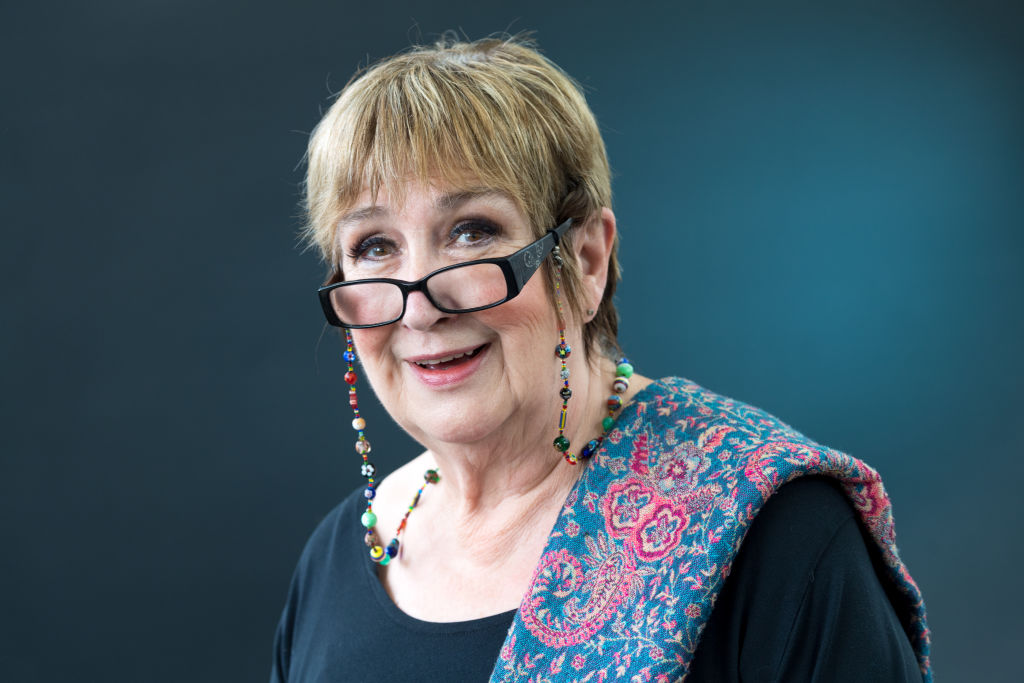
My friendship with Jenni Murray was cemented, believe it or not, at a lap dance club in Streatham. It was back in the early 2000s. I’d been a guest on Woman’s Hour, which Jenni had been presenting since 1987, a couple of weeks earlier. After the program, Jenni asked me to stick around for a chat. She wanted to talk to me about the sexual liberation of women, because she disagreed with some of my points of view on pornography, lap dancing, and prostitution.
While not keen on any of the above, Jenni was a classical liberal, and wondered whether, after decades of feminism, women could now be sexually liberated. She was thinking of writing a book on the theme. “After all,” she said, “there’s even a lap dance club solely for women these days.” She meant a place called Caesars, which was a dive on Streatham High Road that gave over one night a month to a women’s night: “Lap-Attack”.
We agreed to visit Lap-Attack together. It was horrific. The male performers appeared exploited and unhappy, while the female punters were mostly blind drunk and trying their best to pretend they were having fun. In the toilets, I encountered a group of lively black women in their twenties. One of them asked me, “Is that Jenni Murray out there? She’s my heroine”. I told Jenni, who was thrilled at the idea that a working-class woman in a lap-dance club would love what she was doing.
Jenni and I, both working-class feminists, remained friends for the rest of her life. She was a titan, presenting Woman’s Hour until she was 70. She would have done it longer, I believe, had she not been dogged by critics who believed her to be “transphobic”. Her beloved BBC let her down, leading to her resignation. Now that Jenni has died, aged 75, the corporation is giving her the recognition she deserved as a broadcaster — but I remember her bravery, too.
On 20 January 2017, years after our trip to Caesars, I was walking from the Tube to march against Donald Trump’s presidency when my phone rang. It was Jenni. My first thought was that she was at the demonstration and wanted to meet up. But what she actually wanted was my advice. We had spoken only a few weeks earlier, after her interview with the trans activist India Willoughby. During the interview, Jenni had faced a barrage of hostile sexism from this man who claims to be female. It goes without saying that Jenni had handled the conversation extremely professionally — but she was aghast at some of the things Willoughby had said.
“What would have been your reaction,” Jenni asked Willoughby, “to being required to shave your legs when you lived as a man?” she asked.
“What a bizarre question, Jenni. Why would I shave my legs when I was living as a man?” replied Willoughby.
Jenni then asked how Willoughby — as a newcomer to such trials of “womanhood” — felt about women being held to a higher standard than men. Willoughby snapped. “I’m not really sure what your stance is on trans. But it seems quite hostile, quite honestly.”
Dealing with such a response was well within Jenni’s everyday repertoire. I had been a guest on Woman’s Hour many times, almost always with Jenni at the helm, and she had rigorously challenged some of my opinions, as her job required. And of course, if it was a debate-type format, she did the same to my opponent.
Jenni had called because she felt she needed to speak out about the misogyny of trans ideology. Years ago, Jenni had been infuriated by the Rev Peter Stone, who had undergone surgery, was now known as Carol, and seemed concerned about little other than clothing. This was a caricature of womanhood from a man who was ignorant of centuries of feminist struggle. Willoughby had induced similar fury in Jenni — so much so that she felt she had to act. She said that while she had always instinctively known that trans culture was bad for women, she had been worried about stirring the hornets’ nest. She told me that she had decided to write a big piece for The Sunday Times Magazine, in which she would set out her stall.
“How bad is it going to be if I do that?” she asked. I told her that she should be prepared for the worst. The mother of all hostility would be coming down on her. There would be calls for her cancellation. But despite the warnings I’d given her, Jenni didn’t waver.
Her piece, “Be trans, be proud – but don’t call yourself a ‘real woman’” was published in March 2017. In it, she made it clear that her concern was to hold on to women’s hard-won rights, and not anti-trans prejudice. She wrote:
“I’m appalled at the repulsive misogyny evident in the response of trans activists who have accused Nimko Ali, a Somali and a courageous campaigner against female genital mutilation, of ‘practising white feminism’ or who have demanded the ‘no platforming’ (banning from speaking in public) of women, such as the lesbian feminist Julie Bindel, who have questioned the claims of trans women to be real women.”
As I feared, Jenni was subjected to endless abuse: not just scathing commentary in the press, but insults, calls for her sacking, and worse. She later recalled being issued “endless promises that I would be raped or murdered, leaving me genuinely worried for my safety. I had no assistance from the police — not that I asked for it, as I knew they would do nothing.”
What about the BBC, the institution to which Jenni had devoted decades? Rather than offer its unequivocal support, the corporation gave Jenni a warning, she said, and banned her from leading any Woman’s Hour discussion on the topic of transgenderism.
“Jenni would rail against a certain type of middle-class feminist who adopts whichever position they feel is going to give them the greatest social acceptability.”
Throughout, Jenni remained an exceptional journalist. Her long-time producer, Innes Bowen, worked with Jenni between 1998 and 2002 and describes Jenni as “incredibly impressive with her open-mindedness about issues, and her genuine desire to explore all sides of any debate.
“She didn’t want the same old issues being presented time and time again, and if that’s what the producers came up with, she would say: ‘Sorry, we can’t do that. This is not balanced, or it’s not fair.’ She only threw her toys out of her pram about twice a year. Mainly, she was protecting us from our own stupidity.”
Jenni would rail against a certain type of middle-class feminist who adopts whichever position they feel is going to give them the greatest social acceptability. She was not one of those women herself.
“She was genuinely a national treasure,” Bowen says. “Many ex-BBC people believe that they are, but really, they fade into obscurity once they leave their role. For Jenni, the phone never stopped ringing. She was in demand. The country did love her.”
I realized quite how traumatic the Willoughby episode had been for Jenni in 2021, at FiLiA, a grassroots feminist conference. Jenni had been invited to speak on the main stage. When asked about what happened after she wrote the piece for The Sunday Times, she gave a response that left many of us in tears.
She had presented Woman’s Hour for 33 years, she said. “I’d never been perceived as someone who couldn’t be trusted. And suddenly, I had a manager coming into my office saying, ‘Oh, God, Jenni. Have you seen all the shouting on Twitter? I don’t think we can let you discuss this question anymore’.
“Three years later, I decided to quit. I can’t do what I love if I am not being trusted. But I made that excuse: ‘I’ve done it for 33 years, I’m coming up to my 70th birthday, I need to do something different.’ That was bullshit. I did not want to leave Woman’s Hour; I absolutely loved it. But I couldn’t stay in that atmosphere.”
It seems that little has changed. Just this week, the BBC rejected all initial complaints about the decision by Woman’s Hour to interview Raewyn Connell, a man who says he’s a woman, about misogyny. Woman’s Hour barely lives up to its name these days.
In 2006, shortly after Jenni’s breast cancer diagnosis, I was asked by a newspaper how important a voice she was. My answer was that Jenni was irreplaceable. “I honestly think the show will die with her. She is an era — along with the program — and it can’t be reproduced.” It would appear I was right.