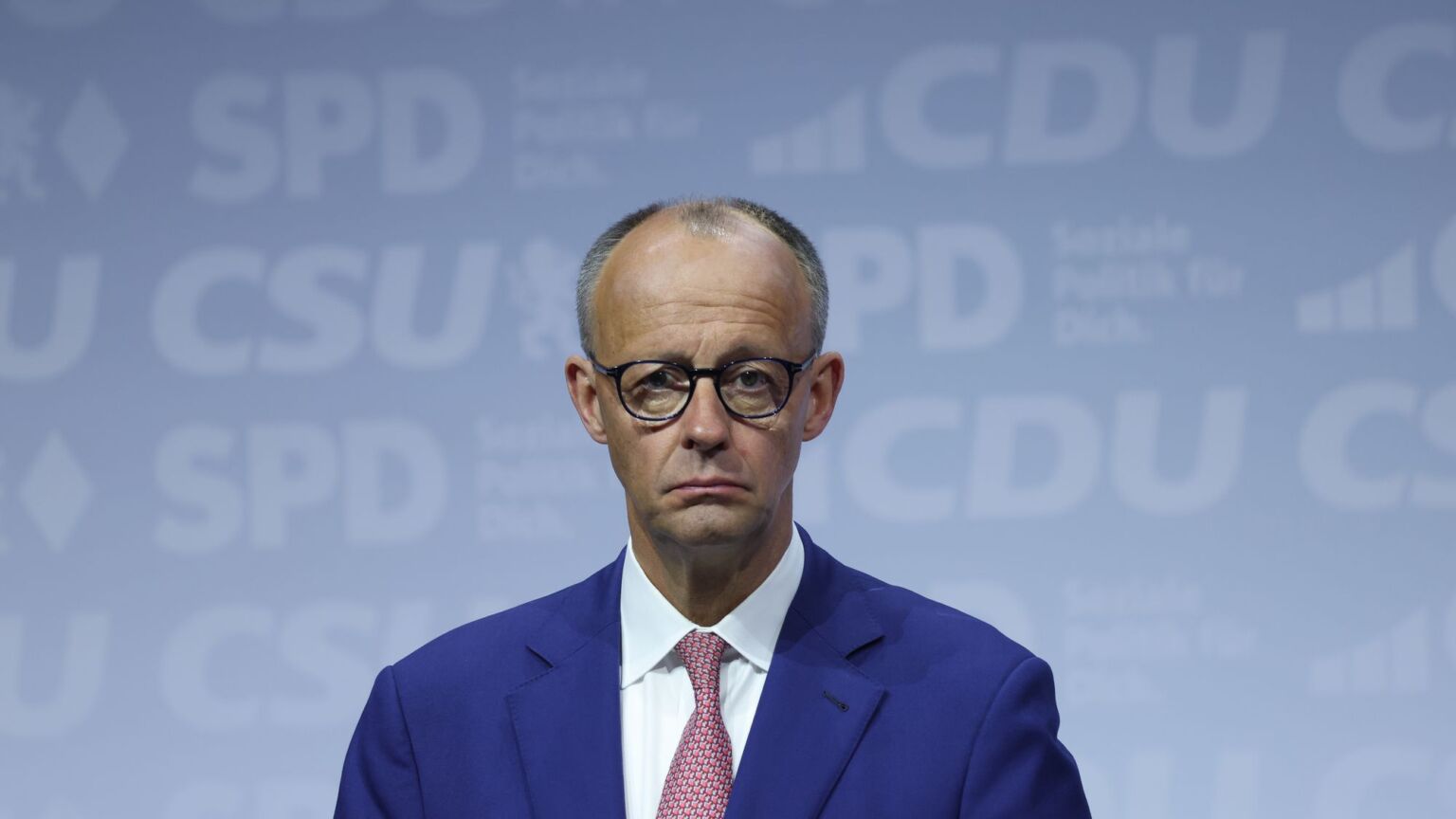
German chancellor Friedrich Merz is often described as a man burdened with high expectations, particularly when it comes to staking out Germany’s place in the world. And he has consistently fallen short of them.
In foreign policy, many had hoped he would accelerate Germany’s long-promised Zeitenwende. This was supposed to involve not only a rebuilding of Germany’s military, but also a turn towards strategic realism – away from the wishful thinking that Germany could avoid taking sides in any geopolitical conflict by hiding behind the so-called rules-based international order. Merz repeatedly fuelled such hope through forceful speeches and displays of determination. But, as always with the German chancellor, the hope lasted only until concrete action was required.
Time and again, Merz has shown that good intentions are not the same as effective leadership. Without the strength of will and moral resources to push through change, words remain empty promises.
A notable example was his much-discussed speech at the beginning of the joint US-Israeli war against Iran. Speaking with unusual bluntness, he seemed to acknowledge that the era of foreign policy dictated purely by international law, and blind to national interests, was over. ‘International legal measures’ against a regime ‘developing nuclear weapons and brutally oppressing its own people’ had proven to be clearly ineffective, he said with refreshing honesty. ‘Appeals from Europe, including Germany, condemnations of Iranian violations of international law, and even extensive sanctions packages’, he continued, ‘have had little impact over the years and decades’.
These were clear words – a no-nonsense rejection of the virtue-signalling and strategic timidity that had long characterised German foreign policy. They also earned him a public endorsement from US president Donald Trump: ‘He’s doing a very good job.’
Anyone who has watched Friedrich Merz closely will not have been surprised when, only days later, he changed his tune. Returning from his trip to Washington, he acknowledged that America’s military action lacked a clear plan. ‘A continuation of this war would not be in our interest’, he said.
The problem here is not Merz’s criticism of Trump’s strategic incoherence, which is reasonable enough. The problem is that this pattern of saying something before rowing back is all too typical of the chancellor. It’s the same story on virtually every vital issue. He is not a reformer with a clear vision. He’s a man always on the back foot, constantly responding to events instead of trying to shape them.
Consider Germany’s response to the recent Iranian drone strike on Cyprus. ‘Where Cyprus needs Germany, Germany will be there’, German foreign minister Johann Wadephul boldly declared at the beginning of last week. Almost immediately, he then walked this back, stating that he saw no need for military assistance as events stood.
Similarly, on Ukraine, Germany’s stance has been less decisive than the government likes to suggest. A video that periodically resurfaces shows Merz, when he was still opposition leader, delivering a stark ultimatum to parliament in October 2024. Give Moscow 24 hours to halt attacks on civilian targets, he said, or Germany would supply Ukraine with Taurus cruise missiles. Since taking office, that resolve has evaporated. His statements on the war have been far more ambiguous – and Ukraine still has not received a single Taurus missile from Germany.
Perhaps the most troubling inconsistency concerns Israel. Rhetorically, Merz presents himself as the chancellor who stands unequivocally behind the embattled Jewish State. At a recent campaign event in Ravensburg, after being interrupted by a small group of Palestinian activists, he declared: ‘We stand with Israel on every single day.’ Many were relieved to hear it – particularly given that other members of his government, such as Wadephul, have not always matched this rhetorical clarity.
Yet this was the same chancellor who, in the summer of 2025, imposed a temporary suspension of weapons deliveries to Israel. And Merz did so at a time when Hamas was still holding hostages, several of them German citizens. ‘At precisely this moment, when maximum pressure on Hamas and its supporters… is more important than ever, Germany has decided to impose an arms embargo against Israel’, wrote Remko Leemhuis, director of the American Jewish Committee in Berlin. He called it a ‘fundamental break with a central guiding principle of German foreign policy’.
Asked about this in an interview in February, Merz defended the decision, saying it had not been easy, but that he had made it ‘out of deepest inner conviction and with a very clear conscience’. What the Israeli army did in Gaza in the summer of 2025 was, he said, unacceptable on humanitarian grounds. If anything could encourage the pro-Palestinian activists who now come to challenge him, it is surely statements like this one.
Germany has long tended to muddle through without a long-term foreign-policy strategy. Successive leaders have acted as if even dictators and Islamist regimes can be easily accommodated and negotiated with. And they have reflexively deferred to international law as a substitute for exercising their own political judgement. Rather than confronting these failures, Merz risks going down as the chancellor who was all bark and no bite.
The reasons, though, go beyond individual character flaws. Political scientist Werner Patzelt has famously described Merz as ‘a willing animal constrained by a tight cage’ – the cage being the coalition he was forced to form with the Social Democrats, who make a change in foreign-policy approach near impossible.
Above all, Merz has failed to build genuine public trust. Rather than engaging honestly with citizens, offering a clear strategy and preparing the country for difficult choices, he has muddled through in precisely the manner of his predecessors. He wants to stay afloat, rather than lead.
For the public, this matters. A timid foreign policy without clear objectives does not merely reflect a leader’s weakness. It also reflects the country’s weakness. And, under Friedrich Merz and the many dithering technocrats that preceded him, Germany has become a very weak country indeed.
Sabine Beppler-Spahl is spiked’s Germany correspondent.