Vladimir Jabotinsky once said of the role of anti-Semitism in World War II: “The Jewish tragedy is, of course, not the microbe which has caused this war. It is only the culture-medium in which the microbe has grown to maturity.”
The same might be said of Iran’s quest to destroy the Jews at the expense of its own sustainability.
Jabotinsky wouldn’t live to see how right he was—in this, as was usually the case, the Zionist intellectual was a prophet. As the Holocaust historian Yehuda Bauer noted about the Nazis: “The killing was totally anti-pragmatic, anti-modern, anti-capitalistic, anti-cost-effective. They murdered the inhabitants of the Lodz ghetto although they were producing essential goods for the German Army; they did the same in Bialystok and elsewhere.” In 1942, the Germans “took some 40,000 or so Jews from the ghettoes near [a] planned road and established slave labor camps for them to build it. And as they were building the road, these Jews were killed.”
Yaron Pasher tried to quantify it: “had the Germans taken the 3,000 trains that were used during the war for the Final Solution plus 2,000 trains of booty to move troops to the front (whether the Eastern Front or the Western Atlantic Wall), the Wehrmacht could have in general transferred approximately seventy-one divisions — namely, about five armies totaling just about half a million troops with full gear, including the horses and other pack animals on which German logistics were based.”
I know people are tired of Nazi analogies, but it is hard to escape the conclusion that the ayatollahs in Iran were similarly beset with, and blinded by, a self-defeating obsession with the Jews.
To Iran, nuclear capability would give the regime two different ways to threaten a new Holocaust: a bomb itself, obviously, but also a nuclear umbrella that would give it immunity from outside attack and enable it to encircle the Jewish state in a “ring of fire” in perpetuity, making life in Israel increasingly difficult, squeezing Israel’s economy, and eroding its territory by making its existing borders indefensible.
The rallying of Western allies committed to nonproliferation used several means to derail Iran’s pursuit of a bomb. One of those means was economic: the policy of “maximum pressure.” President Trump made such pressure a priority, bleeding the Iranian economy with sanctions. The administration itself estimated that by mid-2019, the pressure campaign had cost Iran $10 billion in lost oil exports alone.
The sanctions also brought inflation, raising costs and pushing down the value of the rial, Iran’s currency. In January, the rial “fell to a record low of 1.6 million to $1, according to local currency traders.” Food price inflation, according to economist Adnan Mazarei, held steady at 70%. Having lost its access to the international banking system, he added, meant that “even if it does manage to sell oil, it cannot repatriate the oil revenues back to the country.”
Iran’s inefficient water extraction processes brought some key reservoirs to below 5%. According to Sanam Mahoozi of the University of London, “Sanctions have meant that Iran has limited access to new technologies. These include advanced irrigation systems, high-resolution satellite monitoring such as InSAR data (which can detect land subsidence), cloud-based AI platforms for detailed urban or infrastructure-level monitoring, smart sensors, and precision agriculture tools.”
All of this was the regime’s own doing—and undoing.
The economic struggles revivified the Iranian protest movement. Rather than call off their drive to destroy Israel and thus reverse the economic trends, the Iranians opted to massacre thousands of their own citizens and dare Trump to do something about it.
And he did—but not before practically begging the Iranians to come to their senses and give up the nuclear quest and their concomitant pursuit of a ballistic-missile capacity that could overwhelm Israel’s defenses. Coming into compliance with its obligations would have freed Iran from the suffocating sanctions regime, stabilized its currency, and let the water flow once again.
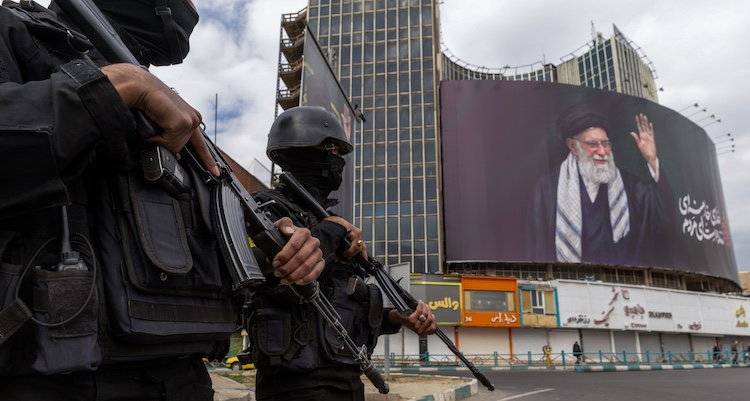
Yet even now, even with its back against the wall and its ayatollah dead, Iran’s despotic rulers cling to war rather than peace and prosperity.
After the Second World War turned against the Axis, Germany put its resources into frantically trying to race to the Final Solution and annihilating the Jews of Hungary, who had yet to be deported to the camps. As losses mounted, people wondered how the Nazi regime could continue to commit to the mass incarceration and murder of Jews at the expense of the Wehrmacht.
The answer, as Iran shows us in our own day, is that a regime animated and motivated by eliminationist anti-Semitism is not a rational actor, and must be treated accordingly.