The Founders risked their blood and treasure in the fight for American self-government.
On July 19, 1776, after New York’s delegates had received instructions from the new Provincial Congress in their colony to support independence, Congress resolved that the Declaration “be fairly engrossed on parchment, with the title and stile of ‘The Unanimous Declaration of the Thirteen United States of America,’ and that the same, when engrossed, be signed by every member of Congress.”
The formal handwritten document, the one now displayed in the Rotunda of the National Archives building in Washington, D.C., was probably prepared by Timothy Matlack, clerk to the Second Continental Congress, who was known for his fine penmanship. He was also a colonel in the Philadelphia Fifth Battalion and later became a delegate to Congress.
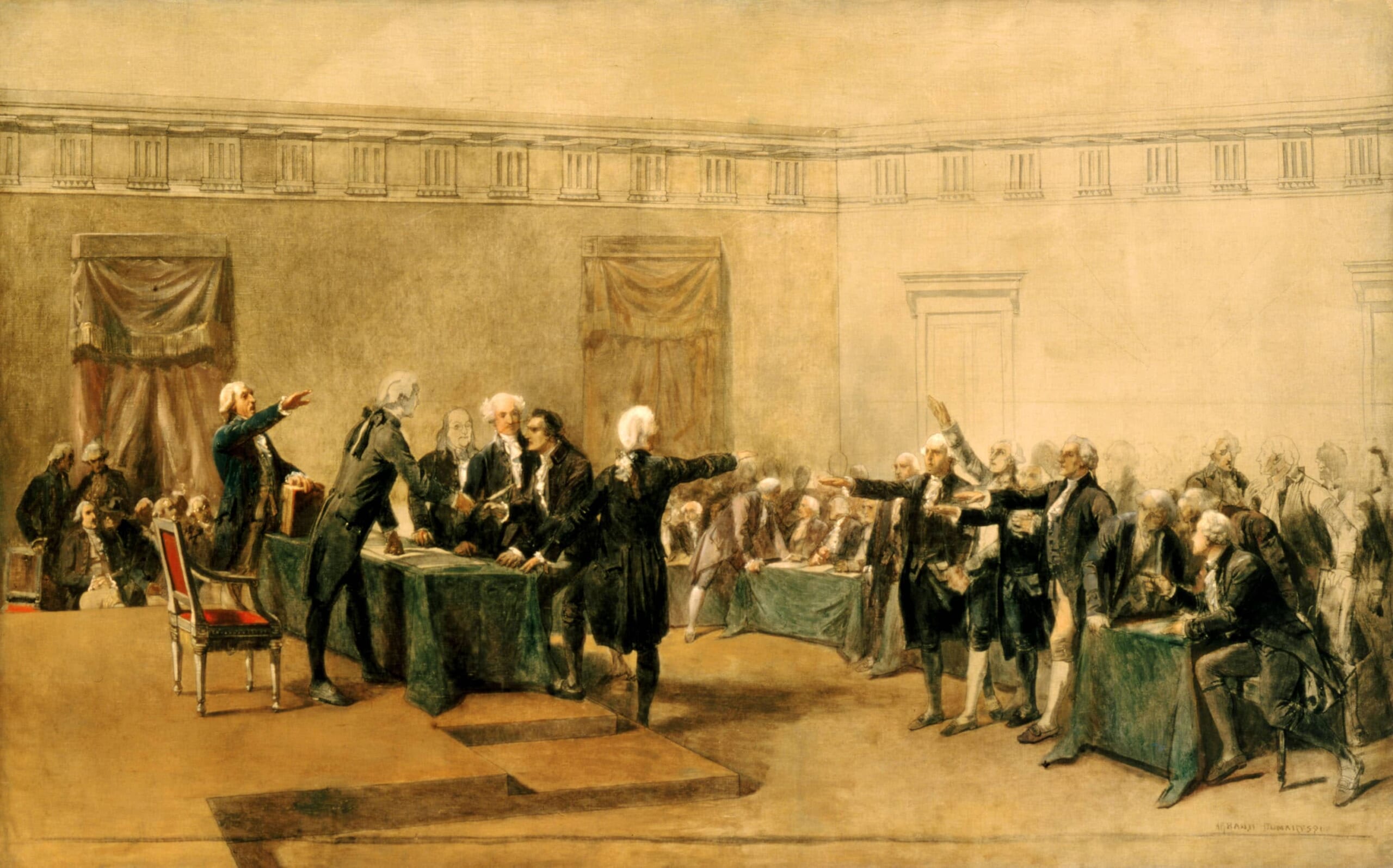
The Journals of the Continental Congress records on August 2, 1776, that “The Declaration of Independence, being engrossed, and compared at the table, was signed [by the members].” Most signed the Declaration on that date, though several delegates signed later. Delaware delegate Thomas McKean was a colonel of the Philadelphia Fourth Battalion, in New Jersey reinforcing Washington’s troops, and was the last person to sign the Declaration, perhaps as late as 1781.
John Hancock, the president of the Continental Congress, famously signed with a large, bold signature. He is supposed to have said that now John Bull—the popular personification of England—can read Hancock’s name without needing spectacles and that the King could double the reward on his head. When Hancock passed the quill—they all signed the document as individuals not identified by colony—he reiterated the importance of unanimity and said that the delegates must all hang together. Benjamin Franklin is said to have quipped in response that “We must all hang together, or most assuredly we will all hang separately.”
And then there is the purported story that Benjamin Harrison of Virginia, a rather portly fellow, told the slim Elbridge Gerry of Massachusetts that when the hanging comes, “I shall have the advantage over you on account of my size. All will be over with me in a moment, but you will be kicking in the air half an hour after I am gone.”
Whether or not the signers engaged in such gallows humor, there was likely some discussion of their fate, as the King’s Proclamation of Rebellion had labeled them all traitors subject to England’s harshest laws. When Washington wrote to his brother in May 1776, while the general was meeting with members of the Continental Congress in Philadelphia, he spoke of the need to conquer “or submit to unconditional terms, & its concomitants, such as Confiscation, hanging, &ca, &ca.” What did he mean by etc., etc.? Perhaps the general explained to the delegates that the punishment for traitors under English law indeed was to be hanged, and then disemboweled while still alive, beheaded, and quartered.
By signing their names to the Declaration, each of those 56 delegates was signing his own death warrant.
Maryland delegate Charles Carroll made sure to sign his name as Charles Carroll of Carrollton so the British would not mistake his father or his cousin of the same name as a signer.
It was not until January 18, 1777, when Congress fled Philadelphia before the city fell to the British, that an authentic copy of the Declaration with all the names attached was printed in Baltimore and sent to each of the states “to have the same put upon record.”
Abraham Clark of New Jersey had written his friend Elias Dayton, a colonel with the Third Battalion of New Jersey forces operating in New York, that Congress had “embarked on a most Tempestuous Sea, Life very uncertain, Seeming dangers Scattered thick Around us.”“Let us prepare for the Worst. We can Die here but once.”
Our Lives, Our Fortunes and Our Sacred Honor
James Smith organized a volunteer company of militia in York County, and they elected him their captain and later their colonel when they became a battalion. Thomas Lynch became a captain in the First South Carolina Regiment of Continentals. Thomas Nelson, who had replaced Washington at the Continental Congress, was a colonel in the Second Virginia Infantry Regiment and then as brigadier general commanded Virginia military forces at the Battle of Yorktown. William Whipple was a brigadier general with the New Hampshire militia and was one of the commanding officers in the decisive Saratoga campaign.
John Hancock was a major general in the Massachusetts militia and later became the first and the third governor of the Commonwealth of Massachusetts. Caesar Rodney was a major general in the Delaware militia and only gave up that post when he was elected governor of his state in 1778.
Josiah Bartlett was an army surgeon for General John Stark’s New Hampshire troops. Benjamin Rush was appointed as the surgeon general of the Middle Department of the Continental Army.
George Walton was a colonel of the First Georgia Regiment of Militia. During the Battle of Savannah in 1778, Walton was hit by a musket ball and captured by the British. He was held as a prisoner of war and not released until a prisoner exchange in October 1779.
Edward Rutledge, Thomas Heyward, and Arthur Middleton served together as captains in the Charles Town Battalion of Artillery and were captured at the Battle of Charleston, South Carolina, in 1780. They were released in a prisoner exchange, though in the meantime Heyward’s and Middleton’s homes were both sacked and pillaged by the British, and Heyward’s distraught wife died in childbirth only a few days after his release.
Richard Stockton was turned in by Loyalists in late 1776 and tortured by the British for having signed the Declaration. British Major General Lord Cornwallis used Stockton’s home as his headquarters during the Battle of Trenton, as did Colonel William Harcourt of the Sixteenth Dragoons while the British occupied Princeton. When Stockton returned home after his incarceration, he found his property in ruins. He never recovered from his mistreatment and died in 1781.
Oliver Wolcott, Sr., was a colonel of the Seventh Connecticut Militia Regiment and then brigadier general of seven Connecticut regiments, and his son Oliver served as his father’s aide-de-camp and then as quartermaster of the Connecticut militia. George Ross’s son James served at the Battle of Bunker Hill and became a lieutenant colonel with the Eighth Pennsylvania Regiment. Philip Livingston’s youngest son Henry was a captain in General Washington’s personal guard, rising to second in command, and his next-youngest son John Abraham served as the commissary of provisions for the Continental Army, was captured by the British, and is believed to have died in prison.
John Witherspoon was unsuccessfully targeted by the British, and during the occupation of Princeton, British soldiers brutally killed a fellow Presbyterian minister thought to be him. His farm Tusculum (named after Cicero’s villa outside of ancient Rome) is believed to have been used as the headquarters for the Fortieth British Regiment. Witherspoon’s eldest son James, a major in the New Jersey Brigade, was struck and killed by a cannonball at the Battle of Germantown.
Lewis Morris and his three sons all served and survived the war. The father was brigadier general of the Westchester County Militia. Lieutenant William Walton Morris served in the Second Continental Artillery and was an aide-de-camp to General Anthony Wayne. Colonel Lewis Morris was appointed an aide-de-camp to General Charles Lee, and then to General John Sullivan, and finally to General Nathaniel Greene for the remainder of the war. Brigadier General Jacob Morris served under both General Lee and General Greene.
John Hart’s three sons—Jesse, Nathanial, and Edward—all served in New Jersey’s First Regiment. John Hart was pursued by Hessian troops when the British invaded New Jersey in the fall of 1776. When Jesse and Nathaniel guided Washington’s 12,000 soldiers through New Jersey before the Battle of Monmouth in 1778, the army encamped at Hart’s farm near Hopewell Township. Edward is said to be one of the men who crossed the Delaware River with Washington in December of 1776.
Dr. Lyman Hall’s home and property on the coast of Georgia were confiscated and burned in 1779. In September 1777, when the British approached the city of Philadelphia, Loyalists led the British to George Clymer’s property, and his wife and children hid in the woods while the soldiers ransacked their home. Abraham Clark’s home in Elizabethtown, New Jersey, on the Staten Island channel was pillaged by the British in the winter of 1776–77 during the Battle of Trenton. William Ellery’s home was burned down by the British sometime during their occupation of Newport, Rhode Island.
When the British general (and American traitor) Benedict Arnold landed in Virginia in 1780, he led a raid on the home of Benjamin Harrison and had Harrison’s furniture and other possessions destroyed, the livestock killed, and all his crops burned. In haste, Harrison relocated his family, which included his seven-year-old son William Henry, who would become the ninth president and whose grandson Benjamin would be the 23rd president.
The British tried to capture William Hooper of North Carolina twice during the Revolution, first at his country estate Finian and then at his house in Wilmington, but he fled with his family both times before his properties were burned down. Colonel Thomas McKean of Delaware wrote John Adams that he was “hunted like a fox by the enemy…obliged to remove my family five times in a few months, and at last fixed them in a little log house on the banks of the Susquehanna…[and] they were soon obliged to move again, occasioned by the incursions of the Indians.”
During the British occupation of New York, all four New York signers were targeted by the British. Philip Livingstone’s residence in Brooklyn Heights was used as a Royal Navy hospital, and his home on Duke Street as a barracks. Lewis Morris’s estate in the southwest Bronx was captured and ransacked, and his farmland destroyed. William Floyd’s home on Long Island was taken and his family was forced to flee into Connecticut during the night. Francis Lewis’s home in Whitestone (present-day Queens) was destroyed. His wife Elizabeth supposedly stood her ground while a troop of light horse surrounded the property and a British ship fired upon the house from the Long Island Sound. She was captured and imprisoned until General Washington had two Loyalist women in Philadelphia arrested to force a prisoner exchange. Elizabeth’s captivity led to her premature death in 1779.
William Paca, a captain in his county militia on the Eastern Shore of Maryland, spent significant amounts of his own fortune to outfit as many Maryland militia troops as possible. William Williams funded a Connecticut militia and turned his home over to the French in the winter of 1780–81. George Taylor, a colonel in the Third Division of the Bucks County Militia, used his ironworks factory to make cannon shot and other munitions for the Continental Army.
Carter Braxton loaned over 10,000 pounds sterling to Congress (about $2 million in current dollars), which was never repaid. He outfitted several American ships in order to smuggle Virginia tobacco in exchange for ammunition and provisions for the Continental Army; more than half of the 14 vessels he owned were captured by the British or lost at sea.
In 1778, Thomas Nelson raised, outfitted, and trained a light calvary unit, largely at his own expense. Nelson guaranteed a loan to Virginia in 1780 to purchase provisions for the Comte de Grasse’s French fleet. When Virginia proved unable to pay, Nelson forfeited his property to pay off the loan. Nevertheless, popular legend has it that during the Battle of Yorktown, Nelson offered a reward to the first American artilleryman who could hit his home in Yorktown, where General Cornwallis kept his headquarters.
Robert Morris served as the superintendent of finance for the Continental Congress and became known as “the financier of the Revolution.” Morris used his own credit and funds to secure desperately needed supplies for the Continental Army, even printing so-called “Morris Notes” backed by his personal credit. At one point, Morris contracted with Pennsylvania to take on the quota of supplies assigned to that state and furnished the Continental Army $1.12 million worth of supplies—the equivalent of some $32 million today. Having financed the Revolution, Morris nevertheless ended up in debtor’s prison because land speculation devastated his personal finances.
Forty-two of 56 signers had served in their colonial legislatures. Fifteen of the signers participated in their states’ constitutional conventions, 13 of the signers went on to become governors, and 18 served in their state legislatures.
After John Dickinson abstained from the July 2 vote on independence, he left Philadelphia and, having previously been commissioned a colonel in the Philadelphia militia, led 10,000 soldiers as a brigadier general to protect New Jersey from British attack. Even though he did not sign the Declaration, Dickinson’s home in northern Philadelphia was burned down by the British during the Battle of Germantown. His mansion on Chestnut Street, near Independence Hall, served as an American hospital and after the war became the residence of the French ambassador. Dickinson retreated to his boyhood home southeast of Dover, where he served in the Delaware militia as a private soldier under fellow signer Major General Caesar Rodney. In 1779, Delaware sent Dickinson back to the Continental Congress as one of their delegates; he was elected governor of Delaware in 1781 and then governor of Pennsylvania in 1782—for two months he was the chief executive of both states.
John Dickinson attended and played a significant role at the Constitutional Convention. He, along with the Declaration signers Roger Sherman, Robert Morris, Benjamin Franklin, George Clymer, James Wilson, and George Reed, signed the United States Constitution. Elbridge Gerry of Massachusetts attended the federal convention but declined to sign the final document.
Sixteen Declaration signers became state and federal judges. Seven became members of the United States House of Representatives, and six became United States Senators. James Wilson and Samuel Chase became Justices of the United States Supreme Court.
After the signing of the Declaration of Independence, John Adams continued in his role as the chairman of the Marine Committee—the equivalent of the secretary of the Navy. In 1778, the Continental Congress assigned Adams to replace Silas Deane as commissioner in France. While traveling aboard the Continental frigate Boston with his then ten-year-old son John Quincy, British warships chased their ship all the way to the French coast. When they were fired upon, Adams manned a 12-pounder ship gun, ignoring the captain’s request that he stay below deck. Adams was the first United States ambassador to the Netherlands, and then (simultaneously) the first United States ambassador to Great Britain. He later became the first vice president of the United States and the second president.
John’s wife Abigail was in Braintree, Massachusetts, at the outbreak of the war, caring for their four children as well as the four children of the widower Dr. Joseph Warren, then-president of the Massachusetts Provincial Congress. Abigail wrote to her husband in Philadelphia:
God is a refuge for us.—Charlstown is laid in ashes. The Battle began upon our intrenchments upon Bunkers Hill, a Saturday morning about 3 o clock and has not ceased yet and tis now 3 o’clock Sabbeth afternoon. Tis expected they will come out over the Neck to night, and a dreadful Battle must ensue. Almighty God cover the heads of our Country men, and be a shield to our Dear Friends. How [many ha]ve fallen we know not—the constant roar of the cannon is so [distre]ssing that we can not Eat, Drink or Sleep…I shall tarry here till tis thought unsafe by my Friends, and then I have secured myself a retreat at your Brothers who has kindly offerd me part of his house. I cannot compose myself to write any further at present.
During the Battle of Bunker Hill, where Warren was summarily executed by the British, Abigail and her two older children, ten-year-old Nabby and seven-year-old John Quincy, climbed Penn’s Hill and listened to the battle in the distance and watched from afar the burning of Charlestown. John Quincy Adams would become the sixth president.
In September 1776, Thomas Jefferson returned to the Virginia House of Delegates for Albemarle County, where he failed to pass his Bill for Establishing Religious Freedom as well as his legislation to disestablish the Anglican Church, though both measures were revived and passed in 1786. He was the second governor of Virginia after Patrick Henry. In 1781, Jefferson escaped British forces led by Benedict Arnold, which razed the new capital of Richmond, and in June, Jefferson fled capture by Lieutenant Colonel Banastre Tarlton’s cavalry unit which had been dispatched to apprehend him at Charlottesville. He was appointed to join Benjamin Franklin and John Adams in Paris as minister plenipotentiary and was the second United States ambassador to France. Jefferson became the second vice president, and the third president.
Jefferson was also the first secretary of state, which meant the engrossed copy of the Declaration that he had drafted—having traveled with Congress throughout the war, twice eluding capture, and then delivered by the Secretary of Congress to President George Washington—was placed in his official custody as the first holder of that office.
The New Jersey delegate Abraham Clark’s two sons Aaron and Thomas were both captains of artillery in the Fourth New Jersey Regiment. Both were captured by the British, and imprisoned, beaten, and starved because their father refused to recant his signing of the Declaration.
John Morton provided the swing vote that allowed the Pennsylvania delegation to support independence on July 2 and voted to approve the Declaration on July 4. Though he died before he could physically sign the Declaration, John Morton’s two oldest sons served: Major Sketchley Morton in the Pennsylvania line of the Continental Army, and Dr. John Morton, a surgeon’s mate in the Fourth Continental Artillery. According to family lore, John Morton said on his deathbed: “Tell them that they will live to see the hour when they shall acknowledge it to have been the most glorious service that I have ever rendered my country.” Morton’s eldest son John, his namesake, was captured and died in 1779 on the prison ship H.M.S. Falmouth, anchored in New York’s East River.
The signers all risked their lives, and many gave up their fortunes to support the Declaration. None forfeited his sacred honor. They were iron men.