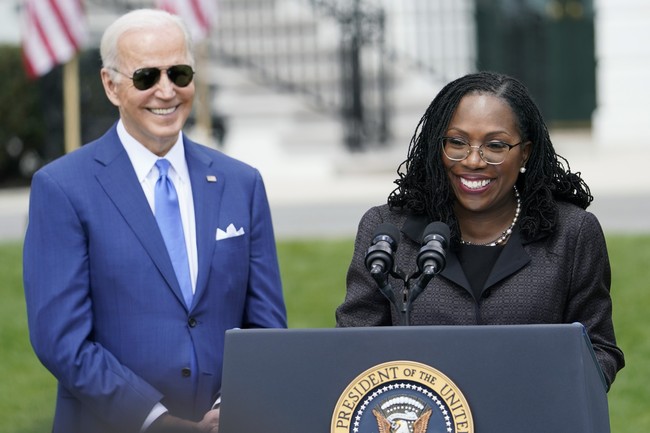
Ouch! For nine straight minutes on Tuesday, Solicitor General D. John Sauer methodically dismantled every argument Justice Ketanji Brown Jackson threw at him during oral arguments in Trump v. Barbara, the Supreme Court’s birthright citizenship case.
Jackson came in hot, framing the administration’s position as requiring the Court to take two uncomfortable leaps: first, that the Framers weren’t importing English common-law birthright citizenship into the 14th Amendment, and second, that they were actively departing from it in favor of a domicile-based standard. “I think you have a number of hurdles to accomplish those two things,” she told Sauer.
She leaned on Schooner’s Exchange, an 1812 case, arguing the Supreme Court had already settled what “allegiance” meant before the 14th Amendment was ever ratified — that allegiance simply meant being subject to a jurisdiction’s laws and entitled to its protection. In her telling, when the Framers used that word, they were just borrowing what the Court had already defined. “I think your first hurdle is to help us understand why we would believe that when the 14th Amendment was ratified, the framers weren’t just incorporating what we had previously said it meant,” she said.
Sauer didn’t hesitate. He went straight to the Congressional Record, pointing out that Senator Lyman Trumbull had explicitly addressed Schooner’s Exchange and rejected it. Trumbull, Sauer noted, had considered using the phrase “owing allegiance” but pulled back precisely because, in his words, “There’s a sort of allegiance from persons temporarily resident in the United States whom we have no right to make citizens.”
So, Jackson pivoted to a back-and-forth between Sen. William Pitt Fessenden and Sen. Benjamin Wade, suggesting that Wade’s remarks showed that the English common-law understanding of allegiance — covering even temporary visitors — was what Congress actually adopted.
Sauer was ready for that, too. He pointed out that Wade had originally introduced a version of the amendment with no allegiance or jurisdictional element whatsoever, just birth on U.S. soil. Fessenden pushed back immediately, noting that it couldn’t be right given the obvious case of children born to temporary visitors. Wade was forced to retreat, citing only the children of ambassadors as exceptions. And critically, Congress ultimately rejected Wade’s proposal entirely. “We think that, you said you can draw an inference from that,” Sauer said, “the inference strongly supports us.”
ICYMI: Liberals Are Having a Meltdown Over Trump’s Election Executive Order
At this point, Jackson pretty much was just throwing dart after dart, trying to hit the bullseye… and it wasn’t working. She shifted to a different line of attack: if parental allegiance is what drives citizenship under the administration’s theory, why doesn’t the text of the 14th Amendment mention parents at all? Sauer had the answer ready. Under 19th-century conceptions of allegiance, a newborn’s domicile — and thus allegiance — followed the parents’ allegiance as a matter of course. Nobody needed to spell it out. “The child’s allegiance status, even on their view, turns on the status of the parent,” he said, turning the argument around on her.
Jackson then hauled out Japanese internment. During World War II, she noted, babies born to parents officially declared enemies of the United States were still granted birthright citizenship — which, in her view, suggested parental allegiance wasn’t actually driving anything. Was the government saying those babies got it wrong? Sauer’s answer was direct: if those parents were domiciled here, then yes, the children should have received citizenship; if they were only temporarily present, then no. Jackson pressed him on what “temporary presence” had to do with allegiance and whether he was really arguing that only domiciled people could form the necessary loyalty.
“Allegiance is not a question of subjective loyalty,” he explained. “It is something you owe. It’s a reciprocal relationship between the citizen, whether they want it or not.” Essentially, temporary passage through the country doesn’t create allegiance, but making the United States your permanent home does.
Jackson tried one more angle, citing a statement suggesting birthright citizenship applies “independently of a residence with intention to continue such residence, independently of any domiciliation.” Sauer acknowledged she was quoting from page 693 of the opinion in question, but noted that the passage doesn’t take the next step — it doesn’t say that temporary local allegiance therefore confers citizenship. And right before that passage, he said, the court’s holding uses the word “domicile” repeatedly.
At this point, she gave up the darts and started grasping at straws. She wanted to know how any of this would work in practice. Are doctors checking immigration papers in delivery rooms? Are pregnant women being deposed about their intentions to remain in the country? The questions had a theatrical quality to them, more about painting a chaotic picture than getting real answers. Sauer pointed her to the SSA guidance cited in the government’s brief. The Social Security number system already checks parents’ immigration status through existing databases. For the vast majority of families, nothing changes. If someone believes they were wrongly denied, there’s a process to dispute it.
🚨HOLY CRAP! President Trump’s top attorney John Sauer just concluded his oral arguments against birthright citizenship for illegal immigrants against Supreme Court Justice Ketanji Brown Jackson:
SCOTUS Justice Jackson attempts to corner him on what the U.S. would do when a… https://t.co/ZfxoRfMR6I pic.twitter.com/tZnGRIyQ9p
— Morse Report (@MorseReport) April 1, 2026
Every time there are oral arguments before the Supreme Court, Justice Jackson embarrasses herself.
Want to support fearless journalism that exposes the Left and tells the stories the media won’t? PJ Media delivers the truth and holds the powerful accountable. Become a VIP member today—your support fuels our mission and unlocks exclusive content, podcasts, an ad-free experience, and more.
Use code FIGHT for 60% off. It’s a great time to join our movement. Join now and stand for America-first journalism!