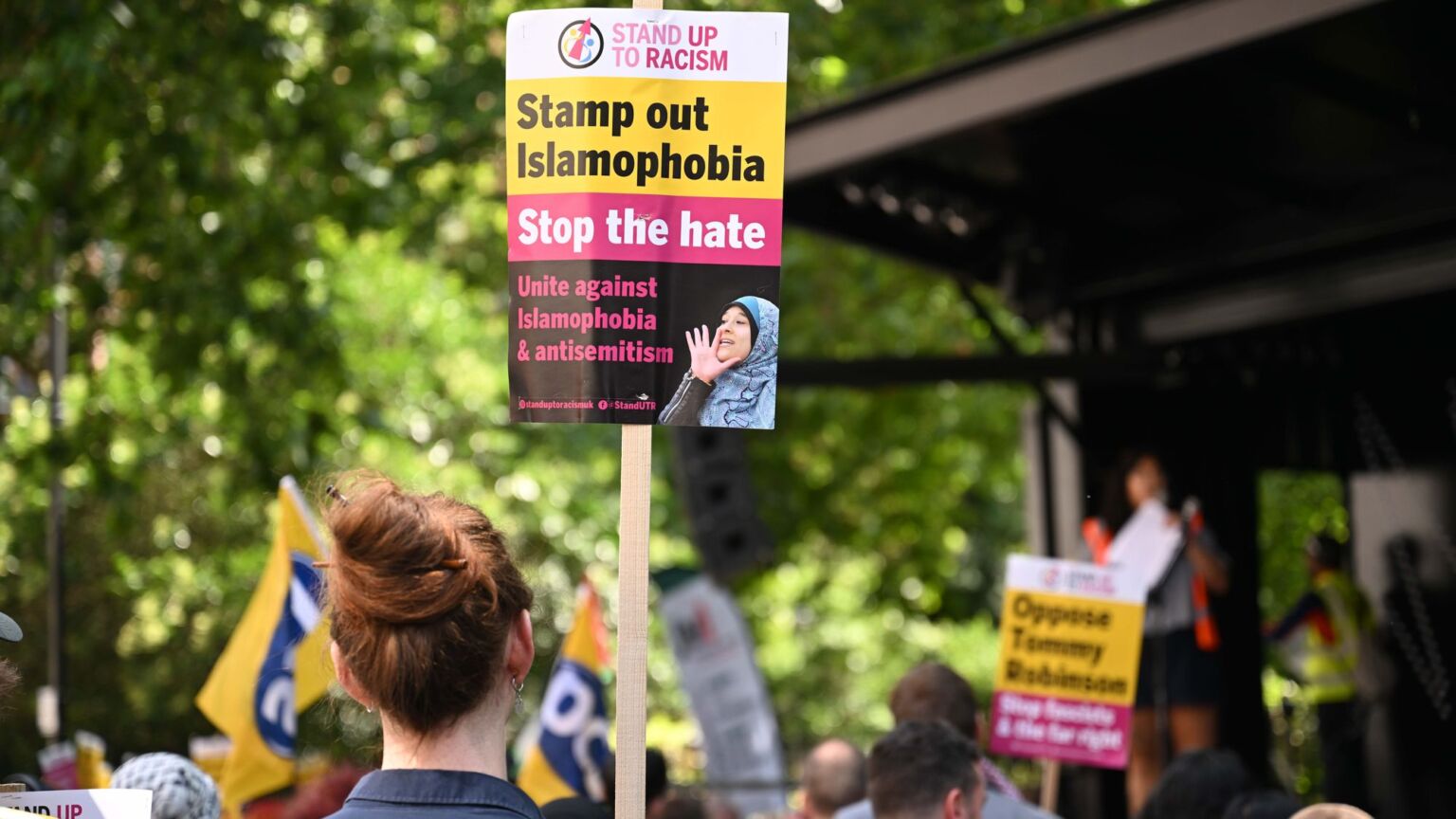
On Monday, the ‘Islamophobia’ definition being mulled over by the UK government was leaked to the BBC. Baroness Shaista Gohir, chief executive of the Muslim Women Network UK, has confirmed that this definition was written by the ‘working group’ on Islamophobia and anti-Muslim hatred, of which Gohir is a member, and that it was delivered to the government in October. The Telegraph reports that the government was planning to announce this new definition on Monday, but the Bondi Beach bloodbath caused them to have second thoughts.
The full definition, in which ‘anti-Muslim hostility’ has replaced ‘Islamophobia’, reads as follows:
‘Anti-Muslim hostility is engaging in or encouraging criminal acts, including acts of violence, vandalism of property, and harassment and intimidation whether physical, verbal, written or electronically communicated, which is directed at Muslims or those perceived to be Muslims because of their religion, ethnicity or appearance.
‘It is also the prejudicial stereotyping and racialisation of Muslims, as part of a collective group with set characteristics, to stir up hatred against them, irrespective of their actual opinions, beliefs or actions as individuals.
‘It is engaging in prohibited discrimination where the relevant conduct – including the creation or use of practices and biases within institutions – is intended to disadvantage Muslims in public and economic life.’
As ever, the devil is in the detail. The first paragraph appears to add nothing to what is already established in law. Stirring up racial hatred and discriminating on the grounds of religion are already illegal. There is little to be gained from a definition that merely repeats what the law says. And this is an important point. Muslims already enjoy protection from all of those criminal acts in law. They do not need special protection, above and beyond what other groups enjoy.
It is the second paragraph where trouble emerges. What exactly is ‘prejudicial stereotyping’? If I say, ‘Muslims don’t drink alcohol’, is that prejudicial stereotyping? There is nothing in the definition to say that it isn’t. There are a whole host of other statements that you could easily think of that are bound to be more controversial, yet which are nonetheless true. What about ‘many Muslims practice polygamy’, or ‘Islam encourages jihad’, for example?
Then there is the question of ‘racialisation’. This insertion seems to be a deliberate attempt by activists to equate criticism of Islam with racism, even though Islam is clearly not a race. Inevitably, the allegation of racism will be used to shut down legitimate criticism of Islamic beliefs and practices.
Fortunately, sneaking the ‘racialisation’ clause past the government will be a difficult task. This is because it was forced to admit last year that the notorious All-Party Parliamentary Group definition of Islamophobia from 2018 conflicts with the 2010 Equality Act, on the grounds that it defined Islamophobia as ‘a type of racism’. As the government admitted, this is not what the Equality Act means by race, which is defined as ‘colour, nationality and national or ethnic origins’.
The only consolation to be found in the new definition, and it is a small one, is that the working group has shied away from the term ‘Islamophobia’. This is because the very term conflates the religion of Islam with Muslims, and makes it appear that the religion itself should be free from criticism. This is a welcome development.
But what we are left with is a definition that is no better than the APPG one when it comes to free speech. Even though this definition will be non-statutory, it will be adopted not only by central government, but also by public services more generally. No doubt it will be adopted by the police and the judiciary, too. Activists will also pressure private corporations and organisations to adopt it. While it will not be a crime to fall foul of this definition, it could cost you your job and your professional reputation. Before long, we will have a de facto Islamic blasphemy code.
The tragedy is that we effectively have a blasphemy law in the UK already, even without this definition. Street preachers have been arrested for questioning what the Koran says about domestic violence, and for displaying a sign reading ‘Love Muslims, Hate Islam’. The police have arrested people for burning a copy of the Koran. The powers-that-be are hardly in need of an added incentive to punish criticism of Islam.
This definition cannot be allowed to stand. It is vague and expansive. It is wide open to exploitation by activists – and you can be sure that this will happen.
This is a critical moment for the UK. Will we adopt an Islamic blasphemy code or not? I hope and pray that this government will see sense and back off.
Tim Dieppe is head of public policy at Christian Concern and the author of the Free Speech Union’s latest briefing paper, Banning Islamophobia: Blasphemy Law by the Backdoor.