There is a schoolteacher in England whose name I cannot tell you, because he was forced to change it. In March 2021, he showed his year nine class at West Yorkshire’s Batley Grammar School a caricature of the Prophet Muhammad – a reproduction of the infamous Charlie Hebdo cartoon from 2015 – as part of a lesson on blasphemy. It was five months after Samuel Paty, a French teacher who had conducted a similar lesson, was beheaded by a jihadist in a suburb of Paris. One might have expected, in the aftermath of a colleague’s decapitation, some institutional solidarity. One would have been naive.
A mob formed. Death threats followed. The Batley teacher’s children slept on mattresses on the floor in temporary accommodation. The headteacher ‘unequivocally’ apologised for the offence caused – a sentence that, if British liberalism ever requires an epitaph, would serve admirably. The teacher was suspended. He was later cleared, but it made no difference. He developed PTSD and became suicidal. When he visited a police station after relocating, officers told him he had ‘made it harder for them by moving’. Dame Sara Khan’s government-commissioned review described him as ‘totally and utterly failed’ by every institution that owed him protection. Five years on, he remains in hiding. Nobody has been arrested for threatening his life. No politician of any consequence has dared say his name.
I begin here because the government’s new 47-page cohesion strategy, Protecting What Matters, begins with him, too. It promises to ‘stand against those who try to intimidate, threaten and harass others because they are offended by so-called “blasphemy”’. It declares: ‘We do not recognise blasphemy law in the UK.’ And then, with exquisite bureaucratic care, it then constructs the apparatus of one. It builds the scaffold and hangs a sign on it reading, ‘Not A Scaffold’.
For this cohesion strategy contains Labour’s non-statutory definition of ‘anti-Muslim hostility’. On the same day it was released, communities secretary Steve Reed announced the appointment of an anti-Muslim-hostility tsar (because this is how we govern now) to ‘champion efforts across the UK to tackle hostility and hatred directed at Muslims and those perceived to be Muslim’. Four million pounds have been committed to the task.
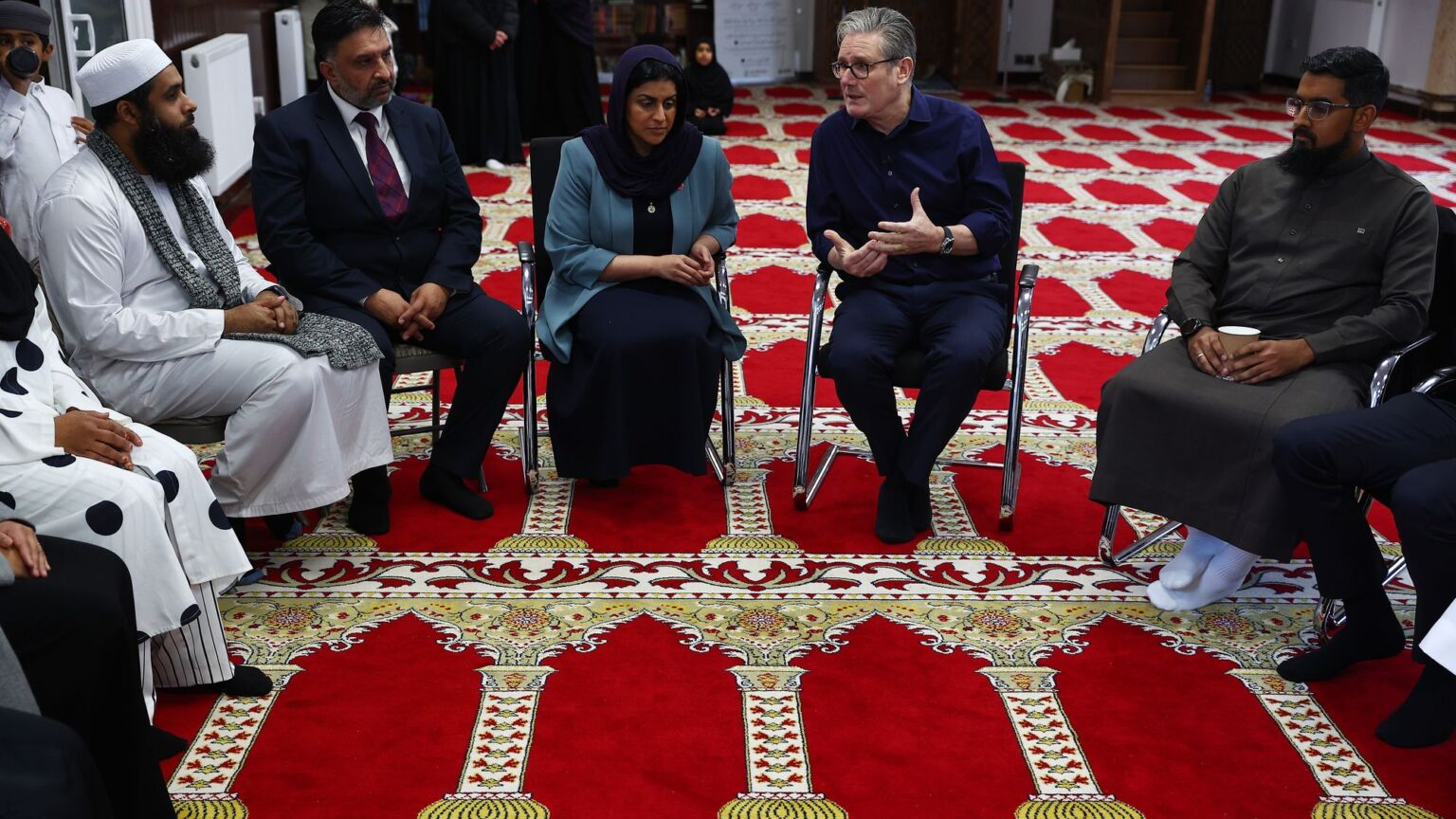
The timing is instructive. Reed’s announcement arrived within 10 days of Labour losing the Gorton and Denton by-election, a seat held since 1935, to the Greens, after Muslim voters deserted Labour over Gaza. It also came days after Starmer praised British Muslims as ‘the face of modern Britain’ at a Ramadan iftar. The cause of this policy was not a review of evidence. It was the count at a leisure centre in Greater Manchester at two o’clock in the morning.
Credit where it is due. The government has abandoned the word ‘Islamophobia’. The old definition, adopted in 2019 by Labour for internal party matters, and by some 50 local councils, defined Islamophobia as ‘a type of racism that targets expressions of Muslimness or perceived Muslimness’. This was always a category error masquerading as moral insight: Islam is not a race and the Equality Act does not recognise Muslims as an ethnic group. Most remarkably, the report accompanying the definition listed as an example of Islamophobia the act of accusing Muslims of exaggerating Islamophobia. The definition was immunised against its own critique. One could not challenge the framework of Islamophobia without being branded Islamophobic.
The replacement definition drops ‘Muslimness’ and ‘racism’. These are genuine improvements on a definition so catastrophically flawed that the government had to disown it last year. However, to celebrate this is to congratulate a man for removing his boot from your throat only to place it on your chest.
Now, examine the new definition, because the language is everything, and Orwell would have spotted the trick at a glance. Its first paragraph condemns criminal acts directed at Muslims: violence, vandalism, harassment. Every behaviour described is already illegal under the Public Order Act, the Equality Act, the Crime and Disorder Act and the Protection from Harassment Act. Reed told the Commons that, ‘You can’t tackle a problem if you can’t describe it’. But these problems are already described, in legislation carrying criminal penalties. If the definition is not redundant, then it is intended to do something the law does not. We are entitled to ask what.
The second paragraph provides the answer. It condemns ‘prejudicial stereotyping’ of Muslims, ‘irrespective of their actual opinions, beliefs or actions as individuals’. Attend to that clause, because it does the heavy lifting. The government has written a definition in which the truth of a claim is explicitly irrelevant to whether stating it constitutes ‘stereotyping’. If polling shows 52 per cent of British Muslims believe homosexuality should be illegal, is citing that figure prejudice or sociology? If Protecting What Matters itself acknowledges the threat of Islamist extremism – accounting for three quarters of the police’s counter-terror workload and 94 per cent of all terror-related deaths in the past 25 years – is observing this a stereotype? The International Holocaust Remembrance Alliance definition of anti-Semitism, for all its flaws, provides eleven illustrative examples. The anti-Muslim hostility definition, in contrast, offers three paragraphs of abstract language and no examples at all. That vagueness is not an oversight. It is the mechanism. It is the chilling effect itself.
Reed assures parliament that there is ‘absolutely no question of blasphemy laws by the back door’. One has heard this before. Every government crackdown on speech is accompanied by the insistence that free speech will be protected. The Online Safety Act said this. The 2019 Islamophobia definition said it, too.
But these assurances simply won’t wash. In 2020, Trevor Phillips, a former chair of the Equality and Human Rights Commission, was suspended from Labour for ‘Islamophobia’ when all he did was cite the disproportionate involvement of Pakistani Muslim men in grooming-gang cases. In Rotherham, Rochdale and Telford, professionals hesitated to investigate child sexual exploitation for fear of the accusation. In 2022, Cineworld pulled The Lady of Heaven – a film about the daughter of Muhammad – from every screen in the country after protests. This has been happening for years, even without a government-endorsed definition, which will now formalise, validate and accelerate a pattern already well established.
Against this, England possesses one legislative safeguard of extraordinary clarity. Section 29J of the Public Order Act (the Waddington Amendment) provides that nothing shall prohibit ‘discussion, criticism or expressions of antipathy, dislike, ridicule, insult or abuse of particular religions or the beliefs or practices of their adherents’. Note the sweep: not merely criticism but ridicule, insult and abuse. The new definition does not repeal Section 29J. It builds a parallel architecture of codes, guidance and tsars in every space where 29J does not apply: universities, workplaces, councils, the NHS. One system protects the right to ridicule religion. The other makes exercising it professionally suicidal.
The most important feature of this debate is who the critics of the government’s definition are. Jonathan Hall KC, the government’s own terrorism-legislation reviewer, warned he was ‘against an Islamophobia definition because it’s directed at a thing, at religion, rather than an anti-Muslim hatred law, which is about protecting people’. Fiyaz Mughal, founder of Tell MAMA – an organisation that records anti-Muslim hate in the UK – warned the process could be exploited by ‘Islamist groups and those affiliated with Muslim Brotherhood front groups’. The National Secular Society called it ‘unnecessary and misguided’.
These are not GB News talking heads. They are liberals, secularists and Muslims who understand something the government will not grasp: that the people most harmed are not comfortable commentators but the vulnerable: ex-Muslims facing death threats for apostasy, Muslim women suffering from honour-based violence, grooming-gang survivors whose testimony was buried because professionals feared the accusation. For these people, the free criticism of Islam is not an intellectual luxury. It is a matter of physical survival.
No religion deserves its own tsar. To assault a Muslim is a crime. To discriminate against a Muslim is unlawful. But to say Islam promotes the subordination of women is not a crime. To mock the proposition that a seventh-century Arabian merchant received the final revelation of the creator of the universe is not a crime. The capacity to give offence is not an unfortunate byproduct of free speech. It is its essential purpose. This is not about protecting Muslims from hatred. It is about protecting Islam from criticism. Those are two completely different things.
England abolished its blasphemy laws in 2008, after a struggle that ran from Milton through Mill through the imprisonment of Charles Bradlaugh to the final repeal. Somewhere in England, a teacher who exercised those hard-won freedoms cannot go home. Protecting What Matters expresses sympathy with him and promises to stand against those who harassed him. Then, with four million pounds and a freshly minted tsar, it builds a machine that seems almost designed to produce the next Batley-style outrage.
Owen Shapell is PhD researcher in social sciences.