In Time Enough for Love, Robert Heinlein dropped a significant remark about laughter. “When apes learn to laugh, they’ll be people.” Laughter is what makes us human. But there are different kinds of laughter, and different ways of being human. The best kind of laughter reinforces our deeper or richer humanity, creating a sense of empathy with others. Other types of laughter, on the other hand, create division and express what we recognize as inhumanity.
Some laughter responds to clever wordplay, sharp irony, unexpected consequences, and, of course, a touch of warmth; it reflects shared cohesion or mutual understanding. Other kinds of laughter violate these norms and criteria, suggesting a propensity for causing discomfort or harm. Such laughter is an expression of malevolence and sadistic violence, of mental unbalance or even outright madness.
Nervous laughter and phatic laughter are a rather different genre of expostulation, having nothing to do with humor or aggression. They are forms of deflecting attention from ill-at-ease-ness or what we might call flow-stall, that is, when a thought or phrase embarrassingly fails to complete itself via misspeaks, accidental interruptions, and brain freeze.
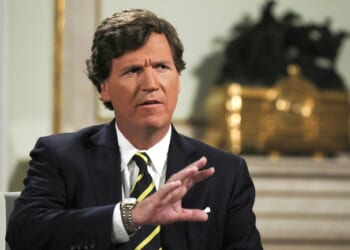
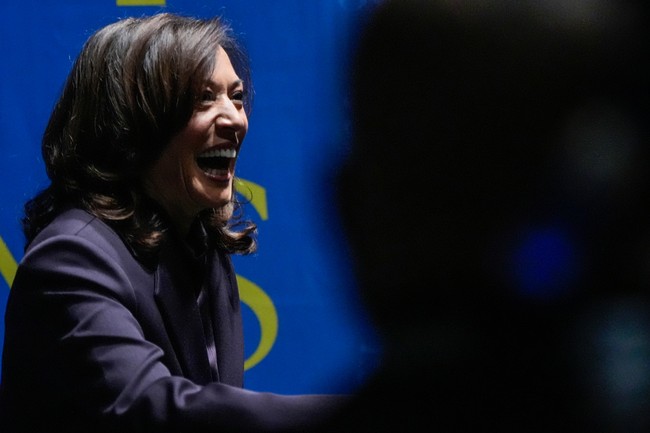
The timbre or quality of laughter is also important. The laughter of certain public figures is famously a symptom of some form of cerebral vertigo. One thinks of the high-pitched shriek of Tucker Carlson, a cross between the screech of a howler monkey in distress and a badly oiled gate hinge. There is definitely something wrong there. Kamala Harris for her part has become notorious for what has been described as a cackle, a disquieting morphic meld between the creepy vocalizations of a hyena and the readle-eak of a grackle, with maybe a chicken thrown into the pot for good measure. We should be thankful she does not yelp, bark, roar or grunt, or the force of her laughter might then be threatening rather than comical or immiserating. I have a friend who laughs like a magpie in a belfry, which makes it impossible to take even the good things he says seriously, and compels me to wonder about his internal balance. Nail-on-chalkboard laughter is often taken as a symptom of incipient derangement, and perhaps rightly so.
We have many qualifiers for different kinds of laughter: hearty laughter, sarcastic laugher, cruel laughter, evil laughter, and so on. The heh heh of the Grinch stealing Christmas signifies the joy of causing pain or discomfort, the gritch of motiveless sadism. The guffaw or vocal explosives of Mafia goon laughter in films indicates the pleasure of subcortical ferocity. The peals and arc-like gales or insidious titters is the stock in trade of the infernal demon. The belly-laugh of the good-natured companion is the Falstaffian sonic surround of camaraderie. One thinks of the Jewish expression, carried over into many other languages: das mentsh trakht un got lakht (man proposes and God laughs). But what is the laughter of God? Is it affectionate? Is it imperial? Here we admit our ignorance.
In her study of Jewish humor, No Joke, Ruth Wisse speaks of laughter’s salvific properties, a special instance of humor that releases a special kind of laughter. Jewish jokes and the laughter they provoke, typically self-deprecating, have multiple functions: they are expressions of humility and modesty; a recognition of the absurdity of the world, and a coping mechanism “transmuting humiliation, subjugation, and dread into funniness.” It’s a bad joke that induces a good joke, the laughter of incredulity and the preposterous fun of verbal, half-unserious self-immolation. It is redemptive laughter in the midst of adversity. As Freud marvelled in Jokes and their Relation to the Unconscious, “I do not know whether there are many other instances of a people making fun to such a degree of its own character.”
One cannot go any further unless one asks what all these species of laughter have in common. This brings up the more genetic question about laughter, in short, what is this weird, cascading outburst in the first place? We are all, at least to some extent, Tucker Carlson or Kamala Harris. When one becomes clinically aware of laughter, one realizes the absolute eerieness of our condition as something other than mere animals capable of some degree of thought.
Gelotology—which AI confuses with Gelatology or the making of ice cream, and which is unintentionally funny in itself—is the science of laughter, a recognized field of study featuring many excellent researchers. In my estimation, one of the best books on the subject is Scott Weems’ HA! Weems views laughter as arising from a contest or squabble in the brain—tension in the mind is probably a better description—accompanied by surprise and joy at the moment of reconciliation.
Max Nieuwdorp in The Power of Hormones provides a clinical analysis of endocrinological paradigms largely in the support of laughter in the quarrel between happy endorphins and angry cortisols.
William Fry in Sweet Madness investigates humor and laughter from a transactional standpoint, as something that is most effective and vivid in social contexts to establish a feeling of complicity or simple entertainment for a society of equals that binds them together. He does not, unfortunately, examine the mechanics of laughter in profound detail.
In The Act of Creation, Arthur Koestler sees laughter as arising from a “collision of matrices” or frameworks that release tension in staccato gusts of breath, a clash of referential schemata or cognitive grids he calls “bisociative events.” It is a creative leap “that gives rise to new and startling perceptions and glimpses of reality.” Laughter detaches us from disturbing feelings, releasing stress or agitation or psychic pressure in a burst of innocent humor, followed by an access of relief. These puffs, blasts and eruptions of air and CO2 from the lungs, this collapsing diaphragm allowing for a fresh intake of oxygen, helps to restore equilibrium after the stress of what we might call anxious patience, waiting for the punch line, hovering before the contrast represented by the unexpected or the eventual and yet sudden fulfillment of desire. The hidden metaphor is that of a tightly coiled spring.
Like the flow of tears, which no other creature shares, and which can be intimately associated with laughter and caused by the same phenomena, laughter is both a mechanism—analogically, a tightly wound spring packed with kinetic energy—and a spiritual or pneumatic (quite literally) mystery of attitude, flair and conscious anticipation, a numinous quality that connects us to something other than the physical. Nobody really knows what it is, but it is surely an imprint of something alien and unsettling.
Spend a little time just observing oneself or others caught up in a snort or a squall of laughter, the throwing back of the head, the shaking of the physique, the cataract of clipped or amorphous sound that has no relation to speech, and simply register what is occurring. One should feel a state of bafflement infused with self-consciousness—and at the same time discover something rather astounding about ourselves. The bizarre, alveolar expulsion of breath, which seems frankly grotesque when we become aware of it, is an uncanny mix of the natural and the unnatural, a sign that we are both in and out of the predictable, customary world. Whether benign or foolish or spiteful, it resembles a form of dyskinesia, the flux of involuntary gestures, almost a kind of disorder.
But laughter may also be the incursion of the transcendent realm or dimension, of the strangely noetic, whether admirable or discreditable, into the material element of our being. The phenomenon comes from elsewhere, as if from a region of existence that Saint Paul describes in his letter to the Ephesians as the realm of the Spirit, that is, of Powers and Fiends from whom we descend in equal parts. It is not an abstract concept but an authentic reality. Angels sing. Demons howl. And we laugh.
Editor’s Note: Support and follow PJ Media’s coverage of leftist corruption and other key news in this new year. Join PJ Media VIP and use promo code FIGHT to get 60% off your membership.