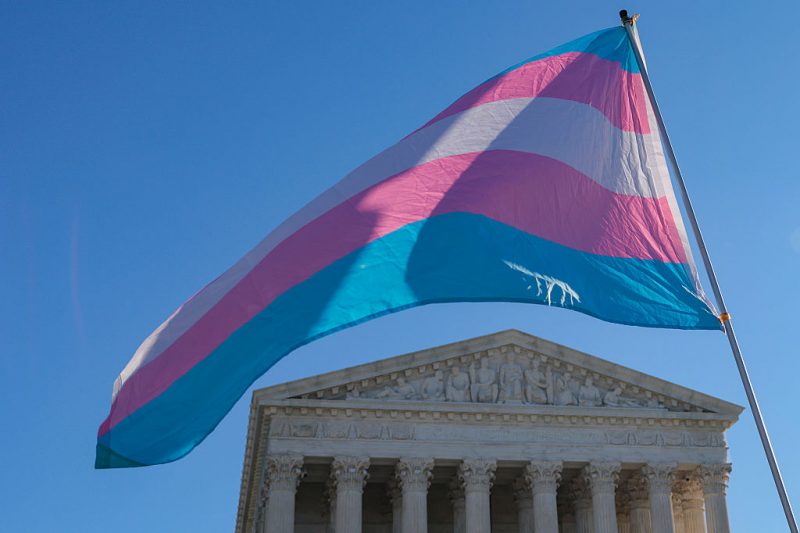
Protesters supporting transgender athletes competing in women’s sports wave a transgender pride flag outside the Supreme Court on January 13, 2026 in Washington, DC. (Photo by Heather Diehl/Getty Images)
OAN Staff Addie Davis 6:01 PM – Wednesday, March 4, 2026
The Supreme Court of the United States (SCOTUS) blocked a California law this week that prohibits schools from alerting parents and guardians when their children express signs of gender dysphoria and begin the process of transitioning to the opposite gender.
“The parents who assert a free exercise claim have sincere religious beliefs about sex and gender, and they feel a religious obligation to raise their children in accordance with those beliefs,” SCOTUS’ majority opinion stated. “California’s policies violate those beliefs.”
The Court’s decision centered on the claim that California’s policies violated parents’ First Amendment right to the free exercise of their religion and their Fourteenth Amendment right to direct the upbringing and education of their children.
SCOTUS’s unsigned per curiam opinion further stated that parents — not the state — have the primary authority over the “upbringing and education of children.” The justices also noted that gender dysphoria has a “significant bearing on a child’s mental health,” and that excluding parents from such critical information prevents them from participating in their child’s wellbeing.
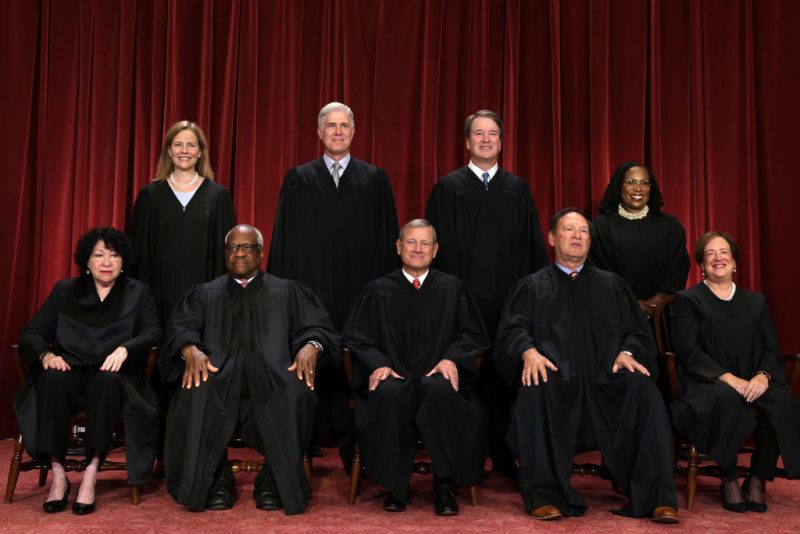
United States Supreme Court (front row L-R) Associate Justice Sonia Sotomayor, Associate Justice Clarence Thomas, Chief Justice of the United States John Roberts, Associate Justice Samuel Alito, and Associate Justice Elena Kagan, (back row L-R) Associate Justice Amy Coney Barrett, Associate Justice Neil Gorsuch, Associate Justice Brett Kavanaugh and Associate Justice Ketanji Brown Jackson pose for their official portrait at the East Conference Room of the Supreme Court building on October 7, 2022 in Washington, DC. (Photo by Alex Wong/Getty Images)
According to the California Post, the Supreme Court granted an emergency appeal from the conservative law firm Thomas More Society on behalf of two sets of Catholic parents, who “argued the law causes schools to mislead them and secretly facilitates gender transition in minors.”
This intervention also follows a wave of legal challenges brought by parents and educators across the state.
The dispute reportedly centers on a 2024 California law that, as reported by the Associated Press, prohibited school staff from “disclosing a student’s gender identity or sexual orientation to any other person without the child’s permission.”
“California’s policy of hiding a child’s gender transition from mom and dad was not only unconstitutional, but it was also dangerous. No school should ever place ideology above a child’s well-being or a parent’s God-given authority. This decision sends a powerful message: the Constitution still protects families, and California schools are not above the law,” California Family Council Vice President Greg Burt told The Post.
The legal pressure on Sacramento intensified in March 2025, when the Trump administration launched a formal investigation into the California Department of Education. Federal officials stated the non-disclosure policy likely violated the Family Educational Rights and Privacy Act (FERPA), which guarantees parents access to their children’s educational and health records.
Ultimately, the Supreme Court sided with the plaintiffs, reinstating a lower-court injunction that blocks the law’s enforcement while the underlying litigation proceeds.
The Supreme Court’s three liberal members dissented from the ruling, with Justice Elena Kagan authoring a sharp dissent joined by Justice Ketanji Brown Jackson. In her opinion, Kagan criticized the Court’s procedural handling of the case, arguing that the majority bypassed standard judicial processes to reach its conclusion.
This 6-3 conservative-led victory mirrors the Court’s previous term, where the justices upheld a similar Tennessee law prohibiting gender-affirming medical care for minors.
The ruling has since triggered an immediate wave of condemnation from Sacramento and LGBTQ+ advocacy groups, who characterized the decision as a profound violation of student civil rights.
Governor Gavin Newsom’s (D-Calif.) Office led the charge, calling the ruling “alarming” while arguing that it’s a direct assault on the “fundamental right” to student privacy. By requiring schools to disclose a child’s “sensitive” information, the Governor’s office claims the court is forcing educators to serve as “gender cops,” prioritizing surveillance over the safety and well-being of their students.
California Attorney General Rob Bonta similarly echoed this sentiment, describing the decision as a “dangerous setback” for the state’s progress in protecting vulnerable youth. Bonta warned further that the ruling strips away protections for LGBTQ+ students — whom he argued now face the risk of domestic rejection or physical abuse if they are forcibly “outed” to unsupportive families.
Civil rights organizations, including Equality California, expanded on these claims as well, arguing that schools often serve as the only safe haven for gender dysphoric youth. They warned that by dismantling this privacy, the court has paved the way for a potential surge in mental health crises and youth homelessness, as students will likely be pushed out of both their schools and their homes.
Stay informed! Receive breaking news blasts directly to your inbox for free. Subscribe here. https://www.oann.com/alerts
What do YOU think? Click here to jump to the comments!