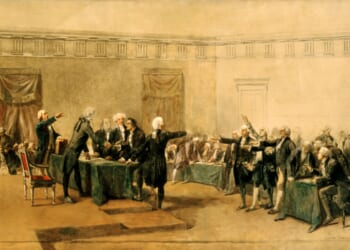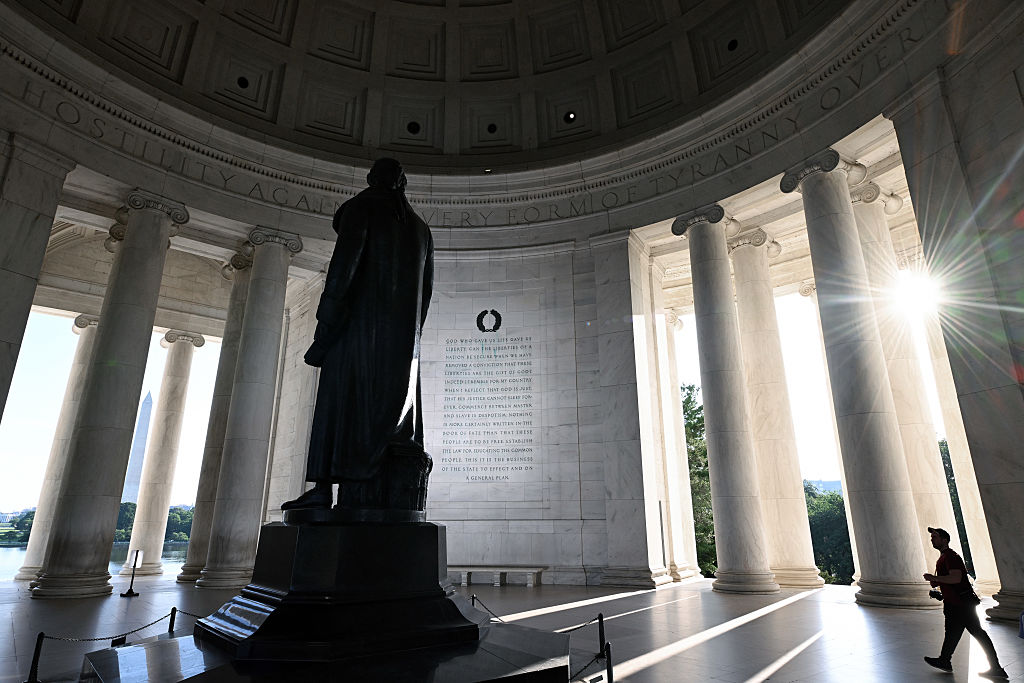
But what was it they so feared? Mob rule, the tyranny of the majority – in a word: democracy. In their own words at various times, the Founding Fathers revealed their disdain of pure democracy.
“It has been observed by an honorable gentleman, that a pure democracy, if it were practicable, would be the most perfect government,” Alexander Hamilton said in a speech to Congress on June 21, 1788. “Experience has proved, that no position in politics is more false than this. The ancient democracies, in which the people themselves deliberated, never possessed one feature of good government. Their very character was tyranny; their figure deformity.”
Thomas Jefferson has often been quoted as saying: “A democracy is nothing more than mob rule, where 51 percent of the people may take away the rights of the other 49.” As it turns out, however, there isn’t any evidence that this quote came from him, and it can only be traced back in written form to the year 2002. But it does sufficiently sum up in modern language his sentiment on the issue.
“The tyranny of the legislature is really the danger most to be feared,” he wrote in his notes on the State of Virginia in 1785, in regard to the new state constitutions. “An elective despotism was not the government we fought for,” he continued. “The republican is the only form of government which is not eternally at open or secret war with the rights of mankind,” he wrote in a 1790 letter to William Hunter.
In an 1814 letter to John Taylor, John Adams wrote, most dramatically:
“Democracy never lasts long. It soon wastes, exhausts, and murders itself. There never was a democracy yet that did not commit suicide.”
“A majority, if they combine, have in some instances proved themselves as tyrannical as a single despot,” wrote Noah Webster in his Letters to a Young Gentleman Commencing His Education, a book published in 1823 which combined educational advice with US history.
And, of course, one should not forget James Madison and the Federalist Papers. “When a majority is Included in a faction, the form of popular government… enables it to sacrifice to its ruling passion or interest both the public good and the rights of other citizens,” he wrote in Federalist No. 10. In the same paper, he surmised: “Hence it is that such democracies have ever been spectacles of turbulence and contention; have ever been found incompatible with personal security and the rights of property; and have in general been as short in their lives as they have been violent in their deaths.”
In Federalist No. 51, Madison warned:
“It is of great importance in a republic not only to guard the society against the oppression of its rulers, but to guard one part of the society against the injustice of the other part.”
In Fact, We Did Not Keep It
All this is why the Founding Fathers crafted a Congress comprised of a House of Representatives elected directly by the people of each district in each state, with the total number of delegates in each state tied to population, and a co-equal Senate in which each state has two senators regardless of population who were elected by joint session of the state’s legislature – itself made up of lawmakers elected directly by the people.
This framework was intended to blend the best features of direct self-rule found in pure democracy while safeguarding against its most dangerous flaws: the ability and tendency of the simple majority to abuse the minority and of the people to vote away their own freedom and equality out of ignorance or greed.

But this framework no longer exists. In 1913, one of the most progressive Congresses in US history changed the Constitution with the 17th Amendment so that the Senate would be chosen by popular election just as the House always had been.
The Founding Fathers always wanted the House to represent the people as directly as possible – for better or worse – and for the Senate to take a slower, calmer, and more level-headed expert approach. And having the state legislatures choose Senators in joint-session votes tied the state and federal governments to each other while maintaining the individual sovereignty of each.
This is the same reason the people don’t directly elect the president even today. We don’t have a presidential popular election in the US; we have 51 separate state (and District of Columbia) elections to choose which presidential candidate each state will support when the Electoral College meets to vote and select the president. It’s just tracked nationally, which likely accounts for much of the common confusion. To be clear, the setup was always intended to be this: Each state as a whole votes on who will be president – what the people vote for is who their states will support. And just as the Republic lost a significant part of its national identity with the 17th Amendment, many today call for the abolition of the Electoral College and the direct popular election of the president.
The Filibuster – A Final Relic of the Republic?
The filibuster, then – both in the 19th century and today – serves as another stumbling block against pure democracy and the tyranny of the majority, especially after the constitutional change in how senators are elected. Lawmakers today may remove it, but in so doing, they erase yet another part of what makes America the Republic it was supposed to be.
The Founding Fathers didn’t invent the filibuster. Indeed, they didn’t even live long enough to see it. But if they had, it seems clear they would have championed it.