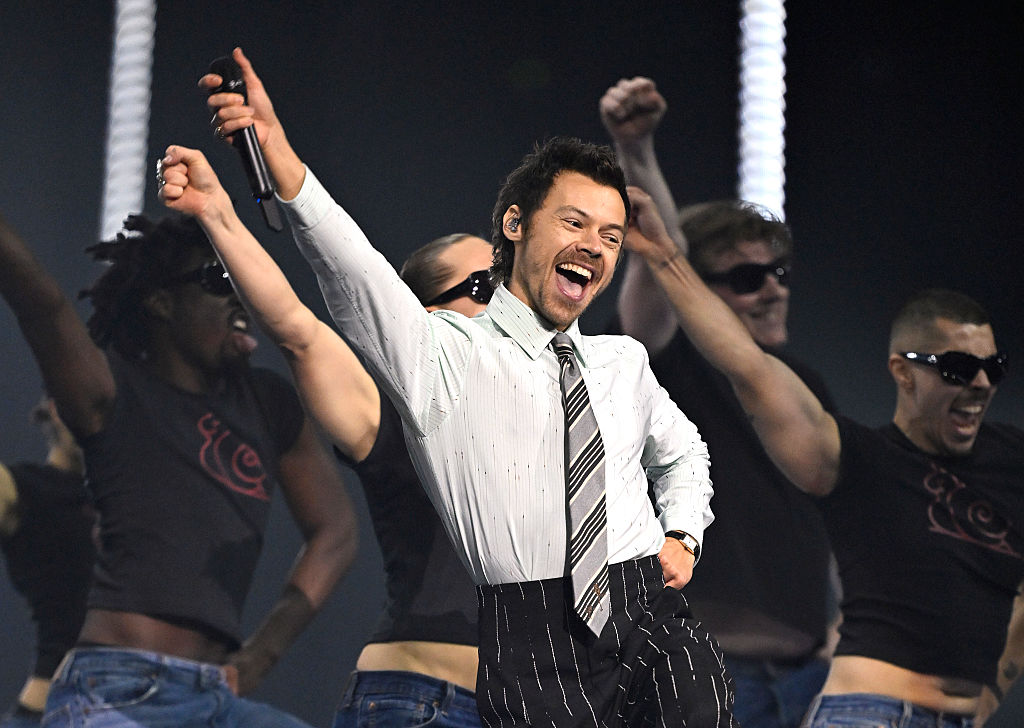
Watching Harry Styles’ performance of “Aperture” at the Brit Awards, there was a moment when I thought: is this the loneliest man in the world? I don’t know if that’s what I was supposed to think. In the interviews for his new album Kiss All the Time. Disco, Occasionally, Styles has talked a lot about how he’s recently been through a process of reconnection: spending time with his family, making new friends, going to clubs in European cities and passing under the radar to party as one of the crowd.
But even sharing the stage with a throng of dancers and a gospel choir, Styles looked isolated. Dancing in sync, but never touching. The video feels lonelier still: in it, Styles is chased through a barren hotel by a hulking, long-haired man before he ends up back in his room, by himself again. Meanwhile, the lyrics suggest love (“We belong together”) but also, and maybe more importantly, painful self-knowledge: “It’s best you know what you don’t/ The aperture lets the light in.”
It makes sense that Styles would use a camera as a metaphor for introspection. Since he auditioned for The X Factor at the age of 16, Styles has been one of the most filmed, photographed and looked at men on the planet. Though he didn’t progress in the competition as a solo artist, judge Simon Cowell spotted his potential and put him together with four other contestants to form One Direction. They came third overall, but once the show was over, they were unstoppable. 1D became the biggest boyband on the planet. The only adult life Styles has ever known has been a public one.
And boyband fame is possibly the most brutal kind. There’s a scene in the 2013 documentary One Direction: This is Us that has stuck with me since I first watched it. The band attempts a shopping trip in Amsterdam, and gets mobbed. The boys are grabbed and clawed at by desperate, shrieking girls. After taking refuge in a Nike store, band member Liam Payne talks to the camera. “One of them had my ear and wouldn’t let go,” he says. “I think she wanted to keep it. I said, you can’t have that, it’s mine.” Payne laughs, but his expression suggests someone who has looked into the abyss.
One Direction broke up in 2016. Payne died in 2024 after falling from his hotel balcony. It was the kind of messy, horrible, drug-fueled death where misadventure is hard to tell from suicide. Shortly before he died, he reportedly told an onlooker: “I used to be in a boy band — that’s why I’m so fucked up.” Not long after Payne’s death, I interviewed a number of ex-boyband members for a feature, and almost all of them described their experience of celebrity as a kind of trauma. “You are a commodity, and not a human,” Ritchie Neville, formerly of Five, told me. “People crack, but I’m surprised more people don’t crack.”
“Boyband fame is maybe the most brutal kind.”
Fame can be intrusive and sadistic for women (I wrote a book, Toxic, about exactly that). Men rarely attain the kind of “car crash” status that is often thrust on a female celebrity, in which watching her decline becomes a kind of spectator sport: think of Amy Winehouse or Britney Spears. But talking to Neville made me wonder whether there was something even more destructive in male fame. Female popstars are sexualized, but they don’t become the focus for mass performances of hysterical lust in the way that boyband members do. To be desired so violently — desired to the point that your fans would rip you apart just to have something of you — must do something terrible to a person. Of course it would fuck you up.
One of the striking things about Styles, in fact, is how not fucked up he’s always seemed to be. He seems to have a protective reluctance to give too much away: characteristically, he has said very little about his feelings on Payne’s death beyond a short statement in the immediate aftermath, though he did address it in an interview with the DJ Zane Lowe for the new album. “Full transparency, it’s something that even the idea of talking about it I struggle with,” he said. “I really struggled with how strange it is to have people own part of your grief in a way.” Fame means that even the most devastating personal experiences can be turned into public property.
It’s something that Styles went through, albeit in a smaller way, back in 2014 when his breakup from Taylor Swift was widely understood to be the inspiration for her album 1989, though some of the references were relatively subtle. Styles gave his own musical account of the Swift break-up on his self-titled debut album, in the song “Two Ghosts”. But that’s an exception in his discography. Styles’s songs are, in general, intimate but impersonal: they very rarely map onto the tabloid version of his life in the way Swift’s songs do. What they often share, though, is a powerful sense of loneliness — a kind of loneliness that chimes, sometimes deliberately and sometimes fortuitously, with his listeners’ lives.
His second album, Fine Line, was released in 2019, but the wistful longing for contact that underpins it felt authored for the lockdown years. “I don’t want to be alone,” he sighs on the opener, “Golden”. When “Watermelon Sugar” was released as a single in 2020, it made perfect sense that the video opened with the message: “This video is dedicated to touching.” It was already a song about skin hunger, which many of us were experiencing that year. The 2022 follow-up, Harry’s House, was directly shaped by those weird years: Styles has said in interviews that “As It Was” in particular was written about the seeming impossibility of returning to normal after the pandemic.
Even in his acting roles, Styles seems drawn towards characters with a deeply melancholy failure to connect. His two leading movie roles (in My Policeman and Don’t Worry Darling) attracted little praise for his dramatic skills, and it’s true that Styles has never yet managed to be truly convincing when delivering dialog, but both films should be recognized as brave, interesting choices which cut against the heartthrob expectations he carried with him: in the former he played a closeted policeman in Fifties Britain, and in the latter he played a red-pilled nightmare who turns out to have kidnapped his wife and forced her consciousness into a simulation of midcentury American white-picket bliss.
But what makes Styles such a great artist of loneliness isn’t just that he understands its pangs. It’s also that he finds something seductive in that idea of being alone. The pain is a good pain — the sharpening, purifying kind. It’s notable that the hobby he has to unwind from being a popstar is long-distance running, which is one of the most solitary things you can do. In a conversation with the author Haruki Murakami (also a runner) for the magazine Runner’s World, Styles describes the joy of running like this: “you can go about your day in the most naked form. It’s just you, alone, moving through the world.”
There’s something else quite telling in that dialogue. Styles tells Murakami: “I think my favorite thing about you is that I know nothing really about you, other than the work you’ve given to people. So I’m as deeply grateful for the amount that you’ve chosen to keep to yourself as for what you’ve chosen to share with us.” It’s a comment that echoes Styles’s own apparent strategy for surviving fame: extreme, meticulous reserve. It’s a method that echoes the careful distance David Bowie kept between himself and his audience, often using characters (Ziggy Stardust, Aladdin Sane) as a screen. Styles’s fashion icon status and arty performances are clearly indebted to Bowie, but this unapologetic self-protection might be the most significant influence that Styles has taken.
One way to describe fame is that it’s the condition of being loved too much — loved more than any one person can bear. For someone like Styles, who has had to survive an entire adulthood of that love, solitude must be the most fascinating thing. For most people, isolation is one of the painful conditions of our age: too much time hunkered down in solitary laptop labor, too many friendships that exist only on screens, too little touch. Styles’s extreme celebrity enforces isolation (when a trip to the shops provokes a riot, all you can do is stay at home) but it also makes being left alone into a luxury. That means that he can find beauty in a condition that, for so many people, is an ugly inevitability. Styles is our perfect pop star, because he has found the romance in loneliness.