As Jews, we’re encouraged to be a light among the nations. But sometimes I think people get the wrong idea. Every so often, we are collectively accused of setting things alight among the nations.
That’s what happened in recent weeks as fires raged in Argentina. A conspiracy theory gained some traction online that held that Israelis were setting wildfires in Patagonia in order to cheapen the value of land and then buy that land. How were they setting the fires? With Israeli grenades.
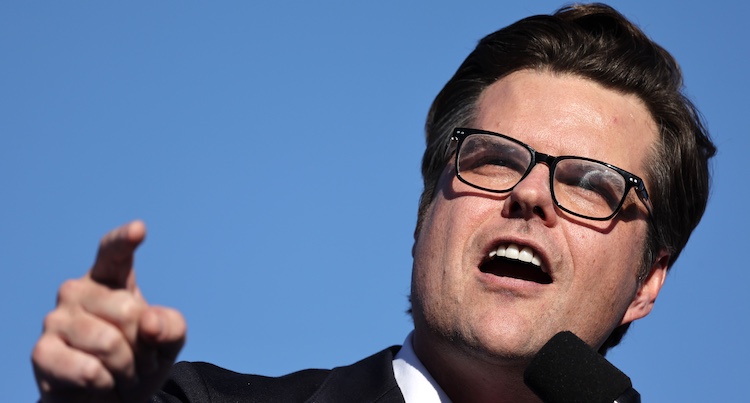
By January 12, all of this had been thoroughly debunked, and an Argentine broadcaster at the center of it apologized. Naturally, the following day, Matt Gaetz—the scandal-soaked weirdo chased from Congress by ethics investigations into another career as a wannabe Candace Owens—did a whole segment repeating the conspiracy theory about Jewish firebugs and Zionist grenades.
The fact that Gaetz chose to run a segment on it after the country where it started denounced and debunked every falsehood is one reason Gaetz is viewed as a clown even among the crowd of maniacs he associates himself with.
Nevertheless, this clown was a congressman and was even nominated to be attorney general by President Trump. Tucker Carlson, currently the dean of the anti-American propaganda fetishists, has been making appearances at the White House. So we have to grapple with the question of how much damage we think the right-wing influencer ecosystem is capable of. After all, it wouldn’t be much consolation to say Matt Gaetz has the intellectual depth of a ceramic ash tray if he were the U.S. attorney general.
One type of damage is indicated by the fact that we’re talking about the firebug conspiracy theory, and that such a canard is worth talking about at all. On that front, history has a warning.
Included in the anti-Semitic slang that has managed to persist through time is the phrase “Jewish lightning.” It’s a relic, and it’s not all that common, but it refers to the reputation that American Jews got thanks to rumors that they were uniquely liable to carry out insurance fires in the 19th century. As a result, insurance companies began to deny Jews insurance coverage. Industry manuals warned of the risk of Jewish firebugs.
As Pamela Nadell writes in her new book on American anti-Semitism (which I reviewed in January’s COMMENTARY), the broad-brush discrimination was based on bunk: “at a meeting in Chicago in April 1867, the lawyer and banker Jonathan Young Scammon, who was then president of the Chicago Fire and Marine Insurance Company, said that of the 276 fires in the city in the past year, only nine had occurred on properties occupied by Jews.”
The historian Britt Tevis came to the same conclusion: “I have found significant evidence that shows that profit-driven insurance companies colluded with local and state officials to frame Jews as a collective for this crime.”
That collusion had a steep cost for Jews, who “frequently found it impossible to overcome the power of this stereotype in court, resulting in tragic outcomes such as imprisonment, bankruptcy, and even suicide.”
This fascinating post on a site dedicated to the history of the Jews of Homestead, Pennsylvania, gives some insight into the phenomenon. In 1911, a fire gutted the town’s synagogue. It was, the author of the post found, one of a string of fires which local officials suspected were set deliberately. The Jews of the area apparently faced suspicion over the fires, and in a strange way the synagogue’s destruction eventually alleviated the suspicion because the shul was insufficiently covered by its insurance plan. Thus, there was no financial incentive for the Jews to burn their own building. It raises the question, however, of whether the synagogue had been denied full insurance coverage because of the “firebug” reputation in the first place. Welcome to the circular world of anti-Semitic conspiracy theories, which hit you coming and going.
Gaetz’s use of the firebug canard is part of the parade of podcaster paranoiacs using new media to spread old lies. (Carlson even went so far as to claim that protecting “usury” and pornography is at the center of prominent Jewish commentators’ concerns.) The white nationalist Nick Fuentes and the aforementioned Owens tend to be even more up-front about their reliance on hoary anti-Jewish myths. What effect is all this having?
Eric Kaufmann, whose fascinating attempt to answer this question is going around the web, says: not too much. The good news is Kaufmann doesn’t see much evidence that audiences are being swayed by Carlson and Fuentes and Owens. Surely Gaetz, less prominent than those Kaufmann studied, would be no more convincing to his audience. Kaufmann even found that Ben Shapiro influences his listeners in a positive direction toward Jews that outstrips the negative influence of Carlson and the others.
Kaufmann finds, as have others, that the real divide has more to do with age than anything else. Another major indicator is, unsurprisingly, listeners’ tendency toward conspiratorial thinking.
One problem with the survey, however, is that it can seek to falsely differentiate respondents’ feelings about Jews from their feelings about Israel. Example: In exploring conspiracism, the study asked whether respondents agreed or disagreed with the statement: “Israel Can Get Away With Anything Because its Supporters Control the Media.”
Here’s what Kaufmann found: “In the general adult population, 46 percent disagreed while 27 percent agreed with the statement. However, moderate and liberal adults under age 35 in the general sample agreed with the statement by 40-36. Among Trump voters under 35, 38 percent disagreed and 35 percent agreed with the statement.”
And just who is one supposed to picture when asked about Israel’s supporters who control the media? Kaufmann frames the question as one about Israel, but the question doesn’t evoke Israelis; it evokes American backers of Israel who control the media—a pretty specific caricature. Kaufmann isn’t too worried because “Those who say Israel’s supporters control the media still rate Jews at roughly 50 out of 100 on a feelings thermometer.”
Yet in a practical sense, how reassuring is this? Are people who say “I have no problem with Jews, just with Israel’s supporters who control the media” saying anything other than “I like Jews except those who conform to negative Jewish stereotypes”? Is Matt Gaetz’s rant about Jewish Israelis (he obviously isn’t talking about Israeli Arabs, since he calls them “settlers”) setting wildfires merely commentary on the Middle East? What about Carlson’s implication that his interlocutors care too much about Israel, usury, and pornography? Is anyone picturing Gaza when they hear that?
Here’s a better question: Should we be any more comfortable with such a person being nominated for attorney general or hanging around the White House?