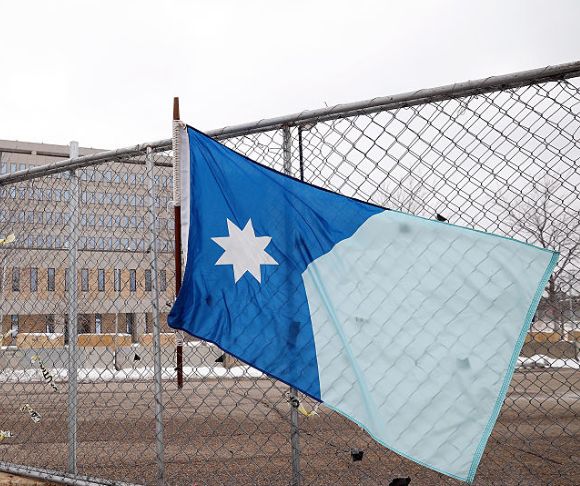
Champlin, Minnesota, has unequivocally decided not to fly the new state flag on any city-owned properties. It seems that a lot of people were allegedly not invited into the process to redo the banner that, with only limited modifications, had waved over the state since 1893. The recent City Council vote could be the last resistance to a state regime change.
It is worth noting that the old seal was designed without legislative approval and later slapped onto a flag simply because one was needed in 1893.
But this new pennant displeases the good people of Champlin because it looks too much like the Somali flag, according to three of the five-member council, and does not reflect any of the great state’s history. Both flags feature fields of blue with a white star.
Flags.com had this to say about the two reasons prompting the redo:
“The first is that since the old flag contained a very intricate state seal, it was difficult to see details at a distance. This made it hard to understand what the flag represented, especially since flags are often viewed from far away.
“The second reason is the imagery of the previous state seal. It depicts a Native American man riding a horse toward the west while a white American man plows a field.”
So How Bad Is the Flag?
Well, first, only grade-schoolers take a lesson on what the flag represents, and wouldn’t it be amazing for the kids to understand their history before it’s erased? But alas, out with the old banner that violated “effective vexillology — the study of flags” and in with the new that must be explained every time someone looks at it. Who better to explain than Aaron Wittnebel, a commissioner on the State Emblems Redesign Commission?
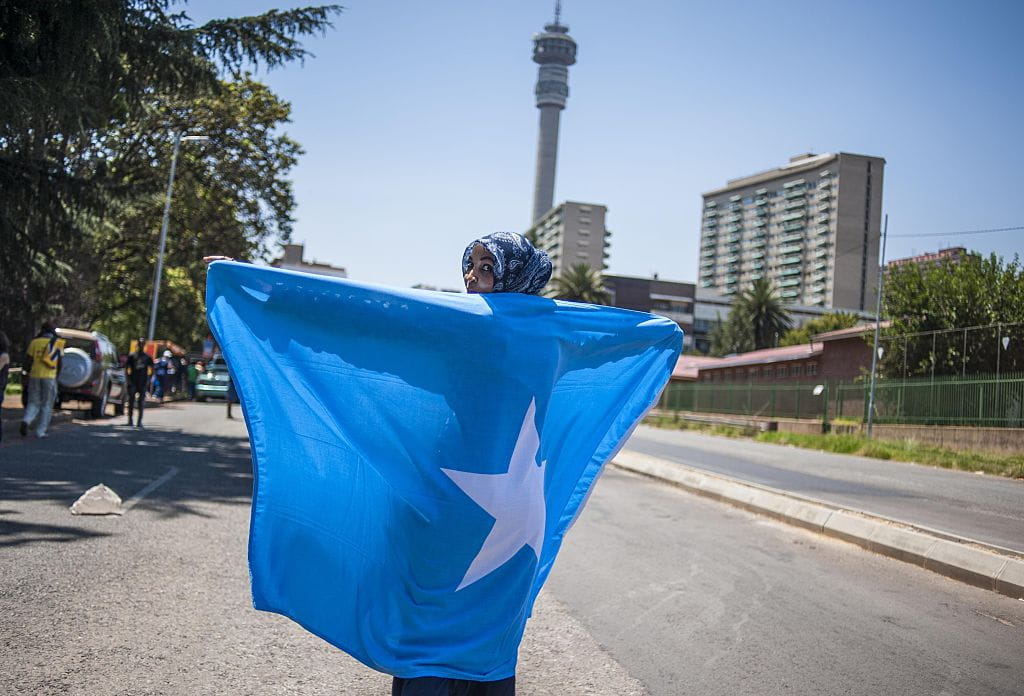
Somalian flag (Photo by Ihsaan Haffeje/Anadolu Agency/Getty Images)
“The white Northern Star points us toward our future while honoring our northern location,” he wrote. Okay, that could be a benefit. “The two blues effortlessly evoke our ‘sky-blue waters,’” making folks want to pop the top on a Pabst Blue Ribbon since elements of the Land-O-Lakes butter packaging were summarily canceled six years ago.
That now-erased farmer plowing a field and a Native American riding a horse headed west are “often taken as a reference to the forced removal and relocation of Native Americans as white settlers expanded westwards across North America.” Or, as he stated in a local Minneapolis op-ed, “a painful symbol of the horrors of ‘Manifest Destiny.’”
Ask yourself where this is headed.
Minnesota Follows Mass
Liberty Nation News’ Joe Schaeffer reported a similar cultural decline in his coverage of the flag change in Massachusetts and related the unease of tradition:
“Whenever an element that plays some small part in America’s cultural heritage is ‘updated,’ the replacement is as dull, insipid, and uninspiring as possible. This applies to religion, entertainment, sports, architecture … just about anything that has ever captured the average American’s imagination.”
Schaeffer fully thrashed the idea and the result of his premise. The Commonwealth kamikazed into a flag remix in September 2025 – obliterating a state seal dating back to 1780. Let’s all dress in gray, eat alike, pray alike, and be as un-American in one of the original colonies as possible. In scarier terms, let’s invite cultural Marxism in for a hearty Heartland dinner after the mess is made on the East Coast.
“What committed cultural Marxists understand and many Americans do not is that the step-by-step destruction of our cultural heritage ends in tyranny,” Schaeffer concluded.
Too Late When the Blood Runs Cold
The new flag, somewhat Somali-Lite, was decided on by a commission that included the Minnesota secretary of state, three appointees from the governor, American Indian representatives, and members from groups such as the Council of Latino Affairs and the Council of African Heritage – a group of 13 people deciding for the 5.84 million residents who might have a different point of view. Citizens (about 30) and the council of Champlin rolled back that flag like a discount at Walmart. It was by far a better citizen-to-flag decision ratio. And it just might be a position other small towns that make up the majority of voters in the swing state might support. Imagine that. The tiny telling the mighty to sit this one out.