It is hard to read any article or book about what ails children today without encountering a discussion of “ACEs,” or “adverse childhood experiences.” Doctors, teachers, therapists, and pundits now regularly talk about ACEs—which include parental divorce, alcoholism, poverty, sexual abuse, emotional abuse, death of a parent, etc.—with what sounds like the same kind of biological certainty as, say, blood pressure or cholesterol levels. We can just add these factors up and then spit out a “score,” which will then tell us the likelihood that you will become a functional adult. If your score is too high, we can take a “trauma-informed” approach to fixing you.
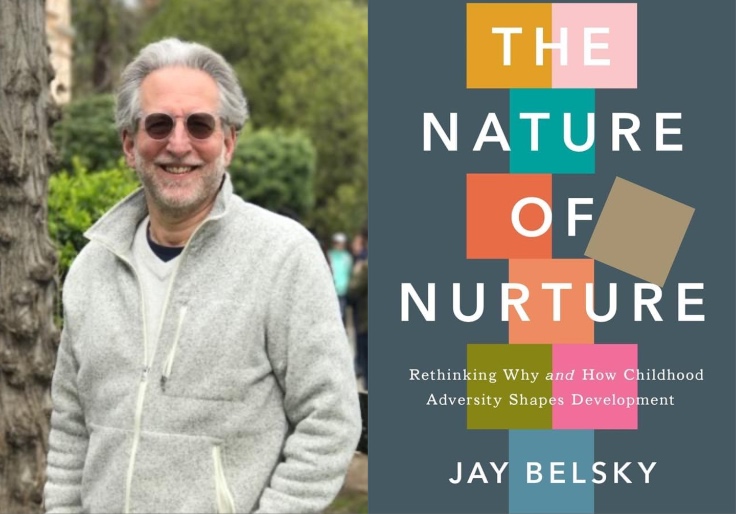
In his new book, The Nature of Nurture, child psychologist and UC Davis professor Jay Belsky acknowledges that these experiences have an impact on adulthood. But he offers a different way of understanding the connection. He wants us to consider the possibility that while the development of these victimized children may be different from what we consider to be good or normal, nothing has gone “awry” in their trajectory from an evolutionary perspective. Evolutionary theory suggests that individuals are driven to behave in certain ways not just to promote their own survival but to ensure the survival of their genes.
One way that young people’s bodies respond to their early adverse experiences—particularly the absence of fathers—is through early sexual development, earlier childbearing, choosing to have multiple partners and more children. These are all behaviors that we judge to be developmentally abnormal. Some of us find them to be morally problematic. But Belsky argues it is useful to see them in a different context—as evolutionarily appropriate.
“Looking at the variations in how people make these tradeoffs, what is perhaps especially notable is that some do and others do not map to the dominant Western, middle-class values of affluent societies.” Belsky explains that “the fast life history ‘choices’ that father-absent girls are disproportionately likely to ‘make’—to initiate sex at a younger age, to engage in unstable pair bonds or intimate relationships, and to provide limited care to many children—are widely presumed to be ‘problematic development.'” But they make sense from an evolutionary perspective. With shorter life expectancy and a future less certain, it makes more sense to start early and have more kids with different men. Indeed, sometimes individuals are even aware of this calculation. Belsky cites a University of Michigan study of poor black teens who were pregnant and found that they were “keenly aware that their future health—and even survival—were at risk, and this understanding seemed to influence their early childbearing.”
It is not only girls who are affected by these circumstances. An Australian study found that “for both sexes greater socioeconomic disadvantage proved to be associated with earlier pubertal development.” And Belsky argues that children who have experienced maltreatment at the hands of a parent might be “inclined to ‘hit first and ask questions later.'”
The body gets signals early in life about whether it exists in adverse circumstances. Belsky relates the question of secure attachment—the process by which a child in the first couple of years of life bonds with his or her primary caregiver. Other researchers have suggested “support and nurturance, as well as lack thereof, influence the child’s ‘internal working model’ of herself (is she lovable?), her caregivers (are they sensitive or caring?), and thus the world more broadly (is it trustworthy and safe?).” The answer to those questions will signal whether pubertal development and childbearing should take place on the fast or the slow track.
All of this is much more complicated, and Belsky is very cautious in how he deploys any of this research. The Nature of Nurture is not an easy read, in part because every statement seems to be qualified with several others, but also because he does not offer many concrete examples.
One of the more difficult discussions in the book concerns “plasticity.” Belsky defines this as “the capacity to modify development in response to lived experiences [which] has emerged across the course of evolution of our species.” While plasticity might seem on the surface a generally positive attribute—who wouldn’t want a child to be adaptable?—Belsky notes that different human beings have different levels of plasticity. Why would that be? What is the evolutionary purpose of different levels of plasticity?
Having a family in which some children are more susceptible to environmental influences and others less so “serves as an inclusive-fitness insurance policy for all family members.” The future, Belsky points out, “is uncertain, so it would be impossible to know whether it will favor more or less developmentally plastic offspring.”
What are the practical implications of all this research? It’s possible, for instance, that less plasticity is better for children in adverse circumstances. Indeed, there is evidence that “those most vulnerable to adversity should also be most likely to benefit from environmental support and enrichment. … And, perhaps even more intriguingly, those most resilient in the face of adversity, so as not to be negatively affected by it, [will] also be less likely to benefit, if at all, from environmental support and enrichment.”
This explains some research that was done on rhesus macaque monkeys “randomly assigned to foster mothers known from prior observation to be highly skilled parents or maltreating ones.” The animals with nervous and fearful temperaments became “basket cases” when they were raised by the maltreating mothers, but they rose to the top of the “dominance hierarchy—with all its mating and thus fitness advantages”—when they were “placed in the care of highly skilled mothers.” For the group of monkeys who already had more laid-back temperaments, the kind of mother who raised them seemed to have little impact.
The implication here for human infants is that the most difficult babies will often get the greatest benefit from highly skilled mothering. This supports the idea that offering intensive instruction, through home-visiting for instance, to mothers who are young or inexperienced in how they can form secure attachments with their children, has tremendous advantages for the most irritable infants.
Belsky suggests that some might take the wrong conclusion from this research. Maybe they will believe “nothing should be done to better the life conditions of children who are less rather than more developmentally plastic because it would be a waste of time, money and effort. … So at the very least it would be more efficient, as well as productive, to focus more on one set of children than the other, presuming we could differentiate them.”
Maybe it is a failure of imagination, but I have no idea who is suggesting that we don’t put any effort into improving the life conditions of less plastic infants. Nevertheless, Belsky interrupts his scientific analysis to rant: “We should, in our extremely affluent society, recognize that every child, no matter whether highly developmentally plastic or not, deserves a decent quality of life, affording them a sense of safety and security. Why? Because they never asked to be here—and we can afford it!”
Sir, this is a Burger King.
Seriously, Belsky seems to be under the impression that we are not spending enough on helping underprivileged mothers nurture underprivileged kids. In fact, money is not the obstacle. Finding highly qualified people to come in and teach maltreating mothers how to parent better is not an easy lift. And getting mothers to accept that help is also hard.
At the conclusion of The Nature of Nurture, Belsky hops back on a soapbox and notes that “it is well past time to reduce the emphasis on seeing children and childhood principally as means to future economic ends.” Again, he repeats that we can “afford” the improvements that are necessary. We can cut childhood poverty by looking to “less affluent—’socialist’—countries which have national policies of child and family support, such as paid parental leave for the care of infants and state-insured child health care.”
It is disappointing to find someone who is so careful about mustering evidence in his own field to be so flippant about it in other contexts. Does paid parental leave improve childhood outcomes? Would it do so in the United States? Does state-sponsored health care produce better health outcomes? He presents no evidence. The assumption behind these strange outbursts is that more money will fix things. He says nothing about problems like substance abuse, mental illness, domestic violence, and social isolation that most often and most severely interfere with stable childhoods. And he says nothing about how government money will fix those problems.
Perhaps this is simply another negative byproduct of academia’s political lopsidedness. If everyone you encounter on campus holds these views, you just assume them to be true. Nevertheless, it’s disappointing to find otherwise serious scholars lose their heads when it comes to public policy.
The Nature of Nurture: Rethinking Why and How Childhood Adversity Shapes Development
by Jay Belsky
Harvard University Press. 220 pp., $35
Naomi Schaefer Riley, a senior fellow at the American Enterprise Institute and the Independent Women’s Forum, is the author of No Way to Treat a Child: How the Foster Care System, Family Courts, and Racial Activists Are Wrecking Young Lives.
The post Naughty by Nature? appeared first on .