Perhaps it takes a monarch to try and wrestle the landscape itself into submission. The 17th-century Moroccan sultan Moulay Ismail dedicated his reign (and the lives of countless slaves) to the construction of a palace complex so vast it became known simply as Dar Kbira, “The Big”. So huge that it remained under construction for all 55 years of Moulay Ismail’s reign, Dar Kbira was initially meant to stretch 300 miles, from Meknes to Marrakesh. But Moulay Ismail died before this was realised, and in the ensuing chaos his vision foundered.
Ismail’s palace lies in ruins now, its once-ornate filigree wrecked by desert winds and a 1755 earthquake. The remains of the sultan’s royal house have been incorporated into a residential neighbourhood. Moroccan life, at the edge of the Sahara Desert, goes on. But the world still contains kings with the vision and resources to imagine defeating the sand and the wind. Today the most ambitious of these is Neom, a series of trillion-dollar “gigaprojects” launched in 2017 by Prince Mohammed bin Salman, the ruler of Saudi Arabia, with the aim of transitioning his country’s economy away from petrodollars toward a more “sustainable” future.
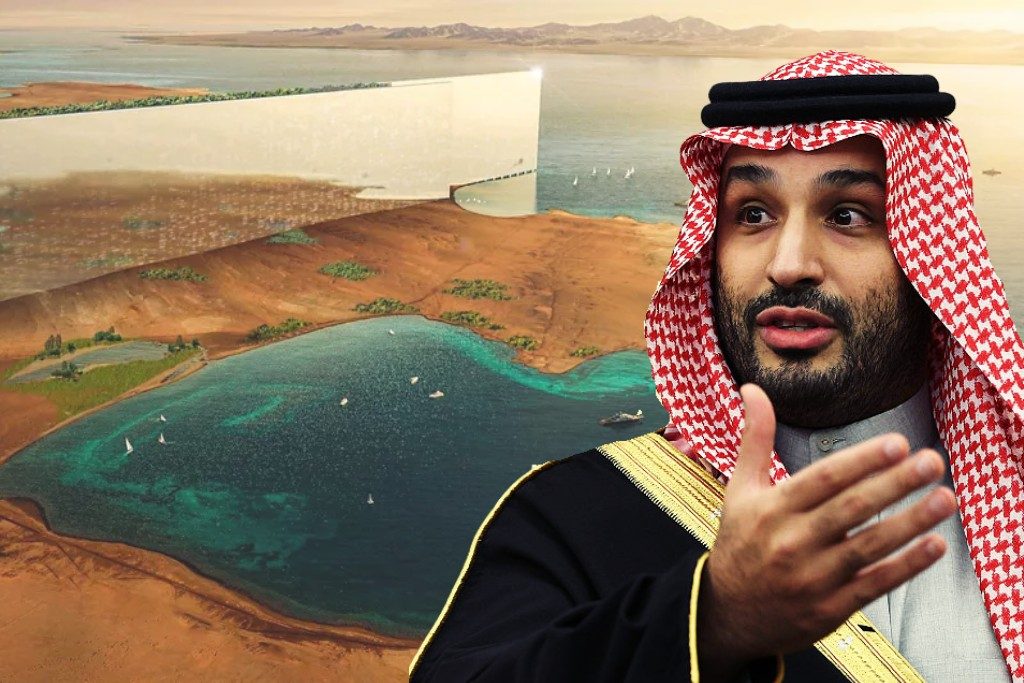
The original vision included a “ski village”, an artificial marina, a floating port city on the Red Sea, and “The Line”, a planned city 500 metres high, 200 metres wide, and stretching over 100 miles from one coast of Saudi Arabia to the other. Only now Neom is in flux, reflecting a wider world in which visions of the future are being hurriedly rewritten.
As initially envisioned, it was ambitious on a scale that dwarfs even Ismail’s vision — especially The Line. What some might politely call “a bold vision” others would simply describe as “bonkers”; this vertical city, with its mirrored exterior walls, was to house millions of people, have its own airport, be self-sufficient in food, and run on renewable energy. The original vision included a “hidden marina” accessed through a gate in the mirrored city wall, in the apex of which a “chandelier” building was to hang in mid-air. On the levels above this arch, there was to be a football stadium.

According to one estimate, building the first 12 sections by 2030 would have meant buying up most of the world’s supply of steel and cement, and bringing in a 40-ft container of materials every eight seconds, 24-hours a day. The early stages of construction involved digging out 100 million cubic metres of soil for the marina, flattening a mountain for an airport runway, and evicting desert tribes (these were dispersed, arrested, and in at least one case killed).
The cost was staggering; trillions have already been spent. You can see the groundworks from space. Only now it looks like it might never be completed. Over the weekend, the management group admitted that Neom will be downscaled and reimagined, reflecting the Saudi monarchy’s shifting priorities.
Is this all just a monument to the hollowness of monarchic ambition? Should we perhaps draw out a homily applicable to the proposed new White House ballroom? The FT reports that some of the pilings are already being covered by sand, and yes, it’s tempting to recall Shelley’s meditation on the fleeting quality of even the grandest ruler:
“My name is Ozymandias, King of Kings;
Look on my Works, ye Mighty, and despair!”
Nothing beside remains. Round the decay
Of that colossal Wreck, boundless and bare
The lone and level sands stretch far away.
But this isn’t just about hubris. Rather, the reworked Neom is testimony, in its abandoned groundworks and re-imagined architecture, to the replacement of one vision for the world’s post-industrial future by another. The updated vision is perhaps better suited to absolute monarchs such as Mohammed bin Salman than what it replaces, but also — for the rest of us — far less utopian.
It’s difficult to find much in the way of visual reporting online, depicting what’s actually there. What you find instead is lavishly visualised CGI renditions of what it will look like: glossy marketing websites, architects’ models, futuristic videos and a ton of “partner content” product-placement material.
Setting aside for a moment how much of this has been realised, or ever will be, in terms of aesthetic and concept, Neom is the Platonic form of an architectural style and overall social order I think of as “Airport Hyperreal”. “Hyperreal”, because the best buildings in this style employ modern construction techniques to play with form, making solid surfaces seem airy and building materials seem less solid than expressions of pure idea. And “Airport” because it’s a style often employed for airports, but also because airports as such are central to the post-industrial, post-national information economy that tends to flourish amid this architectural style.
Britain has a share of this placeless meta-civilisation, but it’s not our strong suit. Peak Britain was the previous age, back when Shelley wrote Ozymandias in 1817. With the 1755 earthquake that wrecked Moulay Ismail’s palace still within living memory, Britain was in her industrial, imperial pomp — an era characterised by frenzied construction of houses, factories, and infrastructure alike. Today, those days are over: it’s now so difficult to get large-scale works agreed in Britain, let alone built, that the 359,866 sheets of consultation paperwork for the proposed Lower Thames Crossing tunnel would, if laid end-to-end, reach almost the whole way from the proposed tunnel site to Calais. As for the “fish disco” at Hinkley Point, and £100m “bat tunnel” of HS2, the less said the better.
What we have, instead of renewed and working infrastructure, is patches of concentrated overgrowth in the Airport Hyperreal style, perched atop the ruins of imperial Britain. Perhaps the most mind-bending version of this is the City of London, some of whose walls date back to Rome but whose lower-rise buildings are mostly Georgian and Victorian — now dwarfed by extravagant, sinuous glass skyscrapers that seem almost to float in mid-air. The same quality of architectural palimpsest has recently become visible in contemporary photos of rapidly developing Manchester as well, where mid-rise, industrial-era brick huddles before brand-new steel and glass monoliths.
Beyond the scale and choice of materials, what separates Airport Hyperreal from its industrial precursor is its attitude to public space. Where industrialists built open-access parks, museums, galleries and libraries, Airport Hyperreal tends to focus resources on exclusive, gate-kept ones. The paradigmatic example is the airport lounge, where higher status travellers can escape the chaos and anomie of the main concourse for a better-resourced and more genteel atmosphere. The same built-in exclusivity can also be seen in the acrylic swimming pool suspended between two skyscrapers at Embassy Gardens in Vauxhall. This is pure Airport Hyperreal, both in gleefully flouting every common-sense stricture of building design, and also in its flamboyant exclusivity: a leisure resource that ordinary passers-by cannot access, made into an eye-catching design feature.
Neom was clearly envisioned for this kind of society. Not, that is, a completely “open” one of un-gated public space, but something at most semi-exclusive. We might call it airport-lounge urbanism: a country-wide programme of building projects, designed for a semi-exclusive, upscale society where manufacturing happens elsewhere, and people divide their time between knowledge work and consumer leisure. A port city; resorts and hotels; a high-density, “sustainable” city with plenty of office space but no factories; a “ski village” comprising real and artificial slopes; a sports stadium half a kilometre into the air; a harbour for cruise ships.
So how should we understand the fact that Neom has been scaled back? The foremost reason, it has been reported, has been unanticipated budget constraints, due to the softening price of oil. In other words: a development whose stated aim was transitioning the world’s foremost petrostate into the post-oil era has ironically been stymied by its reliance on oil profits. But still more significant is the proposed pivot. Instead of creating a sprawling complex centred around a presumed population of millions of knowledge workers, Neom may be re-imagined as “a hub for data centres”, as part of “Prince Mohammed’s aggressive push for the kingdom to become a leading AI player”.
Anyone who makes a living from, within, or predicated on the kind of knowledge work that happens in Airport Hyperreal architecture should see this for what it is: a dread omen. It is, to date, the largest-scale physical expression of a general trend, among the world’s movers and shakers, that we might call the “Greater Reset”.
The “Great Reset”, a programme proposed during Covid by the World Economic Foundation, came swiftly to be decried as a conspiracy theory. But on a more charitable reading, it was intended benevolently: as a means of shifting the post-industrial world toward universal, “sustainable”, tech-optimist utopias. It wasn’t popular with the general public, not least because people accurately intuited how much soft authoritarianism and social engineering would be needed for its realisation.
But however hubristic its vision, and however disingenuously it was designed to exclude the riff-raff, the “Great Reset” vision expressed architecturally in Airport Hyperreal did at least try to imagine utopias for many humans. By contrast, the Neom rethink shows the contours of the Greater Reset: a future where humans are largely obsolete, except to tend vast datacentres, as ever-greater swathes of knowledge work becomes automated. This future is showing signs of having arrived in Britain: our brief overgrowth of Airport Hyperreal architecture is already threatened by the Greater Replacement, with national net job losses of more than 8% over the past year, due to AI. Meanwhile, even private individuals are embracing AI agents such as “Clawdbot” for tasks that a secretary, administrator, or services employee might once have done, such as booking restaurants or even managing finances.
And yet perhaps Britain has less to worry about than some places. Even if the Greater Reset is grim in the short term, London has been there a long time. The still-visible traces of Roman stonework attest to the city’s ability to endure even tremendous upheaval, with or without skyscrapers and spreadsheets. By contrast, the desert monarch Prince Mohammed bin Salman has evidently decided the international laptop class is no longer a sufficiently promising bet to warrant trillions of infrastructure investment.
So now Neom is still about housing, of a kind. It’s still futuristic. But it’s not primarily for humans — at least, not very many of them. We might ask the architects: what will become of the people thus replaced? You might as well ask Moulay Ismail to care about the death of a single slave in the building works at Meknes.
a.appcomments {
background: #FFF;
border: 1px solid #446c76 !important;
font-family: benton-sans,sans-serif;
font-weight: 600;
font-style: normal;
font-size: 12px;
color: #446c76 !important;
padding: 12px 50px;
text-transform: uppercase;
letter-spacing: 1.5px;
text-decoration: none;
width: 100%;
display: block;
text-align: center !important;
}