On Chinese windmills and food prices, Trump is right, Times is wrong
The New York Times employs a “fact-check” reporter, Linda Qiu, who the paper uses to fact-check President Trump but not New York City’s truth-stretching Mayor Zohran Mamdani.
Qiu’s latest article tackles Trump’s big speech at the World Economic Forum in Davos. It manages to mangle both what Trump actually said and what the truth is.
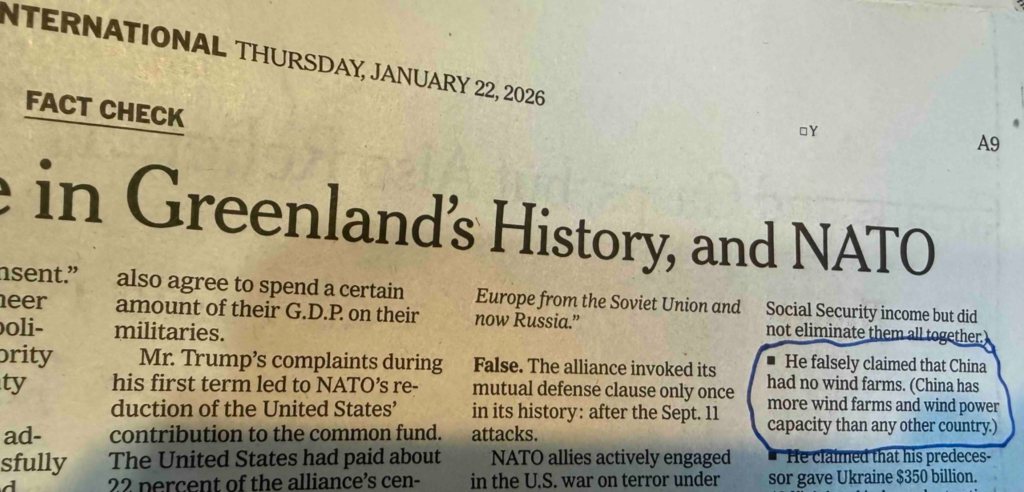
The Times fact-check says Trump “made a host of other inaccurate claims that The New York Times has previously fact-checked,” among them, “He falsely claimed that China had no wind farms. (China has more wind farms and wind power capacity than any other country.)”
Actually, here is the language from Trump’s speech, according to a transcript posted by the World Economic Forum:
China makes almost all of the windmills, and yet, I haven’t been able to find any wind farms in China. Did you ever think of that? That’s a good way of looking at it. They’re smart. China’s very smart. They make them. They sell them for a fortune. They sell them to the stupid people that buy them, but they don’t use them themselves.
They put up a couple of big wind farms. But they don’t use them. They just put them up to show people what they could look like. They don’t spend. They don’t do anything. They use a thing called coal, mostly. China goes with the coal. They go with oil and gas. They’re starting to look at nuclear a little bit, and they’re doing just fine. They make a fortune selling the windmills, though, and I think really, that’s one that they wouldn’t be surprised if it stopped. They were shocked that it continues to go. They were very friendly with me. They’re shocked that people continue to buy those damn things. They killed the birds. They ruined your landscapes. Other than that, I think they’re fabulous, by the way, stupid people buy them.
Contrary to the Times‘ false claim that Trump said China “had no wind farms,” Trump himself acknowledged in the speech that China “put up a couple of big wind farms.” The Times doesn’t share that part of Trump’s speech with its readers, misleading readers by withholding the full truth of what Trump actually said.
As for Trump’s basic point that China gets most of its energy from coal, not wind, even if you rely on China’s own unreliable data, the International Energy Agency lists coal and coal products as 71 percent of China’s energy production, and solar, wind, and other renewables combined at 5.4 percent.
As for the Times‘ claim that China “has more wind farms and wind power capacity than any other country,” that actually supports Trump’s point that “they don’t use them.” “Farms” and “capacity” are different than energy production. What matters is not the number of farms—China is a large-population country, and it operates on a communist central planning system that frequently disregards efficiency and market forces, so it’s not surprising that it would have “more” of anything—but how much energy the farms produce, and at what cost and return on investment.
The Times fact-check about China and wind is not attributed, but comes straight from the talking points of the Chinese foreign ministry, whose spokesman, Guo Jiakun, also responded by talking about installed capacity rather than energy generated and used. It’s the latest in a recent series of false Times reports about how China is surpassing America, which is itself a Chinese propaganda theme.
For its claim that “China has more wind farms and wind power capacity,” the Times hyperlinks its own previous fact-check article, which relies on data from “The World Wind Energy Association, a nonprofit based in Germany.” Yet the World Wind Energy Association used to be run by He Dexin, honorary director of the Chinese Wind Energy Association and a graduate of Northwestern Polytechnical University in China, one of the “seven sons” deeply involved in Chinese military research. The current secretary general of the Chinese Wind Energy Association, Qin Haiyan, is also the vice president of the World Wind Energy Association. The “World Wind Energy Association” isn’t exactly an independent or nonpartisan source.
Even China is tapping the brakes on wind development. The “Global Wind Report 2025” of the Global Wind Energy Council—a report whose regional lead sponsor is Sungrow, a Chinese company—acknowledges in its China section that “developers will be more cautious about future investments due to growing uncertainty about rates of return.” In 2023, China’s National Energy Administration issued a notice about decommissioning wind farms: “the wind farms that have reached the end of the designed service life for grid-connected operations shall be decommissioned.” It says that “Power grid enterprises shall be responsible for … the demolishment of the supporting transmission projects for decommissioned wind farms, and ecological restoration.”
I drive by some of these big wind turbines on the way over the Bourne Bridge to Cape Cod, and some percentage of the time they are standing still because the wind isn’t blowing. One of the ones off Martha’s Vineyard that was finally installed after intense political opposition sheared off and left fiberglass shards all over the beach in Nantucket.
The Times fact-check of Trump is similarly unreliable when it comes to food prices. The fact-check says, “He falsely claimed that grocery prices were ‘coming down.’ (Prices are still increasing.)” Yet this week the Commerce Department’s Bureau of Economic Analysis released the personal consumption expenditure (PCE) price indexes for October and November 2025—delayed because of the government shutdown. They showed food inflation at 0.0 percent in October and 0.0 percent in November. In terms of percent change from a year ago, the PCE inflation number—which is the one the Federal Reserve most closely watches—for food declined to 2.2 percent in October and 1.9 percent in November from 2.4 percent in September. Truflation, a private, real-time data provider, reports food and overall inflation declining even more in January 2026.
Trump is out publicly talking about the possibility of 5.5 percent GDP growth or even 10, 12, or 15 percent growth with 1.2 percent inflation. Maybe the Times fact-checker could take a pause from falsely fact-checking Trump and devote a moment or two to retrospectively fact-checking the July 8, 2024, New York Times opinion piece from Robert Rubin and Kenneth Chenault about “The Enormous Risks a Second Trump Term Poses to Our Economy.” The S&P 500 has gone up more than 23 percent since then. Trump at Davos predicted that the “stock market is going to double, in a relatively short period of time.” The Times fact-check didn’t take on that statement. Maybe the fact-checker was just exhausted from chasing Chinese windmills. Or maybe, given how trigger-happy the paper is in general when it comes to calling the president a purveyor of inaccurate claims, it’s a sign that on some big-picture issues, Trump is looking more credible these days than those who were predicting his second term would be a disaster.