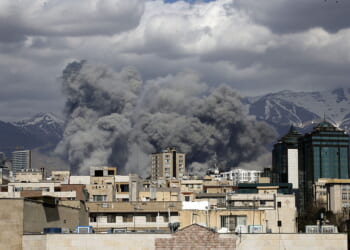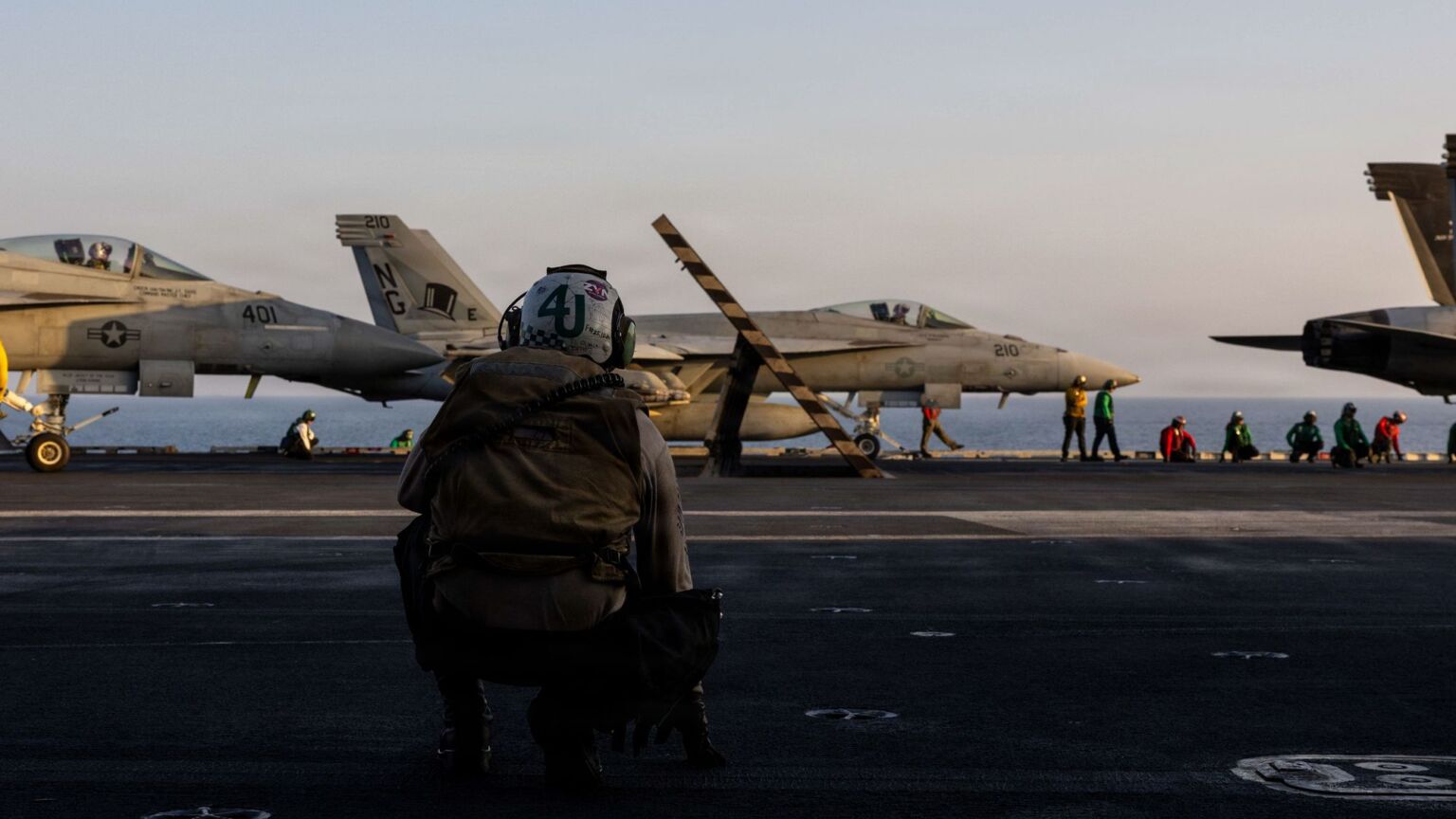
Since the US-Israel war with Iran began, experienced commentators have been trying to make sense of it. One of the chief explanations given is that this is actually the latest stage in the US’s rivalry with China.
Zineb Riboua, a Hudson Institute research fellow, says that Operation Epic Fury is ‘all about China’. ‘Trump’s strikes are the first move by an American president who appears to understand that the road to the Pacific runs through Tehran’, she argues. Similarly, Haviv Rettig Gur, an often-insightful analyst for the Times of Israel, explains that ‘America is in this fight because of China’. He claims that this is part of a great power game to stop Iran being a Middle East outpost for Chinese expansion. Author and academic Doug Stokes makes the same point in the Spectator: ‘The US has used overwhelming force to dismantle what had quietly become the most significant Chinese forward position outside East Asia.’
Substantiating this view, Miles Yu, a former China policy adviser in Donald Trump’s first administration, explains in the Washington Post: ‘For more than a decade, Beijing has worked quietly and methodically to turn Iran into the keystone of its Middle East strategy… Tehran was not just another partner for Beijing, it was also central to China’s grand strategy. And the Chinese Communist Party’s investment in Iran has been monumental.’
These attempts to try to make sense of the war in Iran, and an increasingly unsettled period in geopolitics more broadly, are understandable. As the old US-led post-1945 world order continues to disintegrate, grasping the complexities of today’s deeply uncertain international interregnum isn’t easy. But claiming that the Iran War is really about China is overly simplistic and misleading.
There isn’t always a neat story behind a messy reality. Sometimes, the significance of what is happening lies precisely in its arbitrariness, in the absence of a strategic plan. Trying to make ‘sense’ of the arbitrariness can obscure what is actually happening on the ground and in international relations.
Simply put, the case that Iran is a ‘forward base’ for China is flimsy. It rests on three claims, relating to Iran’s economic ties with China, its strategic location and its military relationship.
It is true that China has extensive economic and trading ties with Iran. In 2021, the two nations signed a 25-year-long, $400 billion strategic and economic partnership deal. But at this stage, the deal is not quite what it was cracked up to be. According to an authoritative tracker of China’s global investments, Beijing has yet to follow through with any major investment projects since the deal was signed five years ago. Indeed, over the past two decades or so, China has actually invested just $25 billion in Iran, about one per cent of its total spending on foreign investment and construction.
Little wonder that Iran doesn’t even rank in the top 10 investment locations for China within the MENA region, comprising West Asia, the Arab Middle East and North Africa. Iran lies well behind Saudi Arabia and Pakistan, and also behind the United Arab Emirates, Iraq and Egypt. Are these all also ‘forward bases’ for China? By that economic logic, Britain too must be an especially close Chinese proxy. A far smaller country than Iran by area and population, Britain holds four times more Chinese economic interests than Iran does.
This alliance is also said to rest on Iran’s dependence on China as a market for about 90 per cent of its US-sanctioned oil. It is no secret that China is a fossil-fuel dependent country and that it gets to buy sanctioned oil at a discount. According to recent figures from the US Energy Information Administration, three US-sanctioned countries accounted for one-third of China’s crude import mix: Russia, 20 per cent; Iran, about 11 per cent; and Venezuela, two per cent.
China has been able to strike huge deals with the likes of Iran, because these suppliers are desperate for markets, not because of any ideological, cultural or strategic affinities. China’s bilateral relationships are primarily transactional. As Professor Kerry Brown, the director of the China Lau Institute at King’s College London, explains, Iran’s desperate need to sell its sanctioned oil is a ‘really fragile basis for a relationship’.
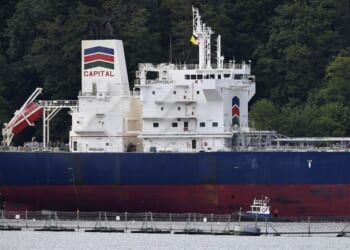
What’s more, the near closure of the Strait of Hormuz by Iran poses a risk to China’s energy security. Despite Iran selectively granting permission for a few tankers to take oil to China (as well as to Pakistan, India and Turkey), this hardly tallies with a supposed client-state looking after its dominant protector. In fact, China has been more far-sighted than America and European countries, and has hedged its reliance on Iranian and Middle Eastern oil. China has developed better alternative sources of energy than most other oil-dependent countries in the world, including switching further to imports from Russia – with the White House’s permission.
So what of Iran’s geographic, strategic location? It’s said that Iran complements China’s Belt and Road initiative, and it’s true that the main Silk Road ‘Belt’ railroad does go through Iran. But it also goes through lots of other central Asian and European countries en route to Rotterdam.
China’s main maritime Silk Road (confusingly, this so-called road is actually a shipping route) already connects China with south-east Asia, south Asia, east Africa, and through the Red Sea and Suez Canal into the Mediterranean. It doesn’t touch Iran.
Some suggest Iran offers China a potential energy and trade corridor that could bypass other maritime choke points. But if China did want to use the Persian Gulf as an alternative trade route to the Red Sea and Suez Canal, it would be subject not just to Iranian disruption, but to potential control by Oman and the other Gulf states on the opposite coast. The geography would also mean China dealing with the inconvenience that there is no sea exit at the northern end of the Gulf.
Then there’s the claim that Iran’s role in fuelling regional instability, largely through its militant proxies, serves a strategic purpose for China by keeping the US busy. In this war, for instance, Washington has moved lots of military assets from the Asian east to the Middle East, much to Taiwan’s concern.
But whatever plans China has for its near East Asian sphere, Iran has been a huge regional threat to Israel and other US allies for nearly half-a-century, since long before China got involved with it. Whether the US devotes its resources to the Middle East or to the Far East is its own political choice, not China’s. Recall that Trump’s National Security Strategy at the end of 2025 declared that ‘the days in which the Middle East dominated American foreign policy in both long-term planning and day-to-day execution are thankfully over’. It was Washington, not Beijing, that u-turned on its own strategy.
Finally, we come to the claim that China is militarily tied to Iran. China has certainly sold materiel to Iran, as it has done to scores of other nations. But it doesn’t seem to have gone beyond that.
It has been claimed, for instance, that China has armed Iran with advanced anti-ship missiles that can travel at three times the speed of sound, penetrate American naval missile-defence systems, and bring down massive American warships, including aircraft carriers. If this were true, it would be a sign that China sees Iran as an important strategic outpost.
Yet it’s now emerging that an Iran-China deal on these advanced cruise weapons is only ‘close’ to completion, not done. Reuters reports that these negotiations have actually been dragging on for two years. This sounds like a tricky and sensitive arms deal between China and Iran, rather than evidence that Beijing has spent many years and billions of dollars building Iran into a structural asset.
China, Russia and Iran have, since 2019, been undertaking joint naval exercises – proof, some say, of a new ‘axis of upheaval’. One of these annual exercises took place within a fortnight of the beginning of the US-Israeli air assault. Yet what is telling is that since the start of the war, China has been nowhere. Russian and Chinese warships fled the Gulf to avoid entanglement in the war.
But the absence of support for Iran from Beijing hasn’t shaken the resolve of those convinced this war is all about China. On the contrary, they now claim that the war has merely ‘exposed the fragility of the anti-US bloc’. They are arguing, in effect, that the absence of some China-Iran military alliance is still proof of its existence. Nothing, it seems, can disabuse them of their theory. Even when Trump requested Chinese naval support to help the US open up the Strait of Hormuz, they stuck to their US-vs-China narrative – which is akin to believing that Winston Churchill would ask Adolf Hitler for help in keeping the Channel open for trade.
The core problem with these misleading explanations for the US-Iran War is that they lead to distorted and, potentially, counter-productive suggestions for how to act. Treating Iran as little more than a part of Xi Jinping’s plan for world domination ignores the fact that the Islamic Republic is a real and existing threat on its own terms. It is run by an Islamist death cult that deploys an iron fist at home, while inspiring and organising terror abroad.
That’s the Iran we need to reckon with politically. Not Iran as an imagined foreign outpost for China, or a base for alleged Chinese expansionism. But the Islamic Republic of Iran, a brutal theocracy that is intrinsically anti-Semitic, anti-Israeli and anti-Western. The brutal repression of the Iranian people is not directed by Beijing but by the reactionary mullahs and the Islamic Revolutionary Guard Corps.
The Islamic Republic’s so-called axis of resistance is real. This brutal Islamist regime has backed equally brutal Islamist groups in Gaza, Lebanon, the West Bank, Iraq, Syria and Yemen in a multi-front war against Israel. It operates further afield too, as we know from the recent reports of Islamic Republic terrorists operating inside Britain. In contrast, the idea of an ‘axis of upheaval’ led by China is just a convenient creation of Western commentators seeking a simple explanation for a far more complex, disorderly geopolitical reality. Focussing on this grouping of autocracies diverts from the genuine, specific and immediate threat from the Islamic Republic itself, acting both domestically and internationally.
Imposing fictional accounts of Chinese expansionism on to the turmoil of world politics is helping no one. They distract from the bigger domestic and geopolitical problems facing Western countries, from their own military and moral disarmament to the threat of Islamism, Russia’s westwards expansionism, and Washington’s destabilising efforts to hold out as the sole global power.
Supporters of freedom and democracy need to bin their China-tinted spectacles. We need to focus instead on the real and present menaces to international stability and national security.
Phil Mullan is the author of Beyond Confrontation: Globalists, Nationalists and Their Discontents.