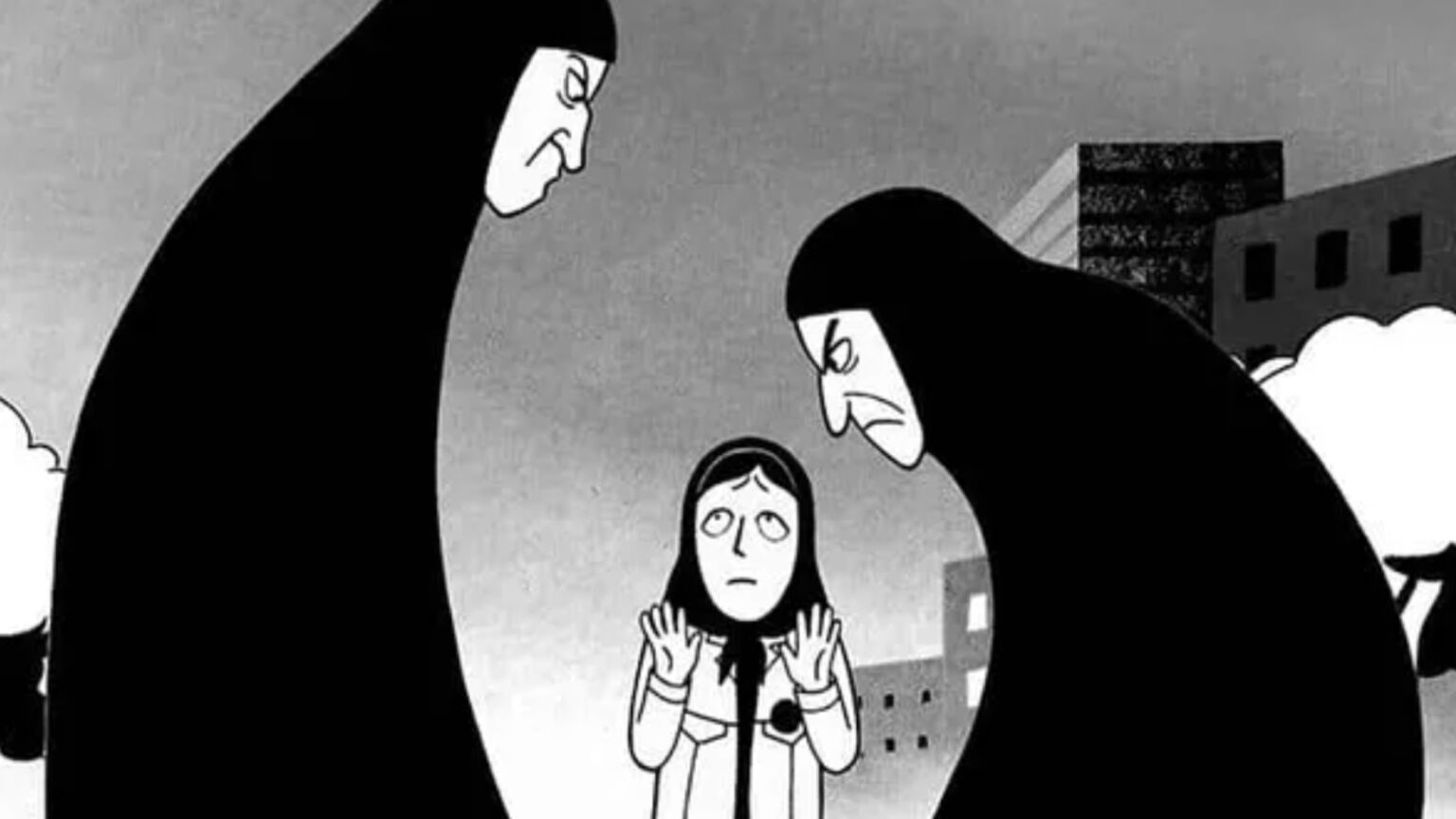
In 2000, the first instalment of the French-language comic book Persepolis was released. The book, which received great acclaim from critics, was the work of Marjane Satrapi – a French-Iranian whose childhood in post-revolutionary Iran had directly informed the book’s storyline.
As you might imagine, girlhood under the Islamic Republic was no picnic. Persepolis recounts a series of painful memories from Satrapi’s past, from spotting the severed limb of a friend in the rubble after a bombing raid to the imprisonment and execution of her beloved uncle, Anouche. While trying to have a ‘normal’ teenage experience, Satrapi’s rebellious, punk-loving main character, Marji, is unable to escape the day-to-day realities of living under an oppressive theocracy. She risks trouble with the police for wearing make-up. Being caught holding hands with a boy results in a hefty fine for her family. Undoubtedly, Persepolis paints a bleak picture of life for women in Iran.
Later in life, Satrapi moved to France. Here, she had the freedom to tell her story to millions. The film version of Persepolis, directed by Satrapi and released in 2007, won the Jury Prize at Cannes. Alas, some 26 years after its release, it seems the very theocrats and bigots Satrapi escaped as a young woman are rearing their ugly heads in the supposedly ‘liberal’ West.
Earlier this month, French TV channel France 4 announced its plans to broadcast the film version of Persepolis on X, citing its relevance to current events in the Middle East. The decision was immediately met with outrage online, and I’m sure you can guess who from: that now familiar mixture of woke progressives and Islamic hardliners. ‘Go fuck yourselves, you filthy Islamophobes and genocidal Zionists’, responded one account to the announcement on X. ‘Is it the veiled Iranian women who killed 160 children in a school last Saturday?’, asked another, referencing both the recent bombing of a primary school in Minab, and a scene in Persepolis when Marji is picked on by a pair of older, veiled, pro-regime women. ‘It’s a shame that… you didn’t think to broadcast a film about the ordeal of the Palestinians’, lamented a third. Several commenters accused the film of being pro-US ‘propaganda’.
Perhaps this reaction was to be expected. So devoted are the West’s useful idiots to woman-hating Islamism that any opposition to it – even from those who have direct experience of it – is unconscionable. Back in 2008, Iranian president Mahmoud Ahmadinejad labelled the film ‘Islamophobic’ and ‘anti-Iranian’, and put pressure on allies to ban the film’s screening. Today, the tote-bag-wearing, Islamo-gauchistes of France calling for this ‘propaganda’ to be taken off air have done the late Ahmadinejad proud.
Satrapi made Persepolis to let young Iranians know that they weren’t unseen in their plight – ‘If they kill you and the whole world doesn’t care, how is that?’, she said. She also wanted to ‘explain things for the non-Iranian audience’. But this only works if said audience is willing to hear others’ experiences. This latest wave of vitriol towards her work suggests many would rather stay swaddled in their own comfortable worldview than face the painful contradictions of their beliefs. As always, the feeling of being on the ‘right side’ of history is far more important than engaging with historical fact.
‘It is dangerous when you start calling people from one part of the world terrorists or fanatics’, Satrapi once warned:
‘You reduce them to some abstract notion… If evil has a geographical place, and if the evil has a name, that is the beginning of fascism. Real life is not this way. You have fanatics and narrow-minded people everywhere.’
Those living in France, enjoying comfortable, free lives, while raging against critics of Islamist repression, prove her point as well as Persepolis ever could.
Georgina Mumford is a content producer at spiked.