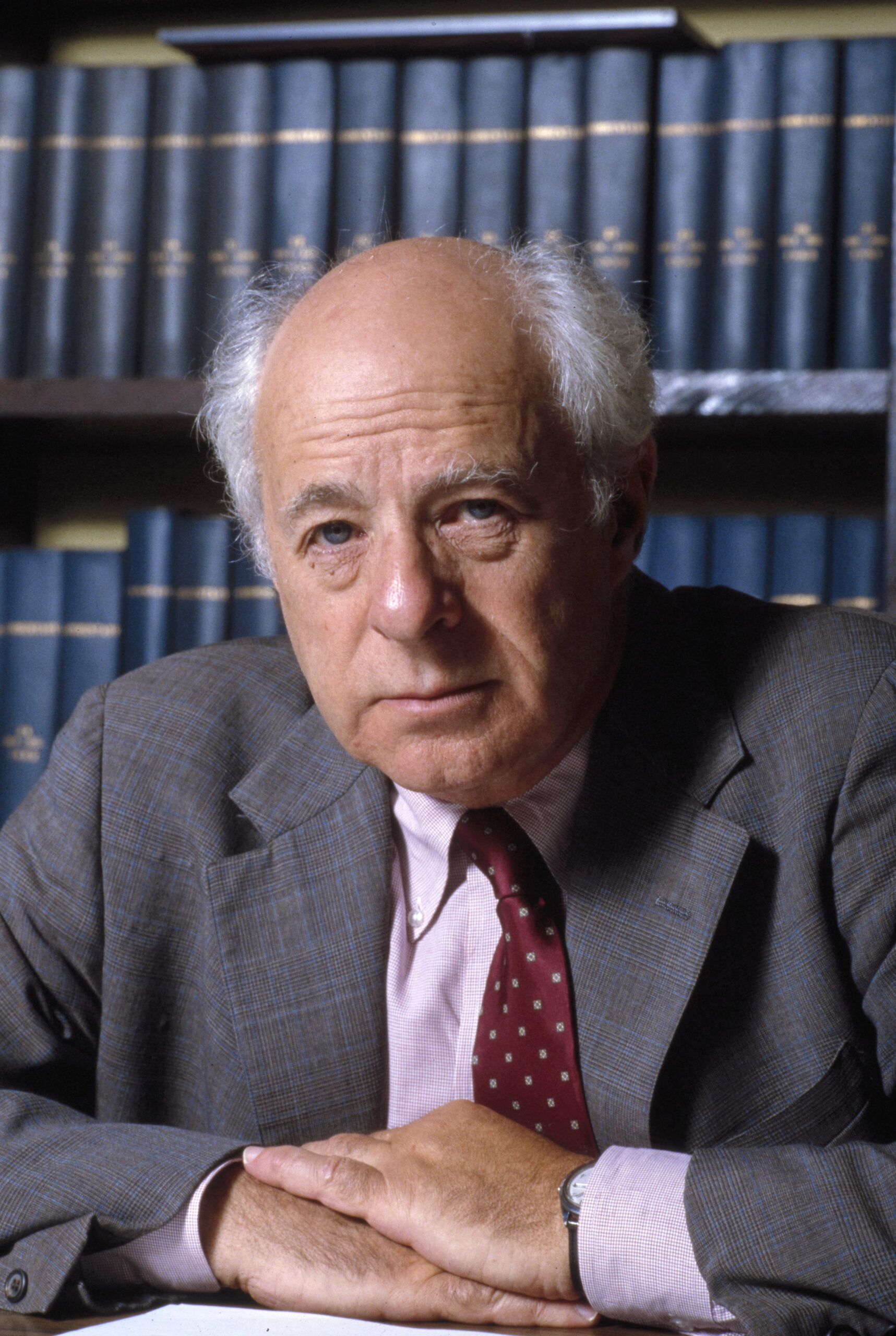
Not many men truly change the course of history. Those who do usually do it through their actions, like General U.S. Grant’s brilliant military campaigns in the Civil War. Fewer still do it with a combination of words and actions, like Abraham Lincoln. Perhaps rarest of all are men like Norman Podhoretz, who change history with mere words.
And what words they were. Norman was not only the long-time legendary editor and soul of COMMENTARY, but also a prolific author of a dozen books, hundreds of essays, articles, and columns, and no telling how many speeches. He could turn out 10,000 words of elegant, sparkling, cogent prose seemingly at a moment’s notice while identifying for his readers the deeper meaning of the day’s news.
Norman was also an original neoconservative, and proud to be so. These days, some historically illiterate podcasters and so-called influencers use the term “neocon” as an all-purpose slur for anything they don’t like. But the neocons were just that—new conservatives—a collection of anti-communist liberals between World War II and the Vietnam War who were, as the saying goes, mugged by reality, in this case the reality of the New Left’s turn against America.
Norman followed this path and blazed it for others. Born in 1930 to working-class Jewish immigrants in Brooklyn, Norman later said that the first Republican he met was in high school. Blessed with natural abilities and good teachers, Norman earned a scholarship to Columbia, while at his father’s insistence, he also studied concurrently at the Jewish Theological Seminary and earned a degree in Hebrew Literature. After more studies at Cambridge and two years in the Army, he returned to New York and wrote for magazines such as the New Yorker and Partisan Review and ran in the liberal intellectual social circles of the times with the likes of Norman Mailer and Allen Ginsberg.
He also wrote for and worked at COMMENTARY, a journal of Jewish thought, which at the time, fit well into those circles. He became editor-in-chief in 1960, on the eve of the disorder, chaos, and anti-Americanism that would be unleashed by the New Left that decade. “They considered this country to be evil,” Norman said of the New Left in 1995. “We neoconservatives were not only outraged by this attitude and thought it intellectually wrong in almost every detail, but also thought it was morally outrageous, contemptible, and dangerous.”
Soon enough, Norman and COMMENTARY defined the neoconservative movement, especially on foreign policy. They published famous, path-setting essays such as Jeane Kirkpatrick’s “Dictatorships and Double Standards” and “The United States in Opposition” by Pat Moynihan. No less a titan than Ronald Reagan called Norman a “must-read” for conservatives of all stripes.
Norman, Kirkpatrick, and other neocons both followed and led Reagan into the presidency, helping to shape a strong and confident foreign policy of defending American interests and free peoples against the menace of Soviet Russia and anti-American insurgencies around the world. Norman maintained a friendly dialogue with Reagan over the years and received a richly deserved Presidential Medal of Freedom from President George W. Bush.
Norman turned over the reins at Commentary in 1995, but he never put down the pen. I’m thankful he didn’t, because that was also the year I discovered the magazine and became a 30-year subscriber. Norman and COMMENTARY were there to chronicle the threat from militant Islam, Communist China, and growing antisemitism and radicalism at home.
Thanks to great thinkers like Norman, I cannot claim to be a “neoconservative.” I was, if I could borrow a phrase, “right from the beginning.” Generations of young readers learned the easy way from Norman what he had learned the hard way, never flirting with liberalism in our youth.
As, in his own words, “a filthy little slum child” of Jewish immigrants from Eastern Europe, Norman was eternally grateful to America for welcoming his family and providing him with unlimited opportunity. Norman said that he had “a love affair with America.” A love affair with America—I think that’s a very apt way to put it, and something we should all try to emulate and instill in our kids and grandkids.
Norman’s love affair with America, I suspect, was behind his dogged support for Donald Trump, when so many of his old friends abandoned our party in 2016. But Norman saw President Trump’s election as “a kind of miracle.” He believed that President Trump could, in his words, “save us from the evil on the Left.”
Despite all their differences, with their shared love of America, their hatred of communism, their shared New York roots—indeed, their shared Brooklyn-to-Manhattan journey—Norman and the president may not be quite the strange bedfellows that they first appeared to be. I’m confident that Norman was pleased with the president’s muscular defense of the American way of life upon his return to office. And I’m especially pleased that Norman lived to watch America join with Israel to devastate Iran’s nuclear program on President Trump’s watch.
One of the great benefits of my work as a senator is the opportunity to cross paths with great men like Norman Podhoretz. After learning from his writing for so many years, I’ve had the occasion to meet him and share a modest correspondence. I can share that Norman may have receded from public writing in recent years, but he remained as witty, brilliant, and courageous as ever in his private correspondence.
Yet, as we all sometimes do when we reflect on our lives, Norman too acknowledged that he at times wondered “what it all amounted to” and sometimes feared the answer was, “not much.” But nothing could be further from the truth, I assured him. For nearly seventy years, Norman informed, educated, persuaded, and succeeded with his words. He taught multiple generations not just to love our country, but also why we should love it and how to defend it. His words reached into the United States Congress, into the Oval Office, and into the councils of nations.
Without Norman and the little magazine he led, the course of history—the Reagan Revolution and the Cold War in particular—might indeed have been very different. I therefore join Norman’s family not only in mourning the loss of this great man, but also in celebrating the highly consequential life of a true American patriot.
Remarks delivered on the floor of the United States Senate, December 17, 2025