Pier Paolo Pasolini didn’t live to see his scandalous final film, Salò, premiere at the 1975 Paris Film Festival. Three weeks before the film’s release, the mangled body of the Italian director was discovered in Ostia, on the outskirts of Rome; he’d been beaten to a pulp, then run over with a car. The murder case was never solved, but competing conspiracy theories swirled: the neofascists, the Marxists, the Sicilian mafia, the Italian secret service, all were blamed in turn for his death. The great provocateur had made many enemies.
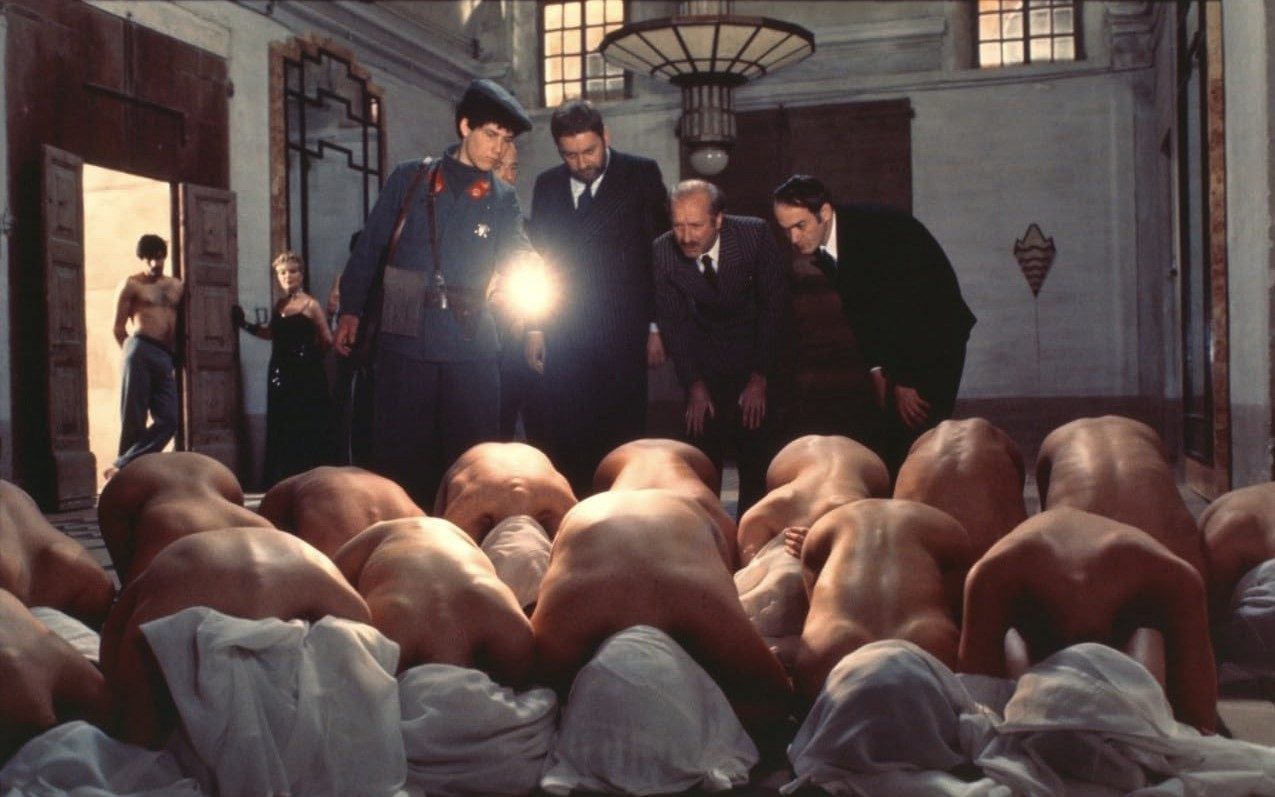
He would make more from the grave. Salò, an adaptation of the Marquis de Sade’s The 120 Days of Sodom, was as vile as it was accomplished, and set off a moral panic. Set in Italy towards the end of the Second World War, in the hastily established German puppet state known as the Republic of Salò, it tells the story of four depraved fascists who kidnap, torture and rape a group of beautiful young men and women in their palace. Over the course of the film, they come up with increasingly sadistic fantasies to sustain their arousal. In one scene, the prisoners are forced to eat human faeces; in another, dog food stuffed with needles.
People fled the early screenings. Vincent Canby, the chief film critic of the New York Times, described the film at the time as “so repugnant” it “dehumanises the human spirit”. It was banned in Italy in January 1976 following accusations of indecency; just over a year later, it was timidly shown in Rome, but even then certain scenes were omitted.
Fifty years after its ban, the film is worth rewatching (on an empty stomach). For it turns out Pasolini not only understood the cruelty of 20th-century totalitarianism, but foresaw the darkness of our own age.
First and foremost, Salò depicts the moral obscenity of fascism, which Pasolini knew well. He was born in Bologna in 1922 — the year Mussolini came to power — and his first poetry collection, Poesie a Casarsa, came out in 1942, the year before Mussolini’s regime collapsed. His early poems were explicitly anti-fascist, as he insisted on writing them in the rough Friulian dialect of his mother’s native northeast rather than in Italian, and Pasolini actively participated in the Resistance. In the mid-Forties, he joined the Italian Communist Party, but soon after was expelled after being accused of corrupting four boys at a dance in Friuli (the charges were later dropped). He fled to Rome, which would become his greatest inspiration, but more or less remained a Leftist his whole life.
More subtly, Salò is also a critique of post-war Italian consumerism. “Everything is good when it’s excessive,” says a fascist autocrat in the film’s opening line. To Pasolini, this perverse greed didn’t vanish after the war, it merely took on a different guise. Long after the execution of Il Duce, he continued to see fascism everywhere in the neocapitalist Italy of the Sixties and Seventies, still in the afterglow of the postwar economic miracle that saw annual GDP growth peak at 8%. Yet if Italians revelled in their famous Fiat 500s, alongside an avalanche of other consumer goods, the director remained uneasy. “I think that consumerism manipulates and violates bodies neither more nor less than Nazism,” Pasolini said in the second-to-last interview he gave before he was murdered. “My film shows the sinister connection between consumerism and Nazism.” It hardly helped, of course, that actual fascists were roaming the streets of Italy at the time, spreading death and destruction as they went.
All the while, the director warned that consumerism would not lead to the liberation of man; instead, it would lead to the “reduction of the human body to a commodity” and “cancellation of another person’s personality”. He hated the idea of things being “mass consumed”, of bodies and personalities and art being interchangeable — all this he perceived as a threat to humanity’s spiritual integrity.
This, he argued, would ultimately lead to the destruction of civilisation, since as people become increasingly obsessed with gratifying their desires, they become vulnerable to manipulation. Salò is therefore as much a dystopian satire, in the mould of A Clockwork Orange, as it is a historical depiction of late-fascist Italy. “It’s the first time I’m making a film about the modern world,” Pasolini said of his creation.
Pasolini’s idea of beauty reflected his politics. He had a way of finding the beautiful in the squalid, and the squalid in the beautiful. His attitude was summed up in his description of Rome, the setting of many of his novels and films, as “surely the most beautiful city in Italy, if not the world. But it is also the most ugly … the richest, the most wretched.” In his films, the hoodlums of the Eternal City possess a raw kind of beauty, while the wealthy are disfigured by an unseen ugliness.
“He had a way of finding the beautiful in the squalid, and the squalid in the beautiful.”
It’s a technique clear in Salò, too. The elegant palace; the handsome youth; the final scene, where two young fascist guards dance together intimately while their victims are tortured elsewhere. How can such a terrible film be so exquisite? It’s as if Pasolini is warning us: no matter how dazzling something can appear in our consumerist society, it can still be rotten at its core.
Pasolini believed he had witnessed “Italy’s ruin”, and this pained him. His friend, the novelist Alberto Moravia, observed that Pasolini was a “great poet in the Italian tradition of mourning the fact that Italy is no longer the country it used to be”. He thought that Italy had lost its richness and vitality; that it had sacrificed its soul for a meaningless mass culture.
There are plenty of differences between the shabby chaos of Italy in the Years of Lead and our own digital moment. All the same, Pasolini was arguably something of an oracle, for in Salò you can spot a vision of our own twisted consumerist society. The system that Pasolini was criticising has since been accelerated by technology. But that technology, and the instant gratification it offers, doesn’t seem to be making us happier. We’re now living in a world where Elon Musk’s Grok has been producing sexualised images at a rate of about 190 per minute; where so-called “gooners” watch hardcore pornography for days at a time. Like the fascists in Salò, these gooners numb themselves to pleasure, and so end up searching for ever more extreme and graphic content.
The rest of us don’t have it quite so bad. Yet we are still addicted to scrolling TikTok videos, Instagram reels, and brainrotting AI slop. Plenty of thinkers, from James Marriott to Jonathan Haidt, have argued that social media is poisoning the human spirit, spreading a form of squalid consumerism that even Pasolini would have found hard to grasp.
Of course, it would be pointless to call for a return to the distant, low-tech past. As much as he may have lamented the passing of the poorer, slower country of his youth, Pasolini could no more banish the Fiats as we can TikTok. And anyway, nostalgia risks obscuring the problems of bygone eras. All the same, the filmmaker’s scepticism of modernity’s deadening impact is surely worth remembering. He thought that it was essential to fully embrace life, not to withdraw from it. “The mark which has dominated all my work”, he said, “is the longing for life.”