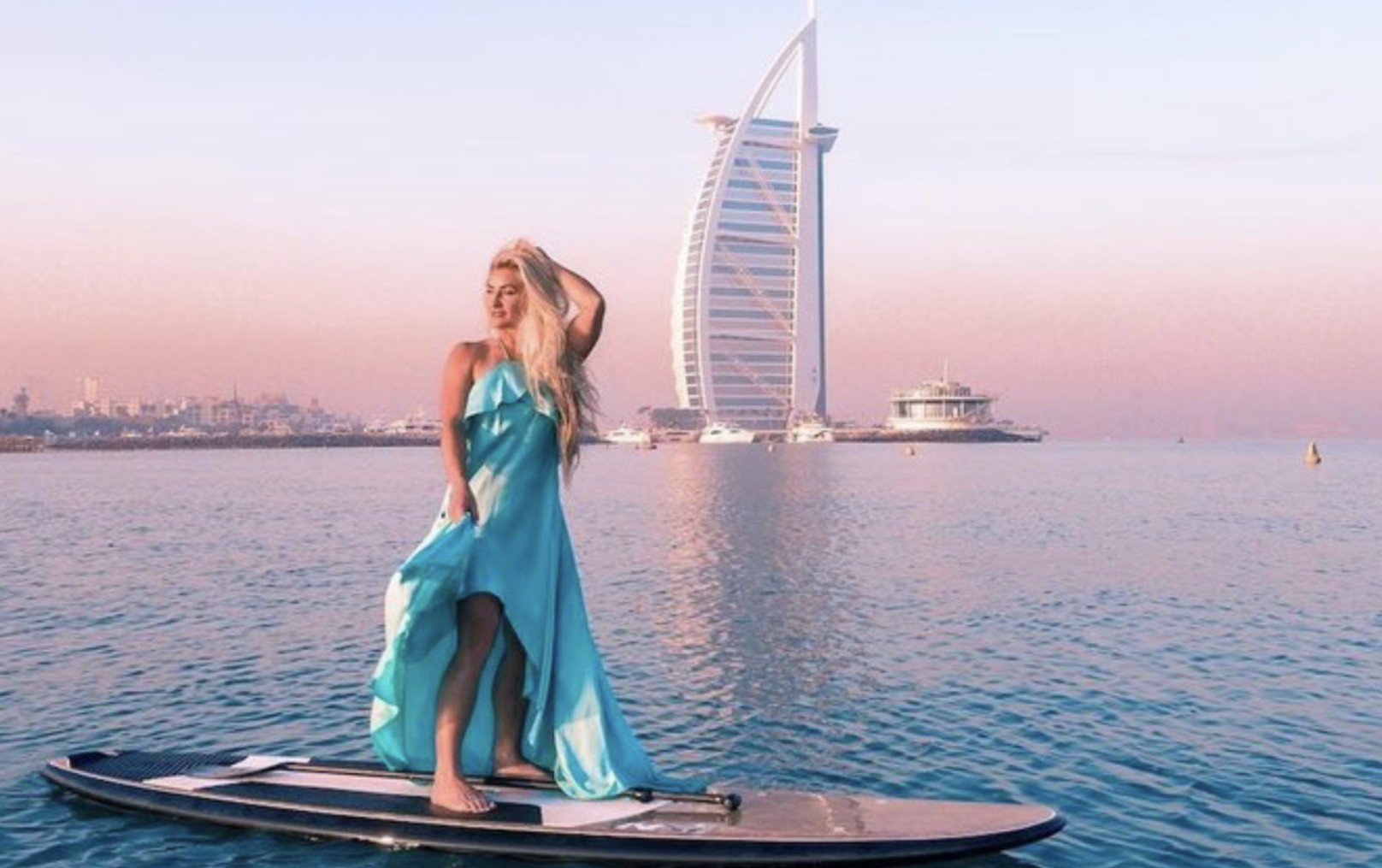
You can tell how long ago I went to Dubai, because I was still a columnist for The Guardian. This was around the turn of the 21st century, when the paper had enough influence to bag two first-class flights and two suites at the Burj Al Arab hotel, which opened in 1999. Everything was so computerised that I couldn’t work out how to open the curtains until I was packing my case to leave. This led a friend to quip: “At least you’ve had the local female experience — sad, in a darkened room.”
How times change. In recent years, Dubai has become a kind of promised land for the young and the restless, the sleazy and the shady and international criminals evading justice — and the most amusing cohort, those who believe Britain is going to the dogs by importing too many Muslims and so go to live in a Muslim country where apostasy is a crime, gender apartheid is practised and the law punishes homosexuality with anything from fines to floggings to a sizeable jail sentence.
Mind you, it’s hardly Liberty Hall for heterosexuals, either. Even married couples who are overcome with lust to the point of hugging in public may expect a stern warning while thousands are cautioned by police on the beaches each year for showing affection. The most shocking case happened when in 2024 a London boy, Marcus Fakana, was sent to jail for having a holiday romance with a female fellow teenager, also on holiday from England with her parents. He spent around a year in prison before being freed due to a “royal pardon” from Dubai’s ruler — Dubai being one of seven hereditary emirates within the United Arab Emirates, each one of them an absolute monarchy.
There’s an inherent tension in young British men and women, famous around the globe for their intoxicated displays of lust under the foreign sun, flocking to a place with such savagely stuffy sexual standards, and where prohibitions on revealing “too much” flesh is a matter for the law. There’s a vital get-out clause, though; these rules don’t apply to Westerners in waterparks, beaches, clubs and bars, which are pretty much the only places Westerners in Dubai frequent. Other foreigners in Dubai, especially the non-white ones, aren’t so privileged. Major construction in Dubai only started in the Nineties; now it is home to one of the world’s densest skylines, including the Burj Khalifa, the world’s tallest building. All this has been built in record time by migrant workers — generally from South and South East Asia, particularly India and Nepal — who have spent 12-hour shifts sacrificing themselves to the monster hotels which house Western tourists. The documentary Slaves of Dubai presents a grim picture of a side of the city that most visitors choose not to see.
Thousands of these workers die every year; some estimates have it as high as 10,000 deaths across the Gulf region, with more than half recorded as “cardiac arrest”. As most of these men are young, this seems unlikely to have occurred “naturally”. It seems far more likely that falling from great heights, electrocution, heat exhaustion and generally hazardous working conditions are to blame.
Dubai is a place in which an Arab and European overclass are waited on hand and foot by an Asian servant class. In an amusingly mis-timed piece in this week’s Heat magazine — “LIVING THE DUBAI DREAM” — the reality TV personality Luisa Zissman named a better quality of life as her reason for moving there, summed up by the fact that she was able to get a pair of false eyelashes delivered in 11 minutes on New Years Eve; I’d take a punt that her speedy courier was neither European nor Arab. But then, this modern slavery practised in places like Dubai seems not to trouble the westerners who flock to the Gulf in search of luxury goods and Instagram likes. What was my excuse for going there, then? Well, we didn’t have the internet back then; no one has that excuse these days. Everyone knows exactly where they’re going and how it got there.
Founded in the early 18th century as a fishing settlement, Dubai became a trade hub in the early 20th century before oil discoveries made it rich in the Sixties and Seventies. These discoveries were relatively minor however; oil revenue makes up less than 2% of its GDP, hence the diversification into real estate and tourism. The emirate is now the seventh most-visited city in the world and its airport is the world’s busiest in the world. Some 92% of the population are expatriates; a lot of these are British, and a good proportion of them are young Britons, often social media influencers. For unformed souls whose fragile sense of self requires ceaseless reassurance from the labels in their clothes, Dubai is perfect. It’s cheaper: Move International recently came up with the figure of 37% cheaper than London, with petrol, rent, and public transport costing far less. There is, of course, zero income tax. It’s always hot — worship of the sun has become almost a religion to youngsters. Every car is a limousine, every carpet is red and everything is covered in so much gilt that it makes Versailles look like Bauhaus.
“You’d have to have a heart of stone not to laugh.”
You’d have to have a heart of stone not to laugh at the way some of those stuck there are carrying on now. “I’m trapped and under attack in Dubai — while back home in Chichester my daughters are furious, the labradoodles are sick and, worst of all, I left my Mounjaro pen in the fridge,” wrote the journalist Shona Sibary in the Daily Mail. But though holidaymakers want to come home, the expats seem disinclined to leave. Somewhat surreally, they repeatedly refer to how much “safer” they feel even in a war zone than in Sadiq Khan’s London. They often mention their trust in the Dubai authorities — the same authorities who routinely remove brown-skinned workers’ passports, of course. I disliked it very much, finding it both garish and dreary at the same time — quite an achievement — and while I’m all for a bit of artifice, I do remember being nonplussed when I was on one of the “best” beaches, idly digging into the sand, only to find concrete a few inches below, probably because land-reclamation has added more than 190 miles of artificial coastline.
Several theories have been proposed about the origin of the word Dubai. One is that it comes from the same root as the Arabic word for “money”; and where there’s brass, there’s muck. Most Brits migrate there in order not to pay tax, as much as for “a better way of life for families” as several showbiz shills say — which again, seems peculiar, given how normalised sexual exploitation is in Dubai (as the eye-popping “Dubai porta-potty party” rumours attest). To thrive amid this seediness requires a kind of warped innocence.
But then, Dubai abounds in these contradictions. It is one of the strangest places in the world; the meeting zone of Medievalism and modernity. “The Venice of the Gulf” is one of the nicknames it aspires to — but we forget that Venice wasn’t historically just a place with lots of water and pretty bridges, but rife with corruption and war-games.
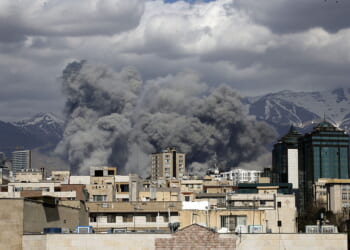
Another hopeful sobriquet is “The City of the World” — which takes on a new meaning now. Nowhere in the world is safe from the coming storm, no matter how many human sacrifices have been made lining them with gold. The existential clash of civilisations can happen as easily on beaches, in the sunshine — much to the bafflement of the young studs and starlets, caught in a war-zone when all they sought was The Good Life.
But Dubai was always built on shifting sands — with cold, hard concrete just a few inches beneath.