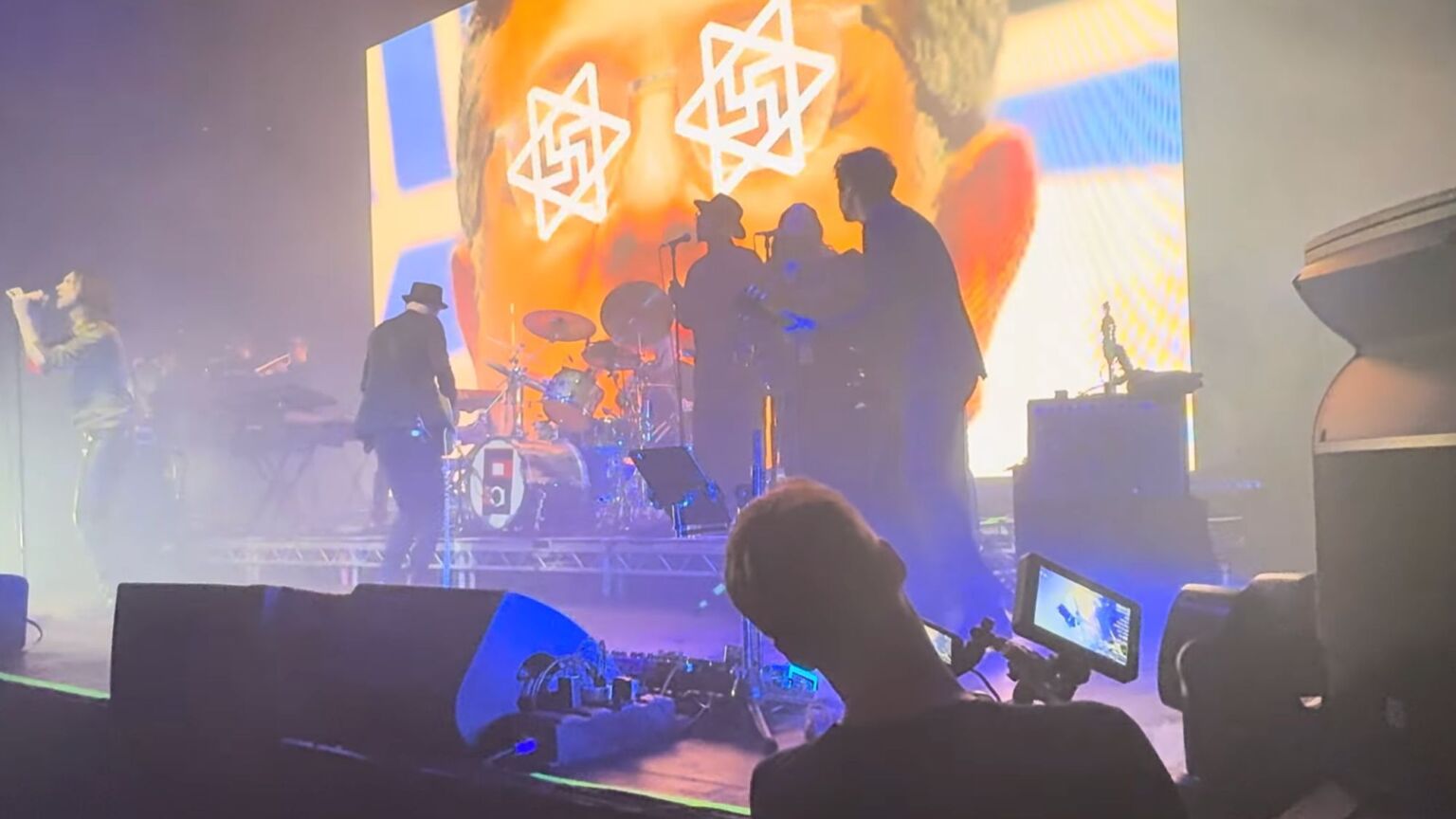
When I witnessed Bobby Gillespie, Primal Scream’s frontman, flailing about in front of a video flashing the Nazi emblem over the eyes of Israeli politicians last week, I realised that the ‘counter-culture’ is well and truly dead.
Primal Scream are one of a long list of bands to have attached their fading brand to Gaza. Recently, they also performed in October’s Gig for Gaza, alongside controversial rap group Kneecap, a member of whom allegedly endorsed Hamas and Hezbollah.
To be fair, at least Primal Scream can’t be accused of jumping on a bandwagon. Gillespie has been an openly devout Palestine activist since at least 2004, when he performed at Brixton Academy’s ‘Hoping for Palestine’ charity concert, before which he wrote an article about the plight of Palestinians for the Guardian. The following year, he caused a backlash for scribbling ‘Make Israel History’ over a ‘Make Poverty History’ poster signed by artists headlining 2005’s Glastonbury festival.
I agreed to attend Monday’s Roundhouse concert with a friend. There was a time when I once admired Gillespie’s politics and thought he was a man of integrity. Although I have since left my Marxist days behind me, and I now find his pronouncements grating, I’ll always have an affinity for the societal rebel. And as with many musicians who dominated the Nineties world of alternative rock, anti-authoritarian sentiment is enshrined in the band’s artistry.
Primal Scream’s XTRMNTR – the album performed at Monday night’s concert to celebrate its 25th anniversary – serves as a critique of an authoritarian elite. It’s a message that feels increasingly pointed in today’s unnerving world, whatever your politics. Certainly, Gillespie holds no candle for the current Labour government. ‘Keir Starmer and David Lammy are war criminals’, he told us between songs, met by strangulated cries of ‘Free Palestine!’ from the sweaty, mullet-shaped heads in the crowd. Notably, there was no mention of the usual capitalist demons on this occasion – perhaps an understandable absence, given the £75 hoodies limply hanging above the merchandise stand through the doors.
Yet on the second playthrough of ‘Swastika Eyes’, a song Gillespie once described as being about ‘the new world order’, my earlier optimism about the band’s integrity suddenly felt naive. The accompanying video projected behind the band displayed an edit of the destruction in Gaza (that much was to be expected) interspersed with literal ‘Swastika Eyes’ planted over the eyes of Israeli and US politicians. Except the swastika and the Jewish Star of David were merged into one sickening symbol.
The symbolism on display felt markedly extreme, even for a band like Primal Scream. To be clear, this was not an Israeli flag merged with a swastika. Nor was it even a blue Star of David. It was just a Star of David, a Jewish symbol, plain and simple. It was a symbol that not only smeared the religion of Judaism itself as a fascist ideology, but also compared Jewish people to the same regime that decimated nearly two-thirds of Jews in Europe. The comparison is stomach-churningly absurd. ‘This isn’t protest art’, Alex Hearn of Labour Against Anti-Semitism told the Daily Mail, ‘it’s dehumanising propaganda that has historically preceded violence against Jewish communities’.
It would be remiss to discuss extremist imagery in alternative music without mentioning punk’s infatuation with swastikas. In the late Seventies, the Sex Pistols’ Sid Vicious was infamously pictured wearing a t-shirt emblazoned with a swastika, posing with his (Jewish) girlfriend, Nancy Spungen. This divided the punk scene. The Clash stated that anyone spotted wearing a swastika at one of their gigs was out – immediately. The National Front even attempted to recruit from Sex Pistols fans at one point. While the symbol was worn merely for shock value by many, eventually some younger punks started wearing it unironically.
Sid Vicious was not a Nazi, but instead wanted to kick against what he perceived as the painfully polite and civilised culture of the older, war-time generation. In today’s world, we might call him a rage-baiter, and I wonder if this is what Primal Scream were up to. Shock sells, and the band has hit more headlines over the past week for the swastika stunt than they had in the past 10 years. (Of course, we know they do care about Palestine, so perhaps my cynicism is getting the better of me.)
A common defence of the swastika eyes I’ve seen online is that being able to feel outraged by a symbol is a ‘privilege’ at a time when tens of thousands of people are dying in the Middle East.
The other defence is free speech. As Primal Scream have rightly reminded us in the statement they posted to Instagram, ‘In a free, pluralistic and liberal society, freedom of expression is a right which we choose to exercise’. If the imagery was intended to provoke debate, then it has clearly succeeded in doing just that.
But debate also includes criticism, and this is surely warranted given what the imagery says about Jewish people. Although Primal Scream will insist it’s not aimed at Jews, this image will nonetheless cause enormous pain to Jewish people – not only to ‘Zionists’ or the Israeli government. While some might claim that Israel is hiding behind the Jewish symbol to commit atrocities, and is therefore responsible for the Star of David being treated like a ‘hate symbol’, this line of thinking does not hold. Jewish people are already hiding their Star of David necklaces on British streets for fear of being attacked. I will certainly be watching to see how long it takes for the Star of David / swastika symbol to make the rounds among the activist groups responsible for terrorising Jewish students on my campus.
As depressing as this may be, as British citizens we have very little influence over events in the Middle East. We do, however, have agency over the attitudes we instil within our culture, and our culture shapes the way minority groups are treated by British society. Why would we willingly put Jews at risk in this country, in associating Judaism with fascism, because activists are looking to sell their views (and merchandise) in the currency of shock value?
Perhaps times were simpler in the 1980s and 1990s for bands like Primal Scream. Back then, alternative artists had clear enemies to rally the people against – Margaret Thatcher, the Tories, the police, corporate greed. But Thatcher is dead, the Tories are out and these musicians are now part of the corporate world they claim to rail against. Besides, it will never be ‘counter-cultural’ to regurgitate what 99 per cent of your peers already spew. The real counter-culture today exists among the people expelled from universities or jobs, forming underground organisations to protect their rights, while being heckled on their way to classes or meetings for sticking to their beliefs.
Unless musicians start to understand this, their attempts at edginess will fall flat. The imagery used by Primal Scream last week was not inspiring or thought-provoking – it was vulgar and exploitative. It trivialised the plight of Palestinians and put a target on Jews’ backs. All for a cheap bid for shock value.
Lottie Tredgett is a masters student at King’s College London and vice-president of the university’s Free Speech Society.