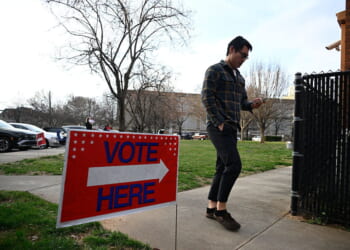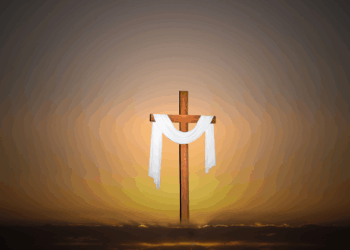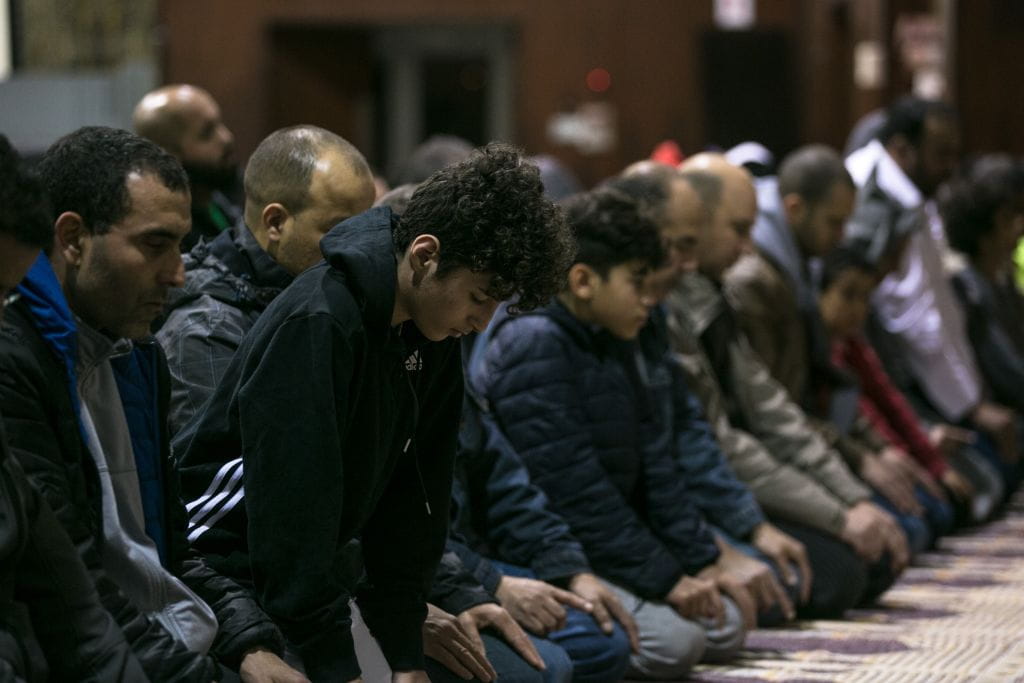
The National Assembly of Quebec on Thursday passed Bill 9, “An Act respecting the reinforcement of laicity in Québec,” which bans prayer spaces in public institutions, such as universities, and collective prayers in public spaces, such as parks, without a permit from the city. It also extends a ban on wearing religious symbols to government-subsidized daycare workers, with an exemption for current workers. This would include crosses. The bill builds on two previously passed laws bolstering secularism. One of them, Quebec’s Bill 21, is currently before the Supreme Court of Canada.
The Act’s other provisions include a prohibition for public institutions, such as hospitals, from offering food based solely on religious tradition without offering alternatives. Public subsidies for private religious schools whose selection process for students or staff is based on their religion are to be phased out. In 2024, the Montreal Gazette reported there were 50 private religious schools in Quebec, supported by a total of $160 million a year from the state, as follows: 27 Catholic, 14 Jewish, 4 Muslim, 2 Protestant Evangelical, 2 Armenian and one Greek Orthodox, the newspaper reported.
Is It Prayer or Provocation?
According to The Gazette, Quebec Minister of Justice Simon Jolin-Barrette and Jean-François Roberge, a member of the National Assembly of Quebec and is responsible for secularism, said collective prayers would no longer be allowed in public places because of “provocative actions carried out by individuals under the guise of demonstrations.”
Roberge, the paper reported, characterized those demonstrations as incompatible with Quebec values.
“It is shocking to see people blocking traffic, taking over public space without a permit, without warning, and then turning our streets, parks and public squares into places of worship,” the newspaper reported Roberge said.
Some Québécois also told the Gazette the bill unfairly targets Muslims. To be sure, the bill would apply to all religious groups.
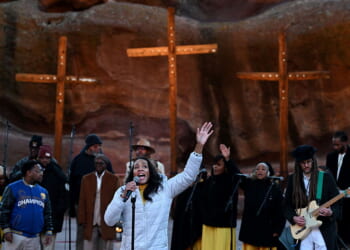
Christian Lépine, Archbishop of Montreal, reportedly led the Way of the Cross procession on Good Friday in Montreal, and told the Montreal Gazette: “Asking for authorizations won’t be new, we’ve always done it, but it will be more complex, require more time. I believe in a secularism that is at the service of freedom for everyone, in respect of each other, in the security and the respect of social peace.”

The recent acts of Islamist terrorism in the US amid the war against the Iranian Revolutionary Guard Corps and other attacks since the Islamist al-Qaeda attack on US soil on September 11, 2001, highlights the fear that may have been the basis of the law.
Fundamentalist Islamists reportedly cite allegiance to the Quran. Some of its passages raise legitimate concern about how these commands are compatible with democratic values of the US Constitution and the Canadian Constitution.
“So when the sacred months have passed away, then slay the idolaters wherever you find them, and take them captives and besiege them and lie in wait for them in every ambush, then if they repent and keep up prayer and pay the poor-rate, leave their way free to them;” (Chapter 9:5, sūrat l-tawbah)
“Muhammad is the Messenger of Allah ; and those with him are forceful against the disbelievers, merciful among themselves. You see them bowing and prostrating [in prayer], seeking bounty from Allah and [His] pleasure. Their mark is on their faces from the trace of prostration.” (Chapter 48:29, sūrat l-fatḥ)
How do prayers based on these texts resonate with the “unbeliever” of Islam? Are these prayers simply affecting the relationship between a person and their god – or a person and their community and country?
In a November press release condemning the bill, Anaïs Bussieres McNicoll, director of the Fundamental Freedoms Program at the CCLA, wrote:
“Public spaces belong to everyone. The freedom to express one’s thoughts, opinions and beliefs in public, including through prayer, is a cornerstone of any democratic society.”
While all lovers of liberty agree in principle, what happens when prayers in public spaces disturb non-believers, or provoke believers of that religion to violence against non-believers? Are all religions equal in their tolerance of who they deem to be unbelievers? Do all religious groups have the ability to live at peace with their neighbors?
The new Quebec law come at a time when 60 Republican members of the US Congress from 25 states have joined the Sharia Free America Caucus. US Reps. Keith Self (R-TX) and Chip Roy (R-TX) launched the group in December “to oppose the influence of Sharia law in the U.S., which they deem incompatible with the Constitution.” The group is pushing for legislation to prioritize American law, and to counter the rise of Sharia in the United States.
Sen. Tommy Tuberville (R-AL), who is running for governor of Alabama, has been frequently posting on X his concerns about the threat of Islam in the US. On March 12, Tuberville posted and pinned to the top of his page: “The enemy is inside the gates.”
“For months, I’ve been warning about the growing threat of Islam in the United States. Islam isn’t a religion; it’s a death cult. Sharia Law teaches that it is righteous to kill all infidels, and especially Christians. Unfortunately, 15 innocent people were murdered by Radical Islamists in Australia this weekend. If we don’t wake up, these types of terrorist attacks will become commonplace. I’m glad that some of my Republican colleagues in the House have a backbone and are joining me in the fight against this anti-American ideology.”
By contrast, the Bible commands followers of Jesus Christ in Romans 12:18: “If it be possible, as much as lieth in you, live peaceably with all men.”
As Canadians await the ruling of its Supreme Court on Bill 21, and how the latest law of secular expansion in Bill 9 will be enforced in practice, Americans are watching. How will this new law from our neighbors to the north effect lawmakers at the local, state and the national level?