Preserving liberty and engendering civic gratitude.
In the first part of my extended reflection on the character of conservatism, I warned that the American Right is confronted by a “pseudo-Rightist culture of repudiation” that in important respects mirrors the intellectual and political Left. The crude white nationalism and vociferous anti-Semitism of the so-called “groypers,” who delight in the nasty, transgressive utterings of the internet chameleon Nick Fuentes, present the most recent example of that phenomenon.
On another front, a spirit of ingratitude dominates in certain precincts of the Right. There is a marked tendency to dismiss even the most admirable conservative wisdom of the past as outdated, irrelevant, or worse. A young critic of mine at The American Conservative, who writes very much in that dismissive spirit, accuses me of making “rote” appeals to the likes of Burke and Churchill, as if deep immersion in the thought and action of these two great conservatives can only be formulaic and irrelevant.
But a conservatism that forgets the most capacious meaning of the social contract, the enduring bond that connects the living to the dead and the yet to be born, and the multiple reasons for gratitude to our noble if imperfect forebears—Burkean themes par excellence—has lost essential bearings, and will rather quickly lose its soul.
Similarly, a conservatism that ignores Churchill’s great insight that opposition to the totalitarian negation of man requires a full-throated defense of “Christian civilization” and “Christian ethics,” and not merely fealty to abstract liberal principles (see his incomparable “Finest Hour” speech), would be both impoverished and disarmed. Nor does the Churchill who reminded us at the height of the Cold War that “meeting jaw to jaw is better than war” need to be reminded of the limits of bellicosity. Contrary to a repeated misuse, Churchill knew that it was not always Munich 1938, and opined that a more traditional Germany, authoritarian but not totalitarian and genocidal, might have been accommodated (not “appeased”) in the 1930s, as he put it in his classic work, The Gathering Storm.
I would suggest that my young critic take the time to study Burke and Churchill with the same care that he parses the “ironic” rhetoric of Nick Fuentes.
In my earlier essay, I made another suggestion that drew fire from other corners. I suggested that two warring factions on the Right, post-liberals and more traditional pro-American conservatives, could conceivably form a common front to oppose the racialism, anti-Semitism, and neo-paganism of the pseudo-Right. Offered in a spirit of statesmanship, which characteristically knits together factions for a common purpose, I do not disown or withdraw that suggestion, while acknowledging how difficult effecting it would be. To do so, moreover, would require some reflection and soul-searching on the part of both parties.
For truth be told, the post-liberals, whose honor I do not question, have contributed to the atmosphere of generalized ingratitude by their assaults on the American Founding, which is in their estimation the product of “liberalism”—and nothing but liberalism. They too often facilely dismiss, or systematically mischaracterize, the achievements of conservative statesmen and theorists of the past. Their treatments of Buckley and Reagan read like caricatures, and express little or no gratitude for what these men did to sustain the cause of ordered liberty against moral nihilism and collectivism at home and totalitarianism abroad.
Now, one can recognize the limits of an earlier fusionism that was arguably too willing to accommodate expressive individualism and ongoing denials of the conservative foundations of the liberal order, as I called it in my 2011 book of the same name. These foundations include a vigorous and independent civil society, the so-called bourgeois family, religious faith, and a self-governing nation-state, not to mention an educational system that passes on the ideas, real history, and achievements of country and civilization.
One can argue that the old fusionists rightly esteemed freedom while inadequately defending its crucial preconditions. They were slow and rather inept in standing up to the massive challenge that the spirit of nihilistic repudiation posed to the health and well-being of republican government in the United States. A populist conservative correction to their complacency was in order.
The post-liberals are not wrong to point out many of the serious limits of theoretical or philosophical liberalism. Nor are they wrong that liberalism has been increasingly defined by excessive individualism, contempt for tradition and traditional wisdom, and a doctrinaire secularism and scientism that undermine the dignity of the human person and the preconditions of a free and civilized society. Liberalism has in decisive respects been historicized. It has succumbed to the progressivist replacement of the sempiternal distinctions between good and evil, truth and falsehood, by the spurious ideological distinction between progress and reaction. And many of these tendencies indeed had their origins in the thought of early modern political philosophy.
But the post-liberals tend to throw the baby out with the bathwater. They partially attributed this debased liberalism to the American Founders themselves, as if the freedom they esteemed was relativistic, hedonistic, anti-religious, and devoid of public spirit. Unlike an older tradition of Catholic reflection about America, they fail to think through the crucial differences between the American and French Revolutions, the spirit of American republicanism, and the debasement of liberty, equality, and fraternity in the guise of Jacobinism.
Alexander Hamilton, an eminent Founder, wrote in 1794 that the French revolutionaries were “fanatics in political science” who rejected “moderate and well-balanced government,” drew on “irreligion and anarchy,” and saw in religion and government “unwarrantable restraints upon the freedom of man.” Their “impiety and infidelity” led to “prodigious crimes heretofore unknown among us.” At their best and indeed most characteristic, the Founders saw the inextricable link between moral anarchy and what came to be called “totalitarian democracy.”
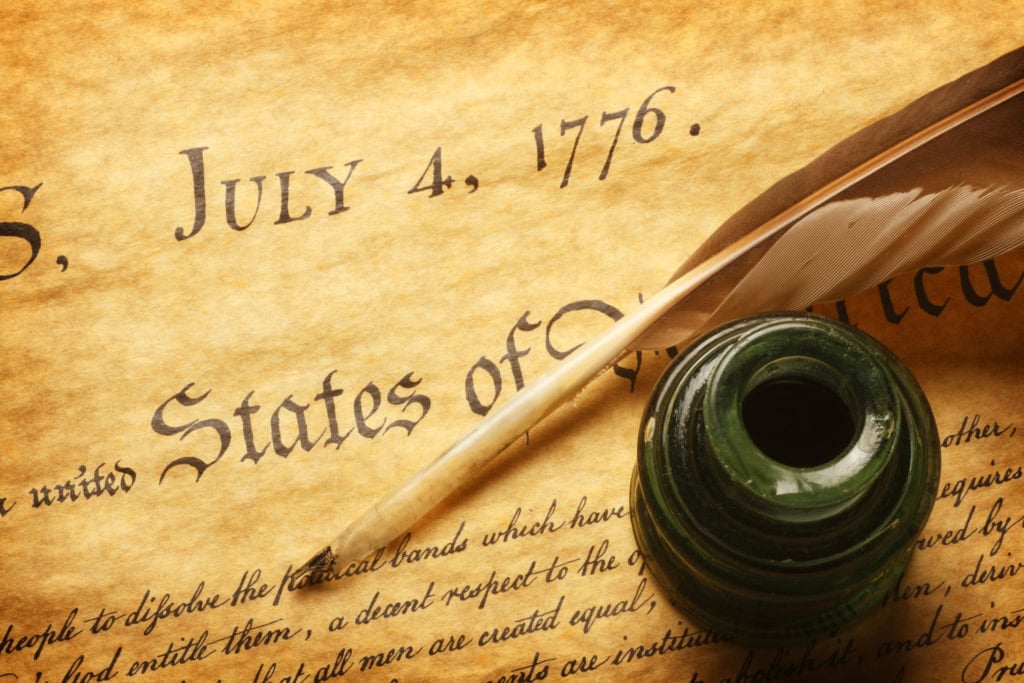
As Matthew Spalding makes clear in his wonderfully thoughtful and accessible new book, The Making of the American Mind: The Story of Our Declaration of Independence, the Declaration is far from being a purely Lockean document, even if it draws on the constitutionalism of Locke’s Second Treatise, while eschewing the hedonism and relativism of the Essay.
As Jefferson wrote a year before his death, the Declaration was an “expression of the American mind,” with its sentiments being found in “the elementary books of public right” authored by “Aristotle, Cicero, Locke, Sidney etc.” It also appeals nobly to “prudence,” “rectitude,” “magnanimity,” and “sacred Honor.” The Declaration’s political theology, in part added by the Continental Congress, is deeper and broader than Jefferson’s Socinian religious thinking. It appeals to a providential God who is at once “Creator” and “Supreme Judge of the world,” not just “Nature’s God.” As Spalding aptly puts it, the Declaration appeals to “[m]an’s rational understanding of a general revelation that is open to further revealed truths.” Thus, while valuing the inestimable good of religious liberty, the Founders still assumed and promoted a “friendship of politics and religion.” That friendship has frayed, and dangerously so, but this was in no way the design or aim of the Founding Fathers, as Washington’s Farewell Address makes clear.
Today, though, we are faced by the specter of what Aleksandr Solzhenitsyn in his 1978 Harvard Address called “anthropocentricity.” He defined this as
a [merely] humanistic way of thinking, which proclaimed itself our guide, did not admit the existence of evil in man, nor any task higher than the quest for earthly happiness, and…fashioned the dangerous tilt toward the worship of man and his material needs into the basis of modern civilization.
Such anthropocentric humanism denied what the Founders (and Tocqueville and Lincoln) readily acknowledged: that nature and God provide a standard of morality above the human will. In a speech in Lewiston, Illinois, that serves as the epigraph to Spalding’s book, Lincoln appealed to the Declaration of Independence as an obstacle to tyranny and a spirited proclamation that could help sustain “truth, and justice, and mercy, and all the humane and Christian virtues.” With these facts in mind, let us not reduce our rich civic tradition to liberalism alone, or see every variant of liberalism as a materialist and atheistic humanism that helped usher in the totalitarian deformation of modernity.
On the other hand, as Solzhenitsyn also reminds us in the Harvard Address, we need to recall that previous ages more attuned to “the spiritual” often consigned our “physical nature” to “perdition.” A serious consideration of history reveals that there is no political golden age, classical or Christian, to which we can retreat or recreate. The anthropological renewal, the “new height of vision” that Solzhenitsyn called for, is thus a most demanding task: it must knit together both elements of our human nature in a way that respects both, but preserves their right order as well. Put in more contemporary terms, we must repudiate those doctrines that have pushed God and the soul aside, while building on the “liberty under God and the law” that is at the heart of our civic and civilizational inheritance. This is a task large enough for chastened and self-aware American liberals and post-liberals to contribute to, if they so choose.
We must move forward in a spirit that draws on the best of conservative and liberal wisdom and practice while understanding (and working against) the propensity of modern liberty toward self-radicalization and self-destruction. In that spirit, we can revive what Roger Scruton called “the crucial idea of free community, in which constraints are real, socially engendered, but also tacitly accepted as a part of citizenship.” Some conservatives have called this “ordered liberty,” and others have labelled it “republican self-government.” All Americans should appreciate that no human being has the right to govern another human being without his consent. But that crucial insight does not mean that human beings are autonomous beings who are free to do what they will, a notion the American Founders clearly denied. Liberty must be guided by an “order of things” that gives meaning to our freedom and makes sense of our search for truth.
As the Catholic political philosopher Orestes Brownson wrote in his underappreciated The American Republic, “[M]an is not God, independent, self-existing, and self-sufficing.” Rather, “man is dependent, and dependent not only upon his Maker, but on his fellow-men, on society, and even on nature, or the material world.” With this recognition, we are at the meeting point of true conservatism and a chastened, noble, and ennobling liberalism that, individually and together, repudiates repudiation in all its forms.