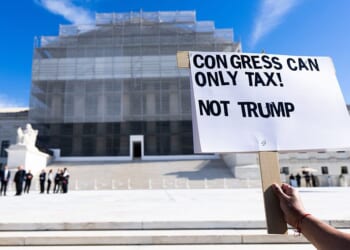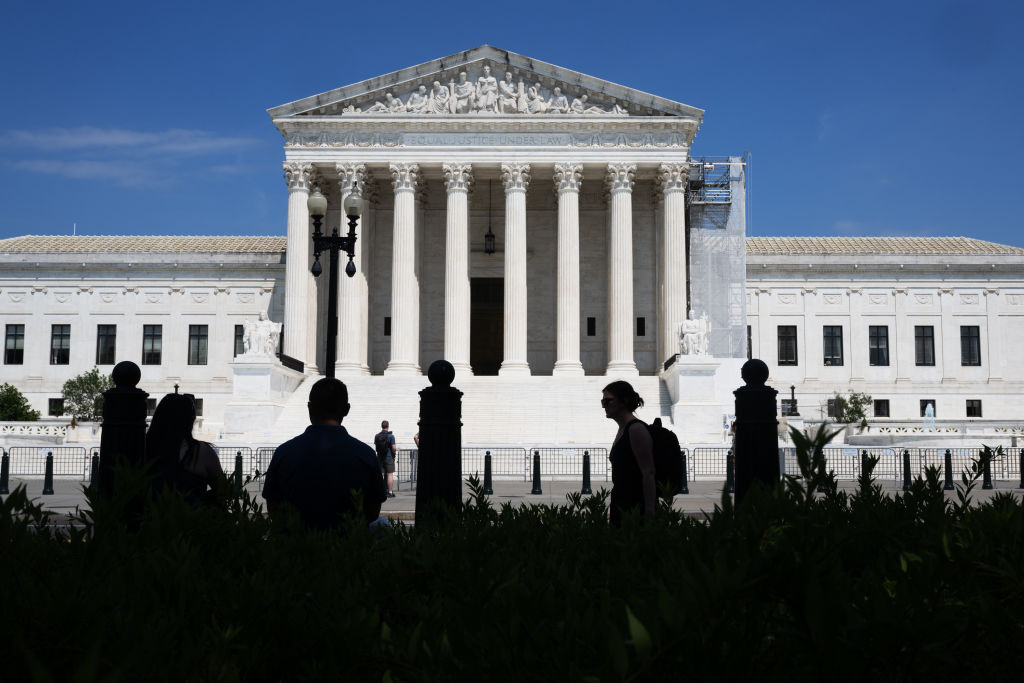
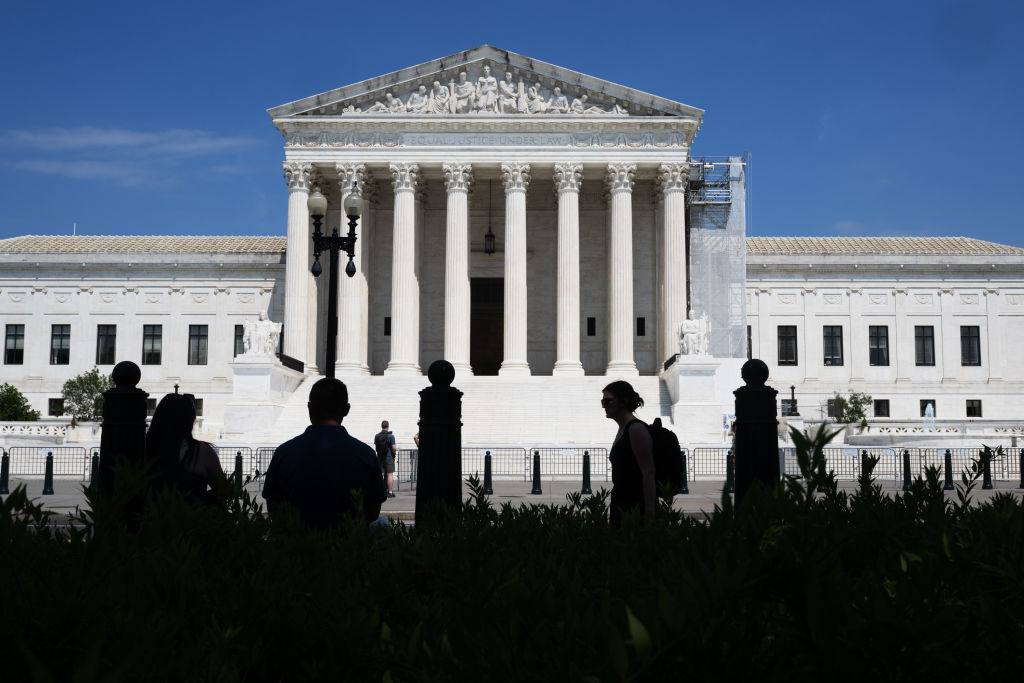
The Supreme Court is set to hear seven cases as it opens on Jan. 12, with 16 more granted certiorari but not yet scheduled for argument. Among the 27 already argued, the most anticipated rulings involve actions of the Trump administration: the constitutional definition of birthright citizenship; the power of the president to impose tariffs, fire agency officials, reshape the federal bureaucracy, and affect economic policy through the Federal Reserve; enforce border security; and deport illegal aliens. Two others concern the Trump administration’s policy to protect girls in sports: Little v. Hecox and West Virginia v. B.P.J involve bans on transgenders playing in girls’ sports in Idaho (Little) and West Virginia.
Pending Decisions From the Supreme Court
The plaintiffs in Learning Resources, Inc. v. Trump are educational toymakers challenging the president’s authority under the International Emergency Powers Act (IEEPA) to impose tariffs. Learning Resources, Inc. manufactures most of its toys in Asia, so it asked the Court to decide definitively that the IEEPA does not give President Trump the authority to impose tariffs and to order a refund of the millions of dollars it has already paid.
A question posed by Justice Amy Coney Barrett on the remedy for reimbursement of the tariffs appeared to signal her skepticism, which seemed to be shared by both liberal and conservative colleagues.
However, some legal scholars opined the government is on solid ground arguing the president’s authority. Assistant Professor of Law at Catholic University of America Chad Squitieri said the IEEPA does empower the president to “regulate … importation” through the use of tariffs, writing in the Harvard Journal of Law & Public Policy:
“Tariffs are not restricted to the revenue-raising context … Tariffs can instead be used to regulate commerce — and the neighboring words in IEEPA are undoubtedly associated with regulating commerce … IEEPA’s use of the terms ‘block,’ ‘prevent,’ and ‘prohibit’ therefore lend additional support for understanding IEEPA as delegating tariff authority.”
In an interview with New York Times opinion editor John Guida, Harvard Law School professor and former top Justice Department attorney Jack Goldsmith argued the Trump administration has a better technical legal argument than the plaintiffs.
“President Trump determined that the tariffs were needed in order to deal with the ‘unusual and extraordinary threat’ of illicit drug inflows and global trade imbalances. This understanding of ‘threat’ is well within presidential practice, and a president typically receives significant deference from courts on such determinations.”
Another consequential case that challenges the president’s authority is Trump v. Slaughter, scheduled for oral arguments on Jan. 21, 2026. The Court is set to decide whether the Constitution authorizes the president to fire at will heads of independent federal agencies such as the Federal Trade Commission (FTC). The decision could overturn a 90-year-old precedent, which limits presidents from removing FTC commissioners, except for “inefficiency, neglect of duty, or malfeasance in office.” If the Supreme Court upholds the removal statute, then it must decide if fired FTC commissioner Rebecca Slaughter will return to her post.
Legal scholars say the case will have wider implications for the president’s ability to fire others in independent multimember agencies without congressional limitations.
Arguments Pending for the Supreme Court
Trump v. Cook is a related case, in which President Trump has asked the Court to pause a federal court’s ruling that blocked him from firing Federal Reserve Governor Lisa Cook, a Joe Biden-appointee, for alleged mortgage fraud. Oral arguments in that case are set for Jan. 21.
The landmark case Trump v. Barbara, which challenges President Trump’s executive order ending birthright citizenship, arrives in Spring 2026. If the Court sides with the administration, it could mean a new interpretation of the 14th Amendment.
The 19th-century Citizen Clause Doctrine of the 14th Amendment says, “All persons born or naturalized in the United States, and subject to the jurisdiction thereof, are citizens of the United States and of the State wherein they reside.”
The battle is over the words “subject to the jurisdiction thereof.” The intent of the 14th Amendment was to right the wrong of the 1857 Dred Scott v. Sanford decision, which ruled in part that anyone “whose ancestors were brought to this country and sold as slaves, is not a ‘citizen.’”
The Trump administration argued in its petition for review that the Citizenship Clause “was adopted to confer citizenship on the newly freed slaves and their children, not on the children of aliens temporarily visiting the United States or of illegal aliens.”
The case will have sweeping implications for children born to illegal immigrants in the United States, and it comes after four years of the Biden administration’s feckless handling of immigration. But legal scholars are divided on how the Court will rule, predicting it will strike down the order as unconstitutional, rule on procedural issues rather than the merits, or redefine the 14th Amendment.
Randy Barnett, law professor at Georgetown University, and Ilan Wurman, law professor at the University of Minnesota, co-authored an opinion piece in The New York Times in February titled, “Trump Might Have a Case on Birthright Citizenship.” In it, they argued the equal protection clause, also found in section 1 of the 14th Amendment, is based on the view of Edward Bates, President Abraham Lincoln’s first attorney general, who said:
“The Constitution uses the word ‘citizen’ only to express the political quality of the individual in his relations to the nation; to declare that he is a member of the body politic, and bound to it by the reciprocal obligation of allegiance on the one side and protection on the other.”
Barnett and Wurman wrote: “Both the Lincoln administration and the Congress that proposed the 14th Amendment held this allegiance-for-protection view, with this difference: In England, the allegiance expected of a subject was obedience to the sovereign monarch in return for his protection. In the American Republic, where the people are sovereign, the allegiance expected of a citizen was obedience to the laws.”
That allegiance-for-protection view clearly underpins the exceptions to birthright citizenship: the children of hostile forces occupying the United States and the children of foreign diplomats. The question is, will the Supreme Court interpret the 14th Amendment with the same allegiance-for-protection view of the Congress that proposed and passed the amendment?