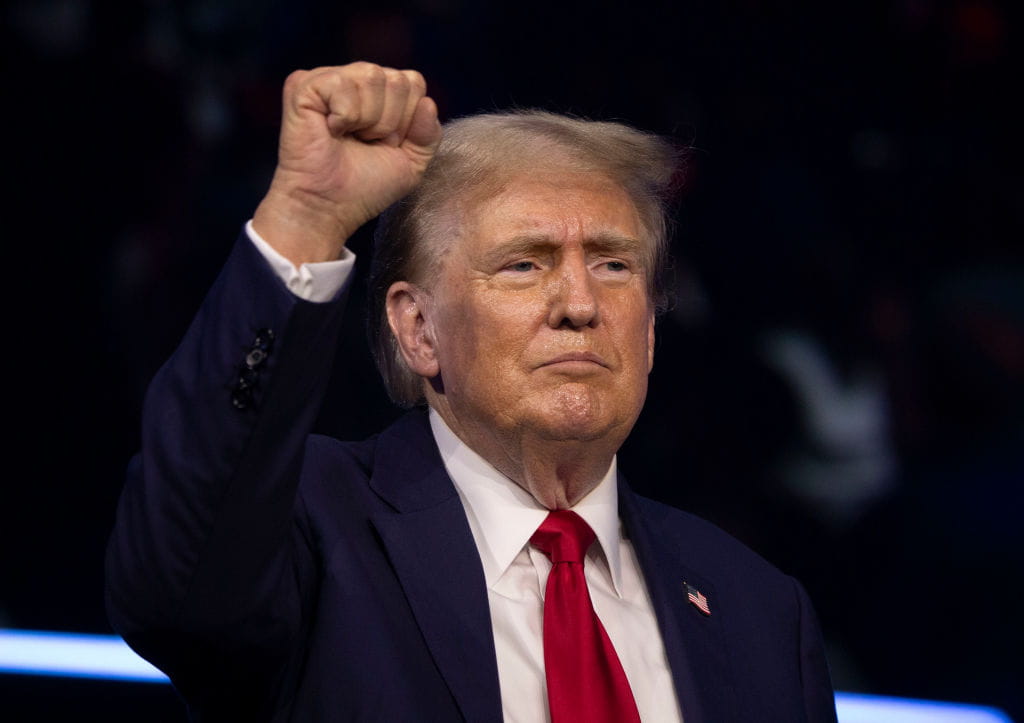
“During every single day of the Trump administration, I will, very simply, put America first,” President Donald Trump said in his Inaugural Address one year ago today. High inflation, a broken border, and conflicts overseas – he had inherited a big plate of challenges to resolve. A year later, on Trump’s first anniversary, did he crush these issues like a Dixie cup, or was it harder than he imagined on the 2024 election campaign trail?
Either way, boring would not be the adjective to describe the first year of his second term behind the Resolute Desk.
Persistent Polling Problems
By Mark Angelides
President Trump has had a difficult year in terms of polling. On the wings of a sweeping Electoral College victory, his initial popularity was at 6% plus – but that didn’t last. Currently, the commander-in-chief is underwater by almost eight points according to Liberty Nation News’ Public Square poll tracker. Notably, many of Trump’s popularity issues stem from doing pretty much what he said he would during the election.
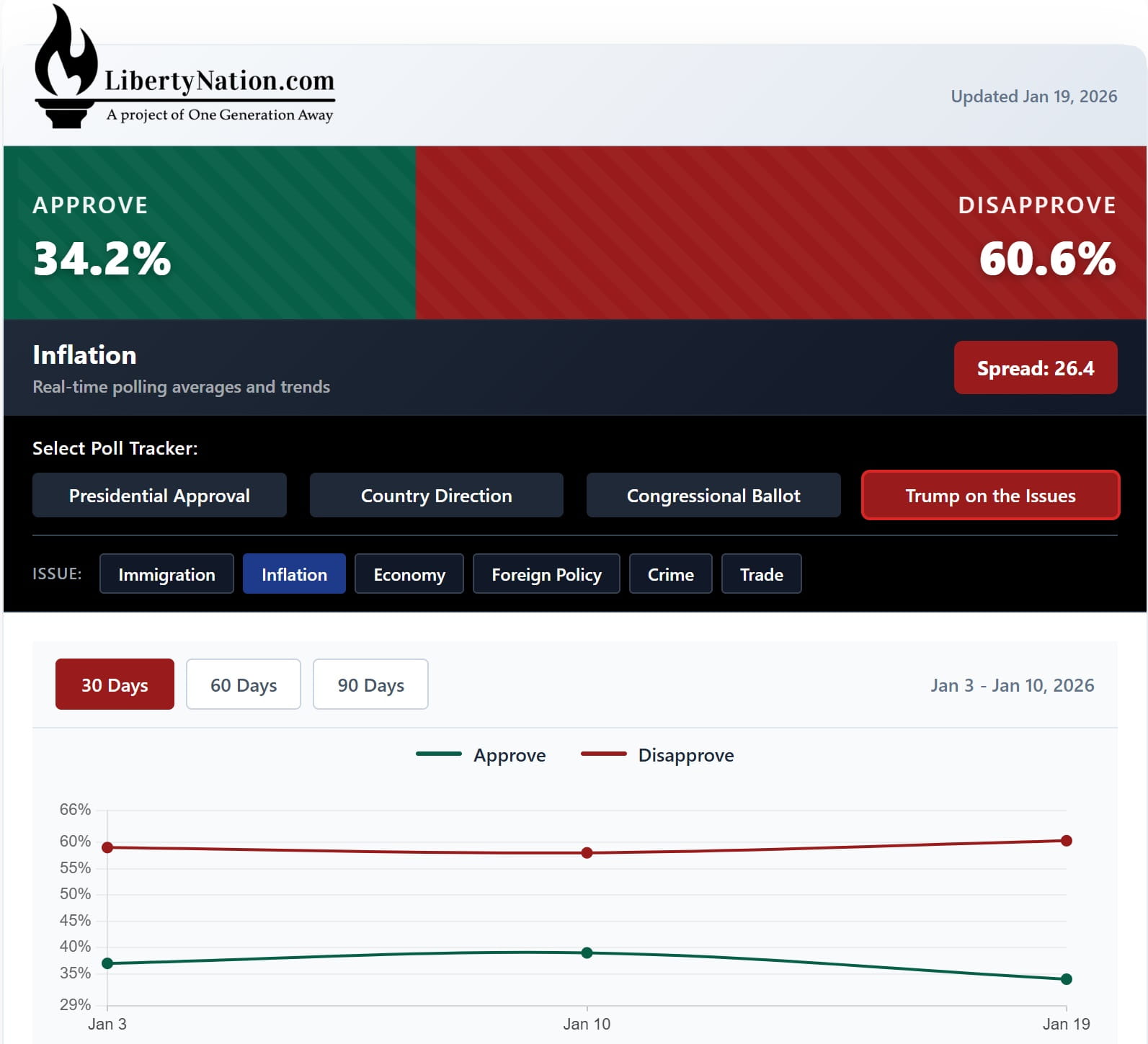 The president was swept back to office, promising to cut off illegal immigration and begin deporting those with no authority to be in the United States. Polling shows now he is down 4 points in this area, and with anti-ICE protests roiling the nation, expect this number to drop sharply.
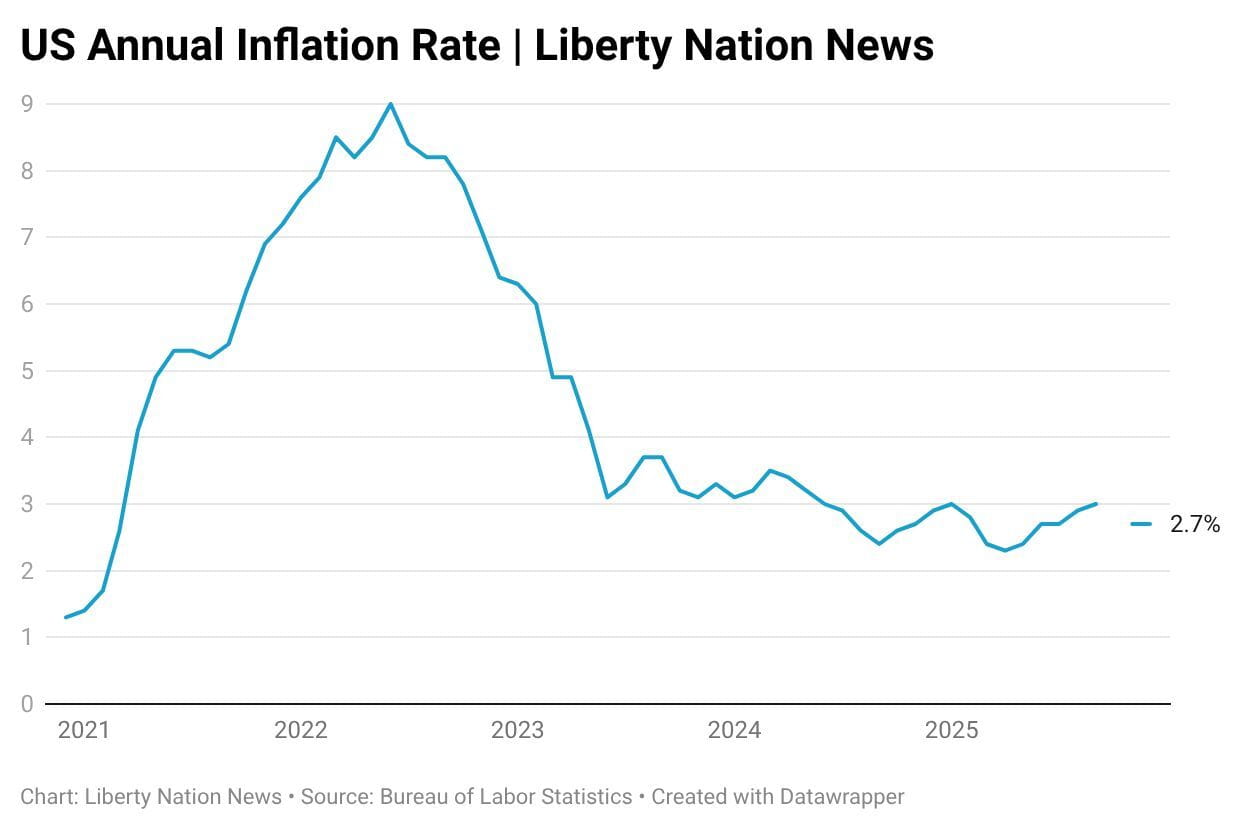
On inflation, there is a major conundrum. Latest reports put the inflation rate at 2.7%, right where the Federal Reserve wants it. But survey after survey suggests this is Trump’s worst area. He has a negative 26-point rating on this crucial metric. Former President Joe Biden immiserated the country with cumulative inflation of almost 22%, and yet his approval rating on this topic was basically the same as Trump’s is now.
The polls have not been kind to the president, and with crucial midterms approaching, this should be flashing warning lights in the White House.
Trumponomics 2.0
By Andrew Moran
At the start of Trump’s second term, the annual inflation rate was 3%. By the end of 2025, it slowed to 2.7%, even as the administration’s sweeping tariff plans traveled through the US marketplace. Other measures, from the producer price index to the personal consumption expenditure price index, suggest inflation has stabilized.
Crude oil and gas prices have notably fallen in the past year. A barrel of West Texas Intermediate, the US benchmark for oil prices, fell about 22% to below $60. Gas prices ended 2025 firmly below $3, with about two dozen states enjoying average pump prices below $2.80 per gallon.
 When Trump unveiled the contours of his sectoral and reciprocal tariffs at the April 2 “Liberation Day” event, economists and investors anticipated either a sharp slowdown or a recession. The Blue-Chip 2025 forecast predicted 2.1% annual growth. In the first quarter, the economy contracted 0.6%, but growth rebounded 3.8% in the second quarter and 4.3% in the third quarter. The Atlanta Fed expects fourth-quarter expansion at around 5%, meaning 2025 growth would be closer to 3%.
The US labor market had a rough second half. After the first few months of the year signaled that employment conditions would remain robust, the situation has cooled substantially. In total, the US economy added 584,000 new jobs – averaging 49,000 monthly new jobs – and the unemployment rate rose to 4.4% from 4% in January 2025. The good news is that the goal of “reprivatizing the economy” is coming to fruition on Trump’s first anniversary as federal payrolls fell by 277,000.
Lowering interest rates was a major goal for the Trumponomics 2.0 agenda. While the Federal Reserve waited until September to start reducing interest rates, the market had already started putting in the work as Treasury yields, mortgage, credit card, and auto loan rates slipped.
Closing the Border
By Michele White
Immigration was one of the top issues for nearly 80 million Americans who elected Trump. After the Biden administration allowed roughly 20 million illegal immigrants to pour over the US southern border for four years, the freshly sworn-in 47th president said on day one of his presidency:
“First, I will declare a national emergency at our southern border. All illegal entry will immediately be halted, and we will begin the process of returning millions and millions of criminal aliens back to the places from which they came. We will reinstate my Remain in Mexico policy. I will end the practice of catch and release. And I will send troops to the southern border to repel the disastrous invasion of our country.”
Shortly after his Inaugural Address, Trump told nearly 20,000 of his supporters gathered at the Capitol One Arena that the US southern border was closed to illegal immigrants. He later rescinded nearly 80 executive actions of the Biden administration regarding enforcement priorities, regional migration frameworks, family reunification, and integration efforts. Trump also signed 11 presidential actions involving immigration enforcement on his first day in office and a total of 16 executive orders, six proclamations, and one memorandum directly related to immigration in the previous year.
As a result of Trump’s robust immigration enforcement, the White House highlighted some successes. By October, illegal crossings at the US-Mexico border plummeted to the lowest annual level since 1970, at 238,000 apprehensions by US Border Patrol agents. Nationwide encounters fell to roughly 692,000 in 2025, down from more than 2.9 million in 2024 and 3.2 million in 2023.
Birth of the ‘Donroe Doctrine’
By Dave Patterson
One year into his second term, there is little fuzz on what Trump’s foreign policy is: America First. How the United States behaves vis-à-vis its neighbors, allies, and friends derives from evaluating transactions with other countries based on the consequences, good or bad, for America. At its most obvious application, it means that the Trump administration will not purposefully disadvantage Americans to achieve some symbolic outcome that panders to a globalist agenda.
Trump codified the America First doctrine in the 2025 US National Security Strategy (NSS), drawing heavily from the 1823 Monroe Doctrine, which, in short, declared that the Western Hemisphere was to be free from European colonization or interference in the affairs of sovereign nations in the Americas. It is very similar to what has become known as the Trump Doctrine, or, euphemistically, the Donroe Doctrine. It charts a course that establishes the Western Hemisphere as the priority for keeping the United States secure.
All of this is not to say that the administration will refrain from engaging with foreign countries when it is in America’s interests to do so. One of the key principles of the NSS is that though America will have a “Predisposition to Non-Intervention,” it also sees the world realistically.
Most recently, and in keeping with the America First Doctrine and the application of the NSS, where the priority for constant vigilance is the Western Hemisphere – America’s backyard – the US Justice Department, supported by the US Armed Forces, arrested and extradited former President Nicolas Maduro and his wife from Venezuela to stand trial for drug crimes and other transnational criminal activities. This was an example of America cleaning up its backyard, setting the stage for more operations to stop drug trafficking, Hezbollah terrorist training, and a host of other criminal enterprises.
The United States has a cohesive, actionable NSS that is consistent with its America First foreign policy doctrine. With Trump leading America, what we have seen recently is simply a foretaste of what is to come. The country will attend to its business while being a good global citizen. However, being a friend, partner, and ally to other nations does not mean subordinating US interests to theirs.
Taking Executive Action
By Kelli Ballard
Trump had a busy year in the Oval Office. The One Big Beautiful Bill received significant media attention and addressed many issues, but the commander-in-chief issued 225 executive orders during the first year of his second term, more than he did during his first. Let’s look at a brief review of some of these EOs that may not be as commonly known.
Artificial Intelligence
Artificial intelligence (AI) was one of the major areas the president focused on, signing four major AI initiatives. Together, these remove barriers to AI development, set clear national guidelines, apply AI to real-world problems such as pediatric cancer, and prepare young Americans through AI education. Combined, they are designed to keep the United States competitive and ahead in AI.
Economy
When it comes to America’s finances, many executive orders were signed. Some of these targeted reforming regulatory policy, directing federal agencies to review and repeal regulations that raise costs, slowing business formation, and reducing US competitiveness, especially in energy, manufacturing, and finance. The others emphasized trade by expanding the use of tariffs, trade enforcement, and import controls to protect domestic industries, manufacturing jobs, and supply-chain resilience. Even foreign funds were under the microscope.
Freedom of Speech
While Trump signed only one executive order on free speech, a couple of others relate to it, particularly Restoring Freedom of Speech and Ending Federal Censorship. This is the primary order that bars federal agencies from pressuring or coordinating with private platforms to censor lawful speech, orders reviews of past government censorship efforts, and says free expression is a core constitutional protection.
National Security
Trump signed a plethora of EOs related to national security, most notably establishing the Iron Dome for America – a missile defense system – and reducing the nation’s reliance on foreign adversaries for critical military materials. Others strengthen intelligence coordination to detect and disrupt foreign espionage, cyber intrusions, and influence campaigns that target the US military, elections, and infrastructure.
Marching Toward Midterms
With less than ten months until the midterm elections, the president will have to prove to the American people that his policies are working. Polling suggests he is underwater on a smorgasbord of topics, making it harder for Trump to break the incumbent’s pattern of losing seats in Congress. On the occasion of Trump’s first anniversary, the White House can tout its record of slowing inflation, closing the border, and ending several foreign conflicts.
It will undoubtedly be another raucous year for Trump 2.0.