The growing ties between Israel and Uganda are a return to the norm rather than an Abraham Accords-era breakthrough. That’s a good thing, because it should serve as a reminder that anti-Israel animus doesn’t have to be the default stance.
Of course there are unusual aspects of the current Kampala-Jerusalem bear hug. It’s not often one reads a headline like this: “Uganda army chief says Jesus told him to build Yoni Netanyahu monument.”
That’s from YNet’s story on last month’s reports that Uganda plans to build a statue of Bibi Netanyahu’s brother, the slain hero of the greatest hostage-rescue operation of the 20th century. In 1976, Palestinian and German terrorists hijacked an Air France passenger plane and had it land at Uganda’s Entebbe airport. Yoni was the commander of the rescue force and the only Israeli soldier killed in the incredible raid.
So why would Uganda memorialize the rescue of hostages from its own soil, a permanent reminder of the country’s culpability in a shameful episode and its defeat by Israeli forces? That’s not as out-of-character as one might expect. Indeed, the country’s relationship with Israel is longstanding and far more positive than negative.
Uganda’s participation in the Entebbe episode was representative of the period of Idi Amin’s coup-born dictatorship, but was ultimately the exception and not the rule in its relations with Israel.
Technically, Zionism’s association with Uganda began half a century before Israel’s establishment—but only technically. The closest the Zionists ever came to seriously considering a Jewish safe haven outside of Palestine was known as the Uganda Program. It envisioned a kind of “night shelter” in British East Africa that wouldn’t preclude an eventual return to Israel and would at least start getting European Jews out of harm’s way. This became a live option among some Zionists after the 1903 Kishinev pogroms, though it threatened to fatally fracture Theodor Herzl’s coalition and was opposed by the British subjects already on the ground in East Africa. It was called the Uganda Program because of the prospective economic benefits it might bring to the Uganda Railway, though the territory itself was in modern-day Kenya.
After Israel’s establishment, Britain’s decolonization program in Africa birthed newly independent countries with which Israel sought to develop ties. The most storied of these was, of course, Ethiopia. But Uganda was another.
Israel began cultivating ties with Uganda before its independence, and its post-independence prime minister, Milton Obote, visited Israel in 1962. (Much of the background to that breakthrough can be found in this briefing by Aryeh Oded, a Foreign Ministry official who was present at the creation of Israel-Uganda relations, including a story about Obote sending an imposter to visit Israel two years earlier pretending to be the real Milton Obote.)
Uganda held strategic value to Israel since it was outside Arab North Africa, which was part of the hostile encirclement of Israel by its immediate neighbors. Israeli ties brought military and economic benefits to Uganda, through military training and agricultural aid. Soon after taking power in 1971, Idi Amin—who also had close ties to Israel when he was in the Ugandan army—began aligning with Libya’s Moammar Gaddafi, who was rallying African states against Israel.
Arab states had tried this a decade earlier to no avail. According to the Israeli diplomat Emmanuel Navon, when Saudi Arabia accused Côte d’Ivoire of being “bought by the Jews,” the latter’s ambassador sharply responded that it was the Arabs who had sold Africans into slavery. By 1972, five years after Israel’s victory in the Six-Day War remade the Middle East and strained Israel’s relations with states on its periphery, Saudi petrodollars were sufficient to lure some African leaders away from Israel.
The Yom Kippur War in 1973 seemed to cement this trend, but over time African leaders began to tire of the Arab cartel’s broken promises. Navon quotes a Zambian Daily Mail editorial stating that the “refusal by Arab countries to sell oil to African states at a reduced price is a tacit example that the Arabs, our former slave masters, are not prepared to abandon the rider and horse partnership. We have not forgotten that they used to abuse us like herds and sell us as slaves.”
Meanwhile, the Entebbe raid weakened Amin and likely hastened his end. Amin was overthrown by Yoweri Museveni, who rules Uganda to this day and who gradually restored cooperation and then formal ties with Israel.
In 2016, Israeli Prime Minister Benjamin Netanyahu visited Uganda and commemorated, alongside Museveni, the 40th anniversary of the Entebbe raid.
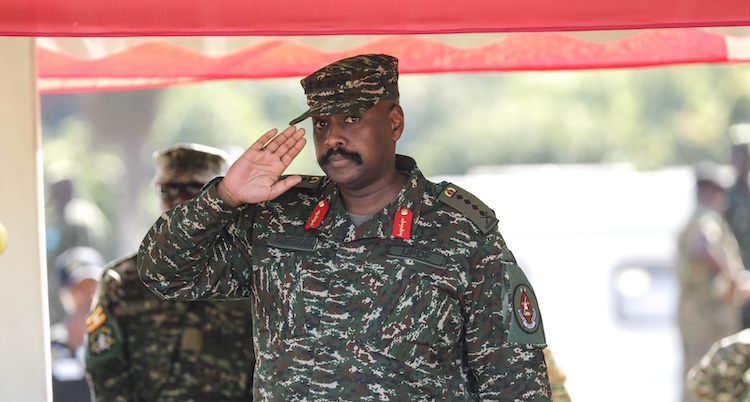
Then came the statement last week from Museveni’s son and Ugandan army chief Gen. Muhoozi Kainerugaba that his forces were prepared to fight alongside those of the Jewish state: “We want the war in the Middle East to end now. The world is tired of it. But any talk of destroying or defeating Israel will bring us into the war. On the side of Israel!”
Although Israel’s African diplomacy far predates the Abraham Accords, those agreements are not exactly irrelevant here either. After all, Gaddafi is gone and the Saudis are encouraging Arab normalization with Israel, so there is no incentive for African countries to again pull away from the Jewish state. It’s an old-new Middle East—and beyond.