Some years back, I was in Sydney during the Jewish High Holidays. On Kol Nidre, the evening beginning Yom Kippur, I went to the Great Synagogue. Guards in full combat gear interrogated, frisked, and wanded the entering congregants.
Several years previously, I’d gone to Shabbat Services in Deauville. The synagogue door was burnt black and blistered from the fire that had been set the previous Yom Kippur, and the shul members decided to preserve it as a reminder. Back in the Seventies, the reminder was constant. Every day we Jews in Chicago and New York saw tattoos on the left arms of our neighbours.
These days, Holocaust Remembrance Ceremonies, however well intentioned, are inert. For, in the Diaspora, young Jews unaffected by antisemitism, and removed from living reminders of outrage, were invited to express sympathy for what were, to them, historical characters. (Israeli Jews, of course, spent and spend entire lives facing the reality of savagery.) We American Jews mouthed “never again”, but did nothing to prevent the reoccurrence. Our comfortable, old-school liberal attitude of “we must change the narrative” was essentially sedative. We did nothing to “change the narrative”. This was not indictable as there was no “narrative”. There was simply the endorphin of permitted brutality.
This year’s Erev-Chanukah, the day before Chanukah, broke with the news of the slaughter of Sydney Jews. That evening, when we first heard of the murder of Rob and Michelle Reiner, we assumed that it was more antisemitic savagery, and, at our Chanukah table, our actual Holocaust Remembrance was that husband-and-wife conference which has been going on intermittently for 2,000 years: “Oh my God, is it time to move…?” The traditional Jewish conference was intermittent as, with most potentially vast changes, it is always too early, save when it is too late.
At its release in 1982, someone wrote of Sophie’s Choice that it was “Mandingo for Jews”. I have always loathed the film subgenre of Jew Porn, allowing folk to feel they are experiencing Good Will for watching actors portray “The Other” being thrown into The Oven.
The inescapable notion that Jews are The Other inspires and allows us to be treated as other-than-human. The crocodile sympathy of moviegoers, and devotees of Anne Frank, Fiddler on the Roof, and so on, is expressed for Jews as victims. And only as victims. The Jew, here, given an award for passivity. Not only is the award moot, it is not even extended to a real Jew.
Forty thousand firearms were taken from the Jews of Warsaw before the Nazis exterminated them. The Jews, of course, hoped to better their position by acquiescence. Hope is the placebo of the powerless. But it is not a strategy.
Violence is a constant and universal possibility. That it can be deterred by Good Feelings was disproved, rather dramatically, by the slaughter of young Israelis at a music festival on October 7.
Some years back I was tasked with taking my niece on a college tour of Brown. The student guide showed us this and that on the beautiful campus, and pointed to a phone kiosk. “There’s one every hundred yards,” he said. “Which will summon our gloriously unarmed Campus Police.”
“We American Jews mouthed ‘never again’, but did nothing to prevent the reoccurrence.”
I thought, at the time, that the University must be a congeries of fools. Not so much as their cops were unarmed (that was, to my mind, simply a dereliction of common sense, understandable in an institution largely engaged in make-believe), but that its representative was selling to prospective buyers, the notion that to be unprotected was laudable — an attitude certainly of interest to the violent. To announce to the world that campus cops were unarmed was merely stupid. To praise that folly was delusion on the order of “changing the narrative”.
A few years back, three Presidents of the Ivy League were called to Congress to testify about their schools’ passivity about antisemitism. Each was asked if the calls on campus for the murder of Jews were antisemitic, and each responded: “it depends on the context.”
Why would any Jewish parents then allow their kids to attend these schools? I’d be pleased to term it a “mystery”; but it is no mystery, it is a horrible passivity — not even the (understandable) dismissal of danger as statistically remote, but something finally much worse — a sort of death wish.
That Jewish parents send their Jewish children to institutions which allow, encourage, and so ensure, antisemitism is an act of sacrifice. It is an endorsement of the majoritarian’s right to oppress the Jews, in the hope the gift will forestall further violence. For the Warsaw Jews it was the surrender of their guns, in the Ivy League, the offer of our children.
These institutions offer Jew-baiting as an extra-curricular activity. What possible benefit could our children derive there which would offset the trauma of their abandonment?
The beleaguered Jewish student there can either embrace passivity as a necessary survival strategy, or — horribly more likely — march with the antisemites calling for the eradication of Israel — an apostasy which would spare them as little as did the Warsaw surrender of firearms.
Jew Hatred isn’t caused by Jews.
The Chanukah celebrants at Bondi Beach, the dancing kids on October 7, the Ivy Jews sheltering in Hillel, neither these nor those they’re persecuted for resembling did anything to inspire hatred. That something in their DNA, appearance, or religious beliefs excuses their persecution is delusional. It’s not a hatred of Jews, but a love of hatred.
Is antisemitic speech and violence a Hate Crime? All crime is hate crime; there is no such thing as Love Crime. To mete out justice based on the ethnic or religious status of the victim or the prejudices of the perpetrator is insanity. We’re all human beings as equal in our legitimate desires for safety as we should be in accountability for our acts.
Jews have been persecuted for 2,000 years because we were defenceless. Since the establishment of the Jewish State, we’ve been reviled because we asserted our right to exist, independent of permission.
Moses fled Egyptian luxury not alone because he slew the taskmaster, but because he was denounced by the Jew he saved. He was heartbroken. After the appearance of Moses, most of the Jews in the Torah plead, scheme, and betray in order to return to Egypt, which is to say, to the security of slavery.
Slavery is the sole possible state of that which the liberal mind celebrates as “equality”. To aspire to it is not merely wrong, it is immoral. For, in preferring subjugation to self-determination, we not only choose for ourselves, but provide example to those groups of which we are members.
My Brown graduate niece, now 43, wears a Free Palestine t-shirt; and the Jews of the world’s largest Jewish city have just elected an antisemite mayor.
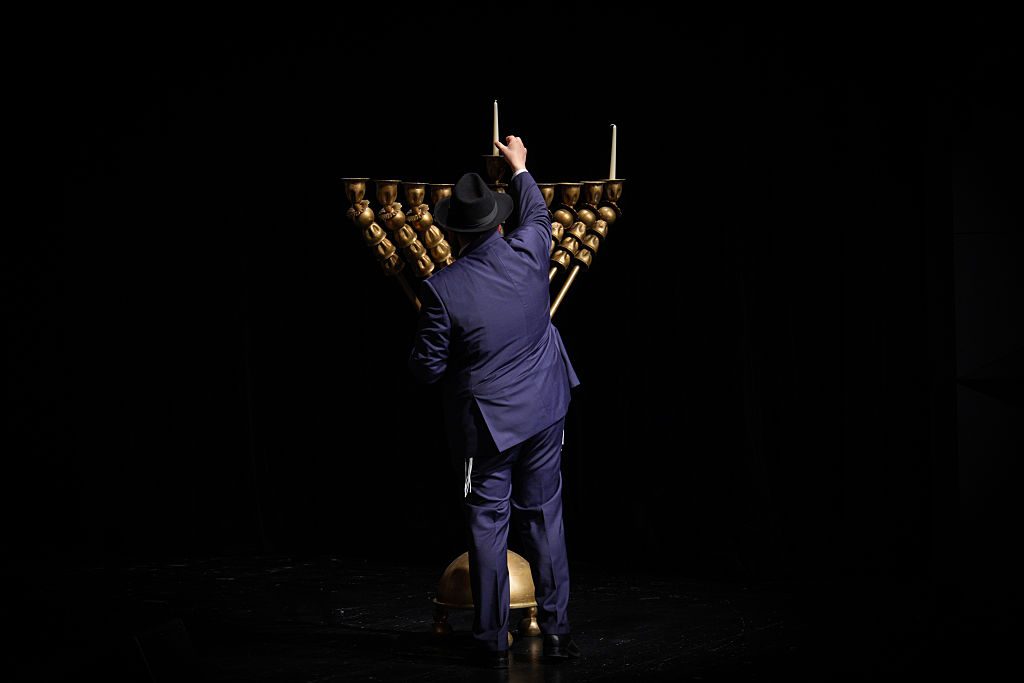
On Erev-Chanukah, last Saturday, we neighbourhood Jews gathered, as planned, to light candles. But the day began with the slaughter on Bondi Beach, and ended with the murders of our Community members, the Reiners.
We were grieving, which is to say, in a state of Cognitive Dissonance. Nothing made sense save that nothing made sense. The last thing we wanted to do was to abandon the safety of our grief for a “religious celebration”. Then an elder explained the Miracle of Chanukah.
We all knew that the desecrated Temple had to be rededicated, that the resanctification required illumination of the sacred lamps. We knew, from childhood, that there was Only Enough Oil to burn for one day, but that the Jews lit the lamps and they burned for the required eight days. We all knew the persistence of the lamps was a miracle; but the Rabbis wrote that the true miracle was not the length of the lamps’ illumination, but that the Jews, knowing the oil was insufficient, lit the lamps in any case. As commanded.
After we heard the story, and, still grieving, we lit the lamps.
As Chanukah is, finally, the Festival of Lights, I’ll end with this note: in Sydney, at the Great Synagogue, I was in line, waiting to be frisked, and a man behind me said, “Aren’t you David Mamet?” I admitted I was. He wished me an easy fast, and a Good Inscription in the Book of Life, and said he was honoured I’d come to his shul.
I asked his name, and he told me. He was the shul’s Rabbi. The line had moved up, and the armed guard saw us talking and asked, “Rabbi, shall I just pass him in…?” “Nah,” the Rabbi said, “frisk him.”
Happy Chanukah.