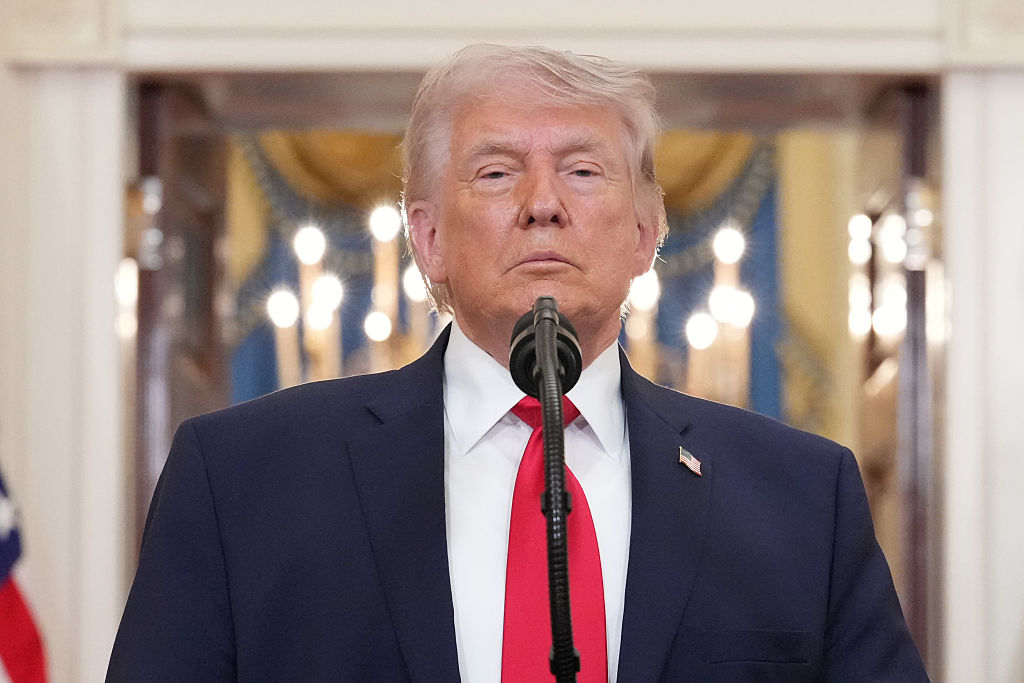
Several new polls show that President Donald Trump is losing a big part of the coalition that helped send him back to the White House: young men. These findings could no doubt have an impact on the GOP during the midterms. But if history has taught us anything about voters, it’s that public opinion is volatile and tricky to gauge. Too often, it seems that no matter what governments do, they can’t satisfy a majority of Americans, usually fomenting backlash that the other party rides into power. Anybody familiar with politics knows this is the cost of ruling. Neither side seems to win midterm elections anymore – they just take turns losing. It’s a feedback loop with no sign of an off-ramp.
Governing Before Midterms
One reason this pattern has become such a dominant force, said political scientist Lee Drutman in his Substack, might be negativity bias. People tend to focus more on what is going wrong in the country than on what is going right. Voters rarely tally achievements, yet they typically keep a running list of disappointments, which only grows the longer a party is in power. Another reason is that coalitions often fragment. “It’s easy to unify at the start of an administration,” said Drutman, “but not everybody’s priorities can be first.” Compromises will disappoint some and push others across the aisle. “The coalition shifts. Until the next election, when the electoral map shifts slightly, enthusiastic winners call it a realignment, and the pattern repeats,” he added.
Of course, sometimes it’s as simple as a president’s party failing to deliver on its agenda or over-promising. Factions frequently say whatever is necessary to win, and sometimes they don’t live up to their words. Other times, once in power, a government moves policy too far in one ideological direction, often pushing away the median voter. Political scientist Christopher Wlezien, a professor at the University of Texas, estimates that this theory accounts for nearly half of the total cost of ruling in presidential elections. No matter how well one legislates, the result is often the same: less support. And the loss is often enough to flip control of the government.
“No modern American president,” said Drutman, “has figured out how to enact and deliver a policy agenda so overwhelmingly popular that the cost of ruling ceased to function. The doom loop does not self-correct. A thermostat with only two settings doesn’t correct. It oscillates with increasing amplitude.”
The Thermostat
In an article published in the American Journal of Political Science, Wlezien shares another theory: thermostatic politics. A household thermostat adjusts the temperature until it reaches a set point, then it stops. Wlezien suggests that public opinion works in the same way: When policy drifts too far from the public’s preferred “temperature,” voters express a desire for change, pushing government to correct course. Government responds, and the cycle repeats. The problem is that most surveys only capture what pollsters call relative preferences – whether people want “more” or “less” of something relative to the status quo. Policymakers must discern whether the shifts in opinion signal a change in ideology or a reaction to policy overreach, and they’re often left guessing.

Much of the public frequently wants the opposite of what a government offers. If it “increases welfare or defense spending,” explained Alexander Kustov in Good Authority, “the public tends to favor such spending less. Conversely, when welfare or defense budgets are cut, calls for increased spending grow louder.” Voters are not necessarily rejecting these policies; they sometimes only want a policy recalibrated. This is healthy for democracy, but “the problem,” said Drutman, “is that America’s thermostat only has two settings, neither of which is temperate.”
But there’s another factor here. Countless people who don’t closely follow politics shape their general perceptions of the government through the internet and mainstream media. The press typically amplifies every wrong turn the party in power makes and highlights problems more than accomplishments. Meanwhile, the opposition remains in the background with less scrutiny. What spreads across the digital landscape and cable television is mostly negative and often stirs public backlash, pushing the thermostat too far in one direction.
Caution: Hot
The cost-of-ruling pattern stretches back to at least the 1990s. It is particularly noticeable in the first midterm election after a president with unified control takes office. Under President Bill Clinton in 1994, Democrats lost 54 seats in the House and eight in the Senate, giving Republicans a majority in both chambers. During Barack Obama’s presidency in 2010, his party lost 63 seats and control of the lower chamber. In 2018, during Trump’s first term, Democrats flipped the House after the GOP lost 40 seats. The only recent exception to this pattern was in 2002, roughly a year after the attacks on September 11.
Trump and the GOP won with a clear agenda in 2024, but they also gained countless votes from people who were tired of the Democratic Party after four years of the Biden administration. Are some people unhappy with the Trump administration now? Of course – but that is expected. He was never going to please everybody, let alone every person who voted for him in 2024. Yes, it’s significant that CNN’s Harry Enten found that the president’s approval rating among men under 45 is minus 19 points and that Reuters/Ipsos revealed he has lost ten points among men 18 to 29. Perhaps that’s just the price of pushing such an ambitious agenda. Sometimes it doesn’t matter how much an administration achieves; the cost of ruling spares few governments.
But Republicans are facing more than a few bad polls. With a slim majority and a wave of departures coming in the House, they must also contend with the public’s urge to turn the dial. The GOP may have time to steady the ship, but sooner or later, every party in power gets burned.