There is entirely too much hand-wringing about the Gaza cease-fire. Israelis have a legitimate concern: The body of the final hostage is still in Gaza, and Hamas and other terrorist groups are dragging their feet. But the larger discourse of pessimism about the cease-fire is almost surely unwarranted.
For example, today’s CNN report: “President Donald Trump’s Gaza ceasefire plan is set to enter a new phase within weeks, but crucial pieces of the agreement remain undefined as Israel tightens its military grip on the battered enclave.”
All true. But so what? Here’s why the cease-fire was such a masterstroke: No matter how slowly it moves forward, there are bulwarks against its moving backwards. Gains are gains. They may be hard-fought, but they stay in the win column.
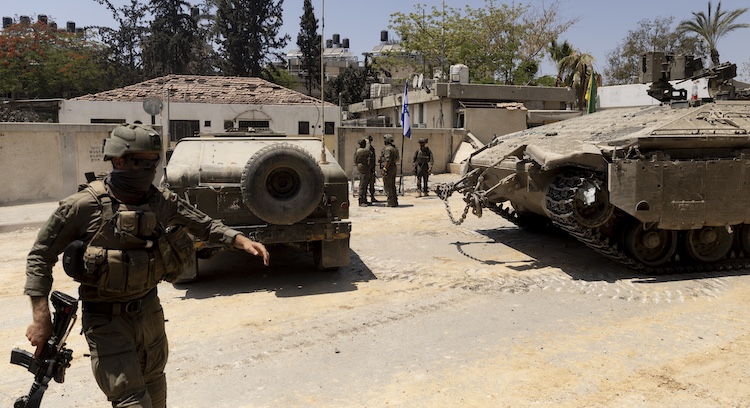
The structure of the cease-fire—which was signed by Hamas—requires no territorial retreat by the IDF until Hamas has fulfilled the prerequisites. The “yellow line” separating IDF-controlled territory from the rest of Gaza is in danger of becoming a border, Israel’s critics complain. But if it does, it is Hamas’s decision to make it so. Hamas signed an agreement that requires it to take certain actions in order to trigger the IDF’s disengagement. No one is stopping Hamas from doing exactly that.
IDF brass have made it clear that Israeli soldiers are to treat that yellow line as if it were Israel’s border. Some in the media have treated this statement as evidence of nefarious intent on the part of the Israeli political echelon. But it is the opposite: It is proof of Israel’s determination to uphold the cease-fire.
Again, this isn’t being imposed on Hamas against its will. It’s part of a deal signed by the two governments at war.
That point is worth expanding on. Hamas may not have agreed to the most favorable terms, but that is what happens when one side loses a war it started. Despite that, Hamas isn’t entirely unhappy with the current state of affairs. In return for giving back nearly all the hostages, dead or alive, the war has been paused. This has given Hamas the time and space to recover its bearings and to try to solidify its control over its half of Gaza.
The collective armies of Gaza understand that they can stretch out this phase of the process by stalling on the return of the final hostage’s body. That is why Israel is considering moving on to the second phase anyway—not because its leaders don’t care about the remains of Ran Gvili but because waiting for Hamas to trigger the second stage will itself incentivize Hamas to hold on to the body in perpetuity.
Refusing to advance to the second stage without the last hostage remains would be a significant strategic error on Israel’s part. For now, Hamas is waiting to see if it can bait Israel into exactly this error.
The pressure should be on Hamas of course, but also on the Arab states that have signed on to back the fulfillment of this deal. And on Europe, too, for that matter. Any time Keir Starmer and Emmanuel Macron move from pretending to care about Palestinians to actually caring about Palestinians, it will be welcome.
No one, except perhaps Hamas, wants this state of affairs to remain permanent.
At least that’s what they say. Let’s remember that after the Six-Day War, Israel was prepared to trade back the territories but the Arab states said, famously: no peace with Israel, no recognition of it, no negotiations with it.
Why were they so adamant? Because although they had lost the war against Israel, the Arab states received a consolation prize: The Palestinians were someone else’s problem now. Egypt was glad to be rid of Gaza and Jordan gave up its claims on the West Bank in the 1980s. The Palestinian Arabs could once again be used by the Arab world to weaken Israel with a permanent insurgency, unless by some miracle the Palestinians pulled themselves together enough for statehood.
The Arab states—and the wider Muslim world—are not exactly champing at the bit to contribute to the Gaza stabilization force that would be needed if Hamas were to be disarmed and replaced. Do they want Palestinian life rebuilt and the Palestinians given a chance to be free of Hamas’s totalitarian terror? Because from a certain angle, it’s starting to look as if maybe those Arab states would rather Gaza be split into an indefinite Israeli military occupation and a Hamas-controlled enclave. Perhaps the Arab world is not yet ready to contemplate the end of its conflict with Israel.