The Islamic Republic of Iran was always far more than a nation state. It was, as one insightful critic puts it, ‘the most ambitious political-theological experiment of the 20th century’. After nearly five decades, it’s an experiment that has failed catastrophically.
Despite its invocation of tradition, the Islamic Republic’s intellectual roots are thoroughly modern. They lie less in seventh-century Arabia than in the social and political tumult of 1920s and 1930s Egypt. For it was there that a very European disillusionment with Western liberal, capitalist modernity began to resonate with largely Cairo-based intellectuals’ resentment of Britain’s de facto colonial rule.
Young Egyptian intellectuals, drawn from an emergent class of professionals, teachers and bureaucrats, were increasingly attracted to European Romanticism – particularly its German variant – and its appeals to authenticity and cultural uniqueness. They saw in this counter-Enlightenment tradition, which culminated in the political modernism of the 1920s, a riposte to Western cultural influence on Egyptian national life. Appropriating its language, they railed against the materialism and soullessness of the modern West. They dreamed of an alternative society that allowed for an expression of their own cultural and spiritual essence – an essence that many saw in nationalist terms, but that some increasingly conceived in terms of Islam.
Though born in an anti-colonial context, Islamism, as this ideological current is now known, was of a piece with that other significant 20th-century political-aesthetic movement, namely fascism. It transformed Islam into a challenge to a war-torn Western modernity, a solution to the crisis of liberalism and capitalism. Islam was no longer a faith – it was a revolutionary ideology. A theological-political project that promised to remake this world, filling people’s lives with meaning, purpose and values. Hassan al Banna – who in 1928 founded the Muslim Brotherhood, Islamism’s principle movement – put it as follows: Islam was not just ‘a religion’, it was also ‘a civilisation, a way of life, an ideology and a state’. Like Mussolini’s fascist state, there was to be nothing outside the Muslim Brotherhood’s Islamic state – it subsumed every individual.
Islamism was also a struggle, a jihad – or indeed a Kampf. A struggle, that is, against those living in a state of ignorance, of jahiliyyah worshipping false idols. A Kampf against Western imperial powers (above all America) and their supposed Middle Eastern outpost of Israel. A jihad against a secular Western society that has divested God of authority, and invested it in man. As Sayyid Qutb, the most influential of all Islamist ideologues, put it in Milestones (1964), there is ‘No sovereignty except God’s, no law except from God, and no authority of one man over another as the authority in all respects belongs to God’.
This was and is Islamism. A modernist, counter-Enlightenment movement that posits Islam as the revolutionary answer to a decadent, imperial West. A vanguardist struggle for ‘the moral purification of society’, as Qutb had it. An attempt to purge Muslim nations of inauthentic, corrupting Western influence, so as to free their authentic Islamic essence. A project to construct a state over which Allah and of course his earthly, clerical interpreters were sovereign. And a mission to continue all this struggle well beyond the borders of the nation and even the Muslim world, in a near-enough cosmic battle with the Western, American and Israeli forces of jahili society – that is, a society ignorant of divine law.
Flourishing amid the defeat of its ideological rival, Arab nationalism, in the late 1960s, Islamism found its most powerful embodiment in the non-Arab Islamic Republic of Iran. Not that the 1979 Iranian Revolution, which ushered in the Islamic Republic, was itself solely or even mainly Islamist. It was fuelled by understandable, anti-imperial discontent with the West-backed authoritarian regime of the shah. It brought together New Leftish, Third Worldist cultural opponents of ‘Westoxfication’, a restive organised working-class and a rebellious clerical class.
But it was the Islamist element, profoundly influenced by the Muslim Brotherhood and above all Qutb, that prevailed in the revolution’s aftermath. This was helped in no small part by the shah’s prior imprisonment of left-wing leaders and, most importantly, the fact that the leftist elements championing the revolution drew from the same anti-Western, counter-Enlightenment wellspring as Islamism itself.
The triumph of Islamism was writ large in the 1979 Constitution of the Islamic Republic of Iran. Following an initial draft drawn up in early 1979 by the French-educated sociologist Hassan Habibi, the so-called Assembly of Experts for Constitution, dominated by Ayatollah Khomeini loyalists, heavily revised it along explicitly Islamist lines. The preamble is replete with Islamist tropes. The revolution is framed as a ‘cleansing’ of ‘the dust and impurities’ that accumulated during the non-Islamic past, a ‘purging’ of ‘foreign ideological influences’, and ‘a return’ to the ‘authentic intellectual standpoints and worldview of Islam’. The system of government, it asserts, is to derive its authority and legislative power not from the people, but from God (‘His exclusive sovereignty and the right to legislate’) – this is straight out of Qutb.
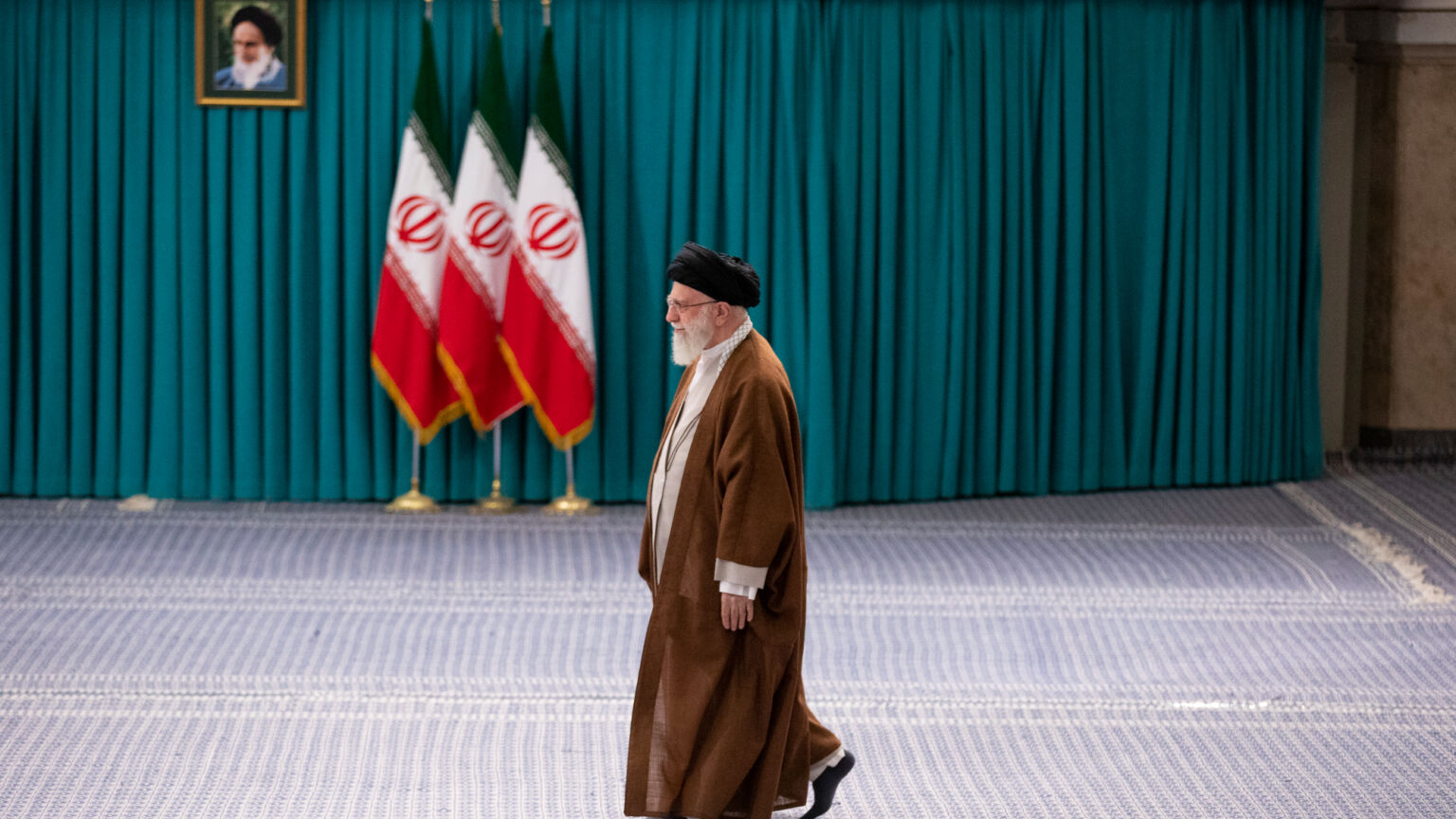
The one, distinctly Shia innovation is the ‘Wilayat al-Faqih’ – the rule of the jurisprudent. Developed by and for Khomeini, it asserts that a qualified Islamic jurist should hold supreme political and religious authority – in other words the position of ‘supreme leader’ that Khomeini was to occupy.
Outside of that, the Islamic Republic’s constitution – with a few now grimly ironic nods to tolerance, equal rights and Iran’s democracy – is an Islamist proof of concept. It’s a reactionary experiment in modern political theology. Shot through with a crusading, almost messianic zeal, it claimed to provide ‘the necessary basis for ensuring the continuation of the revolution at home and abroad’.
Over the past five decades, the Iranians and indeed much of the wider world have come to know at great cost what ‘the continuation of the revolution’ actually means. Within Iran it has meant perpetual repression, an unrelenting Kulturkampf waged against Westernisation that brooks no dissent. It has meant the detention and torture of countless Iranians and the slaughter of many more – all in the name of protecting the revolution.
Outside Iran, it has meant cultivating and supporting an ultra-violent, region-wide network of Islamist proxies, driven by anti-Western and anti-Semitic animus. It has meant the fatwa against Salman Rushdie in 1989, the devastation of Yemen during the late 2010s and early 2020s, and, on 7 October 2023, the worst massacre of Jews since the Holocaust. This struggle alongside other ‘Islamic and popular movements to prepare the way for the formation of a single world community’, as the constitution has it, has caused untold suffering and torn the Middle East apart.
The Islamist dynamic at work in the Islamic Republic is internally repressive and externally crusading. It derives its authority from Allah’s representative in Tehran, and demonstrates its legitimacy through a never-ending war with the satanic forces of America, Israel and the West. All this was evident almost from the very inception of the Islamic Republic.
Already by March 1979, Khomeini had mandated the hijab, presenting it as a crucial weapon in the battle to rid Islamic society of Western ‘impurities’ – such as, presumably, women’s right to show their hair. He also clamped down on dissent and political challengers.
The brutal Iran-Iraq war (1980-1988), which cost the lives of some one million soldiers and civilians on either side, only intensified the repressive climate. At the war’s close, the Islamic Republic began organising mass executions of political prisoners, invariably labelling them traitors to the revolution for allegedly siding with Iraq. They were loaded on to trucks before being taken to specially chosen sites where they were hanged en masse. Used to take out the clerics’ leftist opponents, and sometime allies during the revolution, this wave of state killing represents one of the largest mass executions in postwar history – with an estimated death toll ranging from anywhere between 4,000 to 30,000 people.
At the same time as the Islamic Republic was purging Iranian society of ‘inauthentic’ elements, it was zealously promoting Islamic authenticity abroad. The Jewish State – the inauthentic, ‘settler-colonial’ Zionist entity – was presented as the main, initial obstacle to its worldwide mission. In a highly symbolic act immediately after the revolution, the Islamic Republic shut the Israeli embassy in Tehran, refused to recognise the existence of Israel as a state, and promptly invited Yasser Arafat’s Palestine Liberation Organisation to move into the now empty premises. Three years later, Khomeini sent Islamic Revolutionary Guards to Lebanon, to support Shia militias in a localised war with Israel. In a sense, the Islamic Republic never left Lebanon, building and backing the Hezbollah militia, and turning it into an omnipresent, anti-Semitic menace on Israel’s northern border.
Khomeini’s death in 1989 didn’t change the Islamist dynamic. If anything, his successor, Ali Khamenei, reinforced it. He maintained the war-time expansion of the Islamic Revolutionary Guards Corp and, alongside the volunteer Basij militia, turned it into a several-hundred-thousand strong security force. It was tasked with protecting the Islamist revolution at home, and driving it on abroad.
The Islamic Republic, with the IRGC orchestrating affairs, began ploughing billions into supporting an ever-growing network of Islamist militias (the so-called Axis of Resistance) across the Middle East and beyond – with Iranian backing, Hezbollah detonated a truck bomb outside the Israeli embassy in Buenos Aires in 1992, killing 30 people, including children. And it struck again in Buenos Aires in 1994, bombing a Jewish community centre, killing 85 people. That was just the start. Since the early 1990s, Iran struck up an ever closer relationship with the Muslim Brotherhood-inspired Hamas in Gaza, before expanding its reach into Iraq during the 2000s, and Syria and Yemen in the 2010s.
That wasn’t all. Under Khamenei, the clerical-IRCG nexus also began enjoying the fruits of Iran’s growing, but still mercantilist economy. Iran’s rulers took ownership of large parts of the Iranian economy, siphoning off income and invariably investing it in property and assets overseas. As one Iran expert astutely observes, the Islamic Republic ‘became the extractive state par excellence, with the only real variable being the price of oil’.
Indeed, economically, Iran enjoyed something of an oil-fuelled economic boom in the 1990s and especially 2000s. During the presidency of Mahmoud Ahmadinejad, between 2005 and 2013, it is estimated that Iran earned more from oil than it had done at any point in its history. Thanks to the lack of state auditing, few are sure where all those billions went.
The Islamist dynamic of the Islamic Republic was firmly and violently at work during these first few decades. Yet many within and without Iran still harboured hopes that reform was possible. That somehow, the dominant Islamist elements of the regime could give way to the more republican aspects of the constitution. Those hopes finally began to ebb in 2009.
On 23 June that year, the presidential election delivered a widely disputed victory for the Islamic hardliner, Mahmoud Ahmadinejad, at the expense of the popular reformist candidate, Mir Hossein Mousavi. Two days later, following a state-organised pro-Ahmadinejad rally, tens of thousands of Iranians spilled out on to streets of Tehran, armed with the slogan, ‘Where Is My Vote?’. This was the beginning of the so-called Green Movement, a series of sprawling protests and acts of civil disobedience that continued for months until the state cracked down. There were countless detentions and beatings, and Moussavi was placed under house arrest.
This was a key moment. The protesters weren’t revolutionaries. They weren’t seeking the end of the Islamic Republic. Largely from Iran’s middle-classes, they had mild, reformist attitudes. And yet, in response, Iran’s rulers revealed their true Islamist faces, their intolerance of even tepid democratic disagreement. No deity except Allah. A senior Iranian cleric, Ayatollah Mohammad Taqi Mesbah-Yazdi, invoked the constitution, claiming that the supreme leader’s authority comes from God, not the people – and that the protesters therefore have to submit to Khamenei’s president, Ahmadinejad. Obedience to Ahmadinejad is effectively obedience to God, he said. And vice versa – protesting is un-Islamic.
Khameini went further. He framed the Green Movement as an enemy of the revolution, a product of Western corruption that must be purged. To quell and silence the demonstrations was proof of his regime’s rectitude, its revolutionary virtue. As he put it in 2011, ‘A revolution that cannot defend itself in an age of sedition, against various political or military coup attempts and other such acts, is not alive. This revolution is alive, for it defends itself and indeed prevails and wins.’
With grim prescience, Islamic Republic officials let it be known in 2009 that they would be happy to kill 10,000 people or more to save the regime. They were saying the quiet part of this Islamist project out loud – namely, that the Islamic Republic was for itself, not for the Iranian people. Its crusading, revolutionary mission was more important than even their lives.
From that point on, with international sanctions exacerbating the crisis of Iran’s deeply dysfunctional economy, the antagonism between the Islamic Republic and the Iranian people has slowly but surely intensified. And the reformist charge of the Green Movement has been supplanted by a challenge to the very Islamic Republic itself.
This broke out into the open in 2017. Amid countless labour disputes – in the very working-class, conservative cities and towns that the Islamic Republic liked to depict as its core constituency – young, disenfranchised, immiserated Iranians came out in angry protest against the ruling theocrats, chanting ‘Death to the dictator’ in the direction of Khamenei. The security forces moved in with brutal, lethal efficiency.
Then in 2019, something similar happened. Following a hike in petrol prices, unrest broke out in some 100 cities and towns – and again the target was the regime itself. It is estimated that over 300 people were killed in the subsequent crackdown.
But the Iranians, demonstrating incredible bravery, have continued to grow more restive, more revolutionary – against the sacred Islamist revolution. In 2022, after the death of a young Kurdish woman, Mahsa Amini, at the hands of the security forces who arrested her for not wearing a hijab, the ‘Women, life, freedom’ protests erupted across Iran. The chants of ‘Death to the dictator’ were accompanied by a clear demand for basic freedoms. And again the regime clamped down with lethal force, killing upwards of 1,500.
And all this before we come to the mass protests that exploded across Iran from the end of December last year and into January this year. The trigger may have been economic, as Tehran’s Bazarris shut up shop following the collapse of the currency. But the subsequent movement was thoroughly political in aspiration, amounting to a call for the end of the Islamic Republic and a demand for civil liberties. The Islamic Republic responded in the only way it knows how – by slaughtering somewhere in the region of 30,000 Iranians.
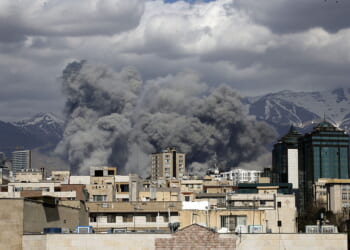
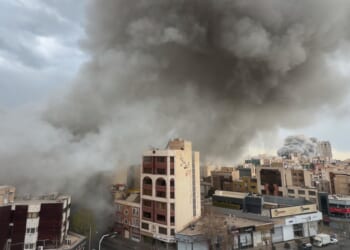
Long before the brutalising US-Israeli attempt at something that looks like regime change, this was a regime already in its death throes. Its Islamist commitment to continuing the revolution at home had long turned into a jihad against Iranians – their every gesture of dissent damned as the product of foreign interference. And its Islamist commitment to ‘liberating’ all ‘deprived and oppressed peoples in the world’ from Western / American / Zionist influence, as its constitution has it, has ultimately brought the anti-Semitic war waged by its proxies right back home, into the heart of Iran itself.
In the eyes of Iranians, the Islamic Republic has long-since lost whatever virtue it might once have claimed to have. They have had to suffer basic shortages of electricity and water, while the regime pumps billions into promoting a genocidal war with Israel. And when they have tried to take back some measure of freedom – to dress how they please, to express a democratic view – they have been violently and lethally suppressed. All in the name of Islamic values.
This explains a telling paradox. The most ambitious theological experiment of the 20th century, this testament to Islamism, is now home to the most secular populace in the Middle East. In the heart of the Islamic Republic, un-belief is flourishing like nowhere else. So much so that in 2023, high-ranking Iranian cleric Mohammad Abolghassem Doulabi revealed that two-thirds of Iran’s mosques – 50,000 out of 75,000 – have been closed due to declining attendance.
Whatever happens after this awful war concludes, the Islamic Republic will fall. Not, as Islamists around the world will insist, because of Western force, be it economic or military. But because of this reactionary project’s own internal contradictions and pathologies. It talks of liberation, while demanding submission to ‘no other deity but Allah’. It commits a nation’s resources to fighting the evil of Westernisation and Zionism, while being unable to provide Iranians with even the most basic necessities of life. And in the name of revolutionary Islam, it murders its own people.
Like fascist Italy or Nazi Germany, the Islamic Republic was born of a very modern, counter-Enlightenment ideology. Let’s hope it too is soon consigned to the dustbin of history.
Tim Black is associate editor of spiked.