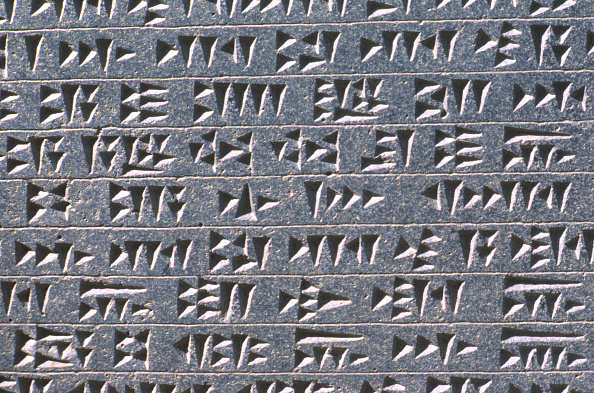
When writers mention “writing” or “literacy” these days, they tend to do it as part of an obituary. Man’s ability to read and write was born in the Mesopotamian city of Uruk, when the ancient Sumerians used clay tablets to record the story of Gilgamesh, He Who Saw the Deep, slayer of the fearsome Humbaba. Over the course of its long and productive life, human literacy gave us the Odyssey, the Mahabharata, Hamlet, Middlemarch — not to mention all those lovely prize-shortlisted novels that sit on our bookshelves waiting for us to get round to them. Then, in the first quarter of the 21st century, it underwent a precipitous decline: children started using iPads in restaurants, bookstores stocked nothing but hastily written multi-book series about elves bonking goblins, and everyone got really into podcasts. Before long, the only thing left for the few remaining literate people to do was shuffle around like members of a dying priestly order, holding candlelit vigils, muttering commemorative chants, as the rest of the world sank into a period of barbaric “secondary orality”. Literacy: 3000 BC – 2026 AD. Requiescat.
In February, however, a pair of archaeologists published a paper that suggests we might have got the story of human literacy rather wrong. Christian Bentz and Ewa Dutkiewicz are researchers at the University of Saarland, who for the last few years have been finding strange artifacts across the Jura mountains in Southern Germany. All of them date from between 43,000 and 34,000 years ago — an era known as the Aurignacian; the final throb of Europe’s last ice age, when mankind subsisted in small, itinerant, mammoth-hunting bands. The type of object varies greatly: archaeologists have unearthed flutes, carvings of animals, humanoid figurines, even strange monsters with the limbs of men and the heads of lions. All of them, however, have one thing in common. Their surfaces are engraved in strange, looping patterns with the same set of 22 symbols.
Feeding the patterns into a piece of software that measured different symbols’ statistical frequency, Bentz and Dutkiewicz realized that, whether they were unearthed in the lowlands of one end of the Jura region or the mountainous Swiss border at the other, the patterns tended to proceed in a remarkably regular way. The most common symbol was a V-shaped notch, followed by various lines, crosses and dots, plus a few complicated symbols, such as Y- and star-shaped signs, that are used only very occasionally. Clearly, the symbols were not merely decorative. They seemed, in fact, to be encoding something — recording information, just like the clay tablets of Uruk, except older by about 40,000 years.
There was, however, one problem. Though the symbols clearly meant something, they clearly could not be a transcription of any kind of spoken language. The patterns are simply too repetitive, with the most common characters — the V-shaped notch in particular — often recurring 10 or 20 times in a row. If the symbols were simply letters corresponding to phonemes like in English, then the words they expressed could not be uttered like a human — there would be too many words like “ggggggggggahlllllllo” and “bbbbbbrpfff”. If they were ideograms like in Chinese, then they would amount to a single concept repeated over and over again — there would be lots of sentences like “cat dog cat cat cat cat cat cat cat cat cat”. Neither of these seemed particularly likely. What, then, did the symbols mean?
Bentz and Dutkiewicz’s solution is to suggest that the phenomenon of “writing” might not be so unitary as we once believed. For the first 40,000 years of its existence, it was simply an abstract symbolic system to process complex data; only in the last 3,000 years did mankind acquire the strange notion that these sign-systems might correspond to the grunts and gurgles they used for everyday communication. Writing, in other words, is two separate inventions: “protowriting”, which bears no resemblance to the spoken language, and “modern day writing”, which does.
“Writing is two separate inventions: ‘protowriting’, which bears no resemblance to the spoken language, and ‘modern day writing’, which does.”
How did protowriting work in practice? The anthropological record gives us a clue: the of Peru, for instance, had their quipu, a set of colored strings with complicated patterns of knots that were used to record tax revenues and grain yields; the Iroquois of the American plains, meanwhile, have their wampum belt, upon which are threaded different types of shell and bead that record treaties and alliances between tribes. But perhaps the most intuitive way to understand protowriting, is to realize that we use it all the time. We are protowriting whenever we tally something up on a sheet of paper, or whenever we mark a date with a cross on a calendar — whenever, in short, we write something down that we can’t actually say. Bentz and Dutkiewicz’s best guess about the meaning of the Jura carvings is that they were used to record the yields from past hunts in years gone by — in other words, a cross between a tally and a calendar.
Perhaps the most interesting thing about Bentz and Dutkiewicz’s insight, though, is the way in which it forces us to reconsider some of the fashionable prognostications about the future of reading and writing that are currently doing the rounds in the media. The “decline of literacy” is much invoked these days: perhaps most influentially by James Marriott, whose blockbuster essay “The dawn of the post-literate society” predicts a rapid “draining away of culture, critical thinking and intelligence” as societies lose the ability to read; but also by the rank-and-file of educational policymaking, who are discerning, in the words of the National Literacy Trust, “the lowest levels of reading enjoyment and daily reading in a generation”.
If literacy is two separate technologies, however, then this raises the question of which type of literacy is really declining. And it doesn’t require too much sociological insight to realize that the crude, record-keeping, tabulating function of protowriting is still very much intact. The average citizen spends more time than ever clicking through inane online forms, reading returns policies, sifting through gas bills to work out whether they have been overcharged. At work, people are surrounded by written information: it flashes up on their office Slack channels, whooshes into their email inboxes, chimes up at them from their phones. What has disappeared is the expectation that the little symbols we encounter should bear some relation to the way we speak — and the corollary that we should aim to deal with written texts via a kind of sustained, immersive attention, like we afford our interlocutor when we are having a conversation. We are, in other words, all Aurignacians now.
In a sense, then, LLMs have only accelerated this reversion to the stone age. After all, what are ChatGPT and Claude if not ways of avoiding the hard graft of making one’s prose conform to the norms and rhythms of the spoken language? The hardcore LLM user treats language as basically ideographic or hieroglyphic; he does not bother typing out sentences; he simply pulls up the interface, taps something like “ePic Giglamsh plot smmry bullet pts simple revisn” into the search bar, and waits for the machine to extrude its nice, chatty précis: “Certainly! Here’s a clear bullet-point plot summary of the Epic of Gilgamesh to help you with your essay or upcoming exam.”
Does this mean, then, that the prophets of literacy’s demise are right? Perhaps not. After all, the written word has been trying to scuttle back in the direction of the Aurignacian carvings for as long as it has existed; even the most literate societies in history have required a dedicated squadron of artists and poets to yank the language continually back towards the vernacular. Dry, scholastic medieval Latin had to be rescued by Dante and Petrarch; frilly late Sanskrit, with its page-long compound words, needed to be put out of its misery by Tulsidas and Kabir. Even the “reading revolution” — the late 18th-century and early 19th-century efflorescence of poetry and novels beloved by those most concerned about the trajectory of human literacy — was built on similar agonisms. Despite all the Romantic poems, and realist novels, the fact remains that most of the writing undertaken during this period was decidedly non-literary: constitutions and penal codes drawn up by lawyers to fill the holes where absolute monarchs had once been; political pamphlets and propagandistic feuilletons cobbled together by journalists from barely comprehensible new abstractions; and modern bureaucracies that carried out levels of tabulation and record-keeping of which the Aurignacians could only dream. The literature of the period was an attempt to rescue the writing from this sorry condition — to reacquaint the written word, as Wordsworth, with “the language really used by men”.
Clearly, the new crisis of literacy isn’t quite the same as the one Wordsworth discerned at the beginning of the 19th century. There are certainly new phenomena to contend with: twitchy, under-socialized children who scream if denied access to the family iPad, and college literature students who can’t comprehend a page of Dickens. But still, the those concerned about the “literacy crisis” would do well to remember the essential inevitability of “crisis” in the history of writing. Literacy always involves a tussle between the demand that writing be like speech, and the temptation to treat it like a simple Aurignacian sequence of chips and notches, a kind of autonomous code. And if the history of writing tells us one thing, it is that whenever writing looks most lost — whenever it seems to have lost all relevance to human lives, and decayed to pure, sterile manipulation of symbols — a new form might just be about to explode into being.