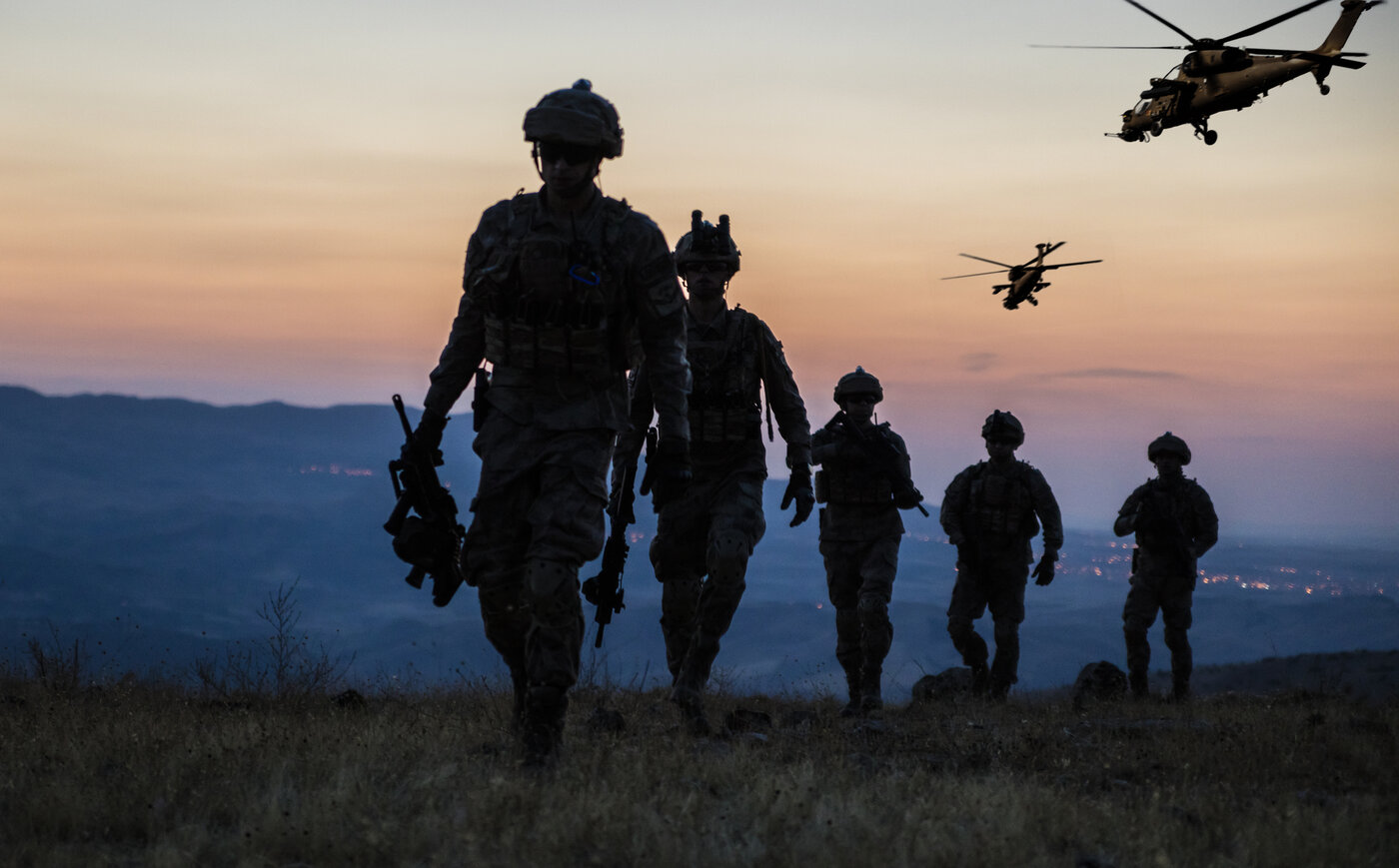
A week and a half into the Iran war, supporters of the conflict have already begun proposing new ways to achieve its shifting objectives. The latest, and perhaps most ambitious, has been to use Special Operations Forces (SOF) raids to seize Iran’s dispersed stockpiles of highly enriched uranium. Proponents argue that such raids could accomplish a critical war aim without committing the United States to another “forever war.” In reality, the so-called “commando option,” while perhaps technically feasible, would be extraordinarily risky, operationally complex, and unlikely to accomplish its stated mission.
Iran’s nuclear facilities—such as Fordow and Natanz—are large, heavily fortified installations. A small team of SEALs or similar “Tier One” operators would be insufficient. The initial assault alone would require a company-sized element, or larger.
Similarly, the assaulting force would require a considerably larger blocking force to control access to the site and repel a possible attack. Depending on the terrain and the size of the facility, the blocking force alone could approach battalion strength (1,000+ personnel). Additionally, the assaulting force would require specialized troops and equipment, such as engineers and earthmoving equipment, all of which would greatly complicate an already daunting logistical problem.
And then there is the issue of time. The colloquial use of the term “raid” implies speed and precision. The clearing, securing, and exploiting of each site would take considerably longer than a traditional SOF raid. The team would need to achieve its mission while presumably under hostile fire. Each raid could quickly devolve into a pitched battle against an enemy capable of bombarding American forces with missiles and drones from relatively close range, limiting the ground force’s ability to respond. While the US has demonstrated an ability to defend fixed installations against such weapons, its experience in defending troops in the field is limited. Such a risky operation would be an unwise venue to test such a capability.
The operation itself would be a daunting undertaking, but its logistics would be even more so. Setting aside the issues of getting such a force into one of these sites, the question becomes how to extract the seized uranium—all 970 pounds of it—from deep inside Iranian territory. And that is just what is known.
Finally, such an operation would likely have to be executed not once but repeatedly—perhaps indefinitely—as the Iranian regime has dispersed its stockpile.
Special Operations Forces cannot do everything. They are a scalpel that policymakers in Washington, DC, have tended to use as a multitool. Their proposed use in Iran for seizing the regime’s stockpile of enriched uranium is but the latest idea in this trend. It is also the most reckless—an idea closer to fantasy than to feasibility.