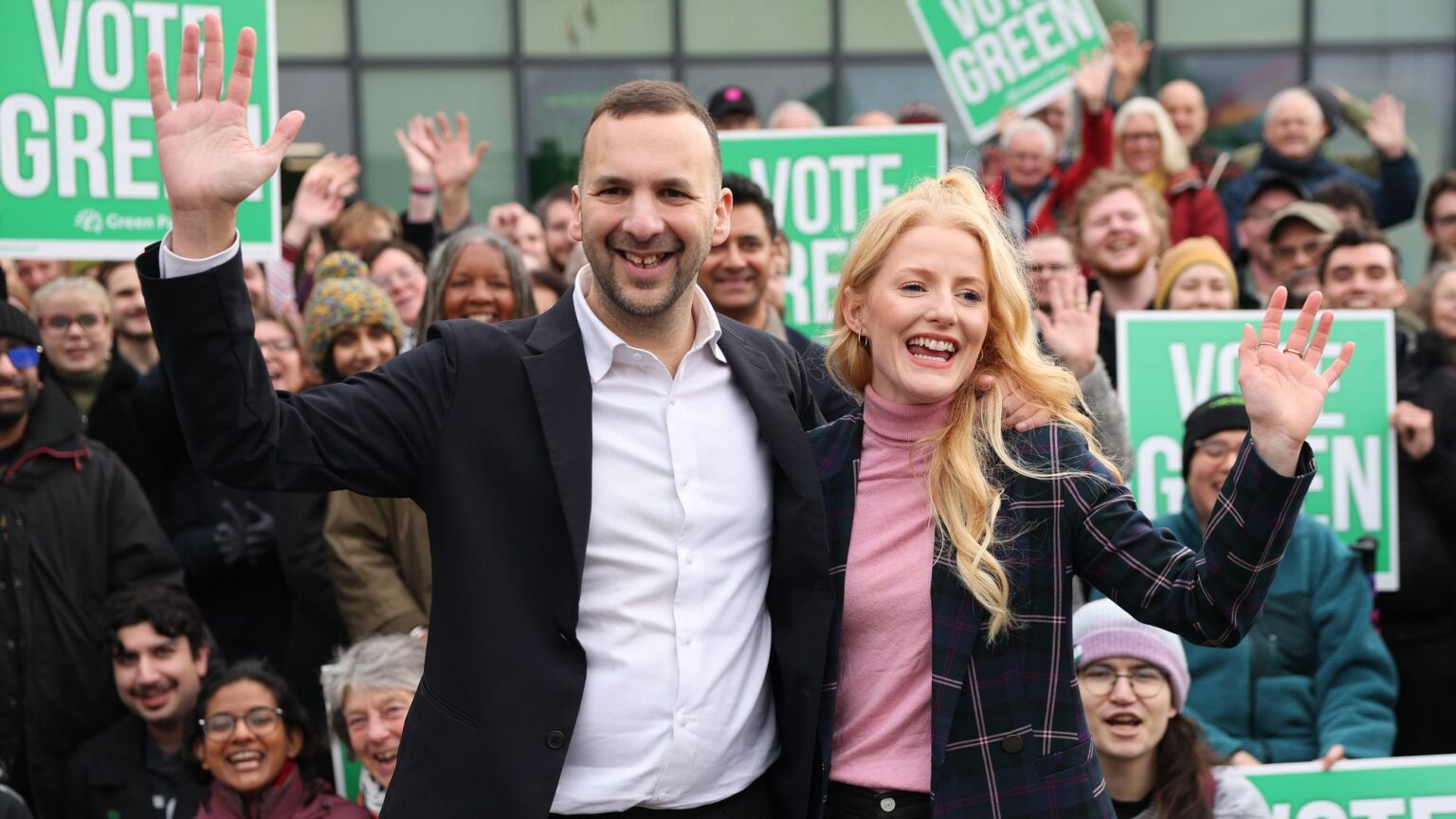
This year has already seemed to augur a momentous break in British politics. The result of last month’s Gorton and Denton by-election, in which the Green Party and Reform UK took first and second place, has in the eyes of many signalled the end of the traditional, two-party system. In response, it has become common to remark that these outfits merely represent two sides of the same coin, or more specifically, to grouse that they’re just as awful as each other.
‘We now have a polity made of two populist blocks, Reform and the Greens, prepared to say anything, however incendiary, in order to win’, said Janice Turner in The Times following the by-election. Elsewhere, Camilla Long in The Sunday Times characterised our new order as a choice between the Jew-hating, pro-Palestinian lot or the ones who want to deport Muslims. Never one to miss an opportunity to sneer at ghastly arrivistes, Matthew Parris added in his Times notebook last week: ‘These Reform and Green Party outfits are a cartload of clowns, joined by a handful of serious people driven by nothing but a notion of riding to office on the backs of a crowd of what Lenin called useful idiots.’
The problem with such judgements is that they’re forged from a superior vantage point, hence the unedifying air of haughty disdain to this commentary. To view this transformation in British politics from such a narrow perspective is to restrict one’s understanding of what’s really taking place. In truth, far from being populist bedfellows, the Greens and Reform are both pushing in polar opposite directions.
With their high-taxation, pro-immigration, pro-windfarm and pro-EU policies, and their solid endorsement of identity politics, whether it be trans rights or ethnic-minority recognition, the Greens represent the perpetuation of a consensus that has lorded over British politics for decades. What distinguishes them from Labour is not so much their stance on these matters, but their determination to push them further and deeper: they only seek to accelerate the consensus in areas pertaining to the economy, society and culture.
Reform UK, conversely, is driving in the opposite direction, either seeking to halt the march of what the elites call ‘progress’ – it is of course no such thing – or to turn the clock back. Their detractors are unwittingly correct when they mock Reform as a reactionary party which has its chief appeal in nostalgia. They do indeed appeal to a lost era, when Britain wasn’t crippled by taxation, Net Zero zealotry and fragmented by identity politics, when being patriotic wasn’t taboo. This was a place where you weren’t cancelled or collared by the police for expressing opinions deemed ‘offensive’, where it wasn’t official policy for institutions to discriminate on the grounds of skin colour when it came to hiring staff, where the authorities didn’t genuflect to religious intimidation. It’s not a mythical, halcyon age their supporters pine for. The Britain they miss is one they actually remember.
In his new (and otherwise perceptive) book, Centrists of the World Unite!, Adrian Wooldridge concludes: ‘Left-wing and right-wing extremists are not really opposites but evil twins.’ It takes a lofty centrist to make such a blinkered observation.
If the Greens and Reform together represent the future of British politics, this doesn’t so much suggest a recalibration, but a continuation of politics as they’ve always been – only with greater intensity.
Henceforth, we will have a collection of optimistic, collectivist leftists who thirst for change, who see salvation in the future, who want to press forward come what may. On the other we will have a coterie of pessimistic, individualist conservatives who are attached to their country, its history and people like themselves – people who are suspicious of recent changes and are rather fond of how things used to be.
Woke bigotry
The Office of Equality and Opportunity last week issued fresh guidance to employers in England, urging them to refrain from using ‘stereotypically masculine’ language, including terms like ‘competitive’ and ‘ambitious’ in job adverts, because it believes such wording can deter women from applying for jobs. The women and equalities minister, Bridget Phillipson, thinks that removing such forbidding, macho talk would ‘ensure women can thrive’.
The only one who’s reinforcing negative stereotypes here are the Labour government and Phillipson herself. All this move will do is entrench stereotypes that many, not least feminists, have for eons been trying to dismantle: the idea that women can’t be assertive, strong or independent.
This suggestion is straight from the hyper-liberal playbook. It mirrors recent and equally retrograde trends regarding race in the US – chronicled irreverently by Nellie Bowles in her 2024 book, Morning After the Revolution – where the woke have condemned the qualities of objectivity, linear thinking, perfectionism and even ‘being on time’ as being inherently ‘white’. This, too, merely reinforces age-old prejudices about black people.
Just because some aspects of the human character have for centuries been attached to and associated with a class of people now characterised as humanity’s historic oppressors (men and white people), it doesn’t mean those traits should be rejected wholesale. Yet some people are so consumed with their abhorrence of these two groups that they either don’t notice or don’t care how bigoted they’re being.
Better than the real thing
While spiked’s editor swanned off the other week to see Morrissey perform at London’s O2 Arena, I contented myself with a visit to Margate last Saturday, to watch in a pub a performance by The Joneses, one of many current tribute bands to The Smiths.
Tribute bands first appeared in earnest in the 1990s. The emergence of this phenomenon – epitomised by such acts as the Bootleg Beatles and The Australian Pink Floyd Show, who became headline acts in their own right – was deemed fitting for a time when postmodernism was all the rage. One of the many dichotomies declared ‘collapsed’ back then was that between the real and the artificial. Everything was now ‘hyperreal’, wrote the doyen of that movement, Jean Baudrillard, with U2 joining in the spirit of the age with their 1991 song, ‘Even Better Than the Real Thing’. I saw two tribute bands to The Who that decade, and I also couldn’t help wondering if these youthful, energetic impersonators were better than the creaking real thing.
Hyper-liberalism may be the most deplorable legacy of postmodernism, but we should also appreciate what good came from it. Alas, I have never seen The Smiths play live. But being part of a collective of like-minded middle-aged people last Saturday, joyously singing as one to that paean to teenage despair, ‘Heaven Knows I’m Miserable Now’, is a memory I shall cherish forever.