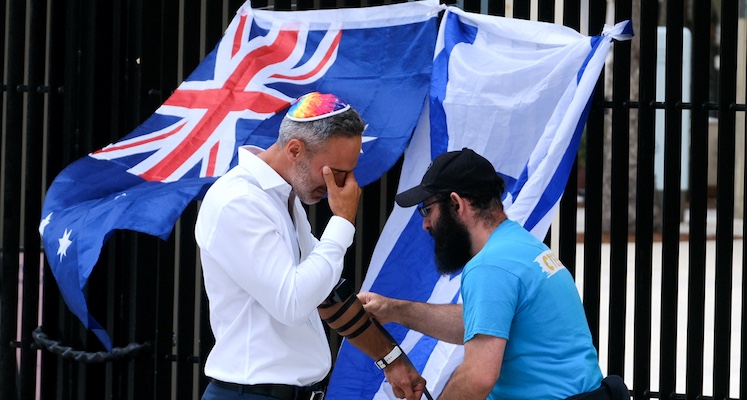
The Adelaide writers festival canceled its invitation to an author whose appearance was deemed, in the wake of the Bondi Beach massacre, in poor taste.
The writer, the Australian-born Randa Abdel-Fattah, is blaming something fascinatingly termed “anti-Palestinian racism.”
The actual reason appears to be that she has said “if you are a Zionist you have no claim or right to cultural safety.” The call for Jews to be denied safety by an Australian does indeed seem a bit impolitic considering all the vigilante Jew-hunting there. She reportedly also posted: “The goal is decolonisation and the end of this murderous Zionist colony”—a rather genocidey thing to say.
The response has been predictable: Dozens of authors pulled out of the event in solidarity with Abdel-Fattah, and the festival’s employees are currently being subjected to a campaign of threats. “In one email,” notes the Advertiser, “an irate critic of Dr Abdel-Fattah’s axing made ‘threats’ about the raping of children.”
The framing of this by Abdel-Fattah and her supporters as a kind of “cancel culture” is interesting, because Abdel-Fattah is a vocal proponent of such cancellations. The obvious example is her call for the general public to ensure Jews (sorry, “Zionists”) are unsafe in public. Even the most generous reading of that statement is that Jews with opinions she doesn’t like should be removed from public spaces where they might share those opinions.
But Abdel-Fattah also led the charge in 2024 to have the Adelaide writers festival cancel its invitation to columnist Tom Friedman over what she said was Friedman’s offensive description of the Middle East. It would seem, then, that in canceling Abdel-Fattah’s appearance, the festival was taking its cues from Abdel-Fattah.
Abdel-Fattah, by the way, defends her attempted cancellation of Friedman.
So now that we know this isn’t about cancel culture or freedom of expression, what is it all about?
The answer is that Australian political culture, much like the political culture of some enlightened European states, does not discourage the expression of rabid anti-Semitism until the incitement leads to an inevitable massacre like Bondi Beach, and then the state seeks only to outlaw specific phrases that are perceived as having sparked the violence. As a result, anti-Semitism itself carries no cultural or political stigma.
This is the wider explanation for what’s happening in the West. People seem to have forgotten that behavior can be both legal and morally unacceptable. “Globalize the intifada” and “From the river to the sea” are calls for mass violence against Jews all around the world. They are also examples of legal speech in the U.S. (though speech that likely violates various campus codes of conduct) and held that same status until recently in Australia. The idea here was that you shouldn’t have to be told “Don’t call for the extermination of the Jewish people.” There was a period of time in which humans understood this, and people who called for the extermination of the Jews would not be handsomely rewarded by the institutions of culture, politics and academia.
That time, however, has passed. So Abdel-Fattah can use similarly eliminationist language about Jews without worrying about her fellowship at an Australian university. She could also count on getting invited to writing festivals. Uninviting her after Bondi is the festival’s attempt to put the toothpaste back in the bottle.
There’s a very simple lesson here: If you feel you have to outlaw certain expressions of vile anti-Semitism just to get everyone to stop saying them, you have already failed as a society—and hate-speech laws aren’t going to fix what you’ve already broken.
The general atmosphere of violent anti-Semitism around the world is the result of a Western culture filled with political leaders who cannot bring themselves to say “what you just said may be legal but it reveals you to be a terrible human being, a lover of evil ideas, and an embarrassment to a self-governing society.” In other words, fighting anti-Semitism requires the presence of adults with a basic moral compass and the spine to match. Without that, the only question is how quickly society declines.