You don’t often get a new Beatles album. But you often get an old one. The Beatles released 12 studio albums, one of them a double album, in their eight-year recording career with Parlophone/EMI. Since 1970, however, the Beatle business has expressed 15 albums, 9 of them double albums on vinyl, and 3 of them triples—and that’s not counting the expanded and remastered box sets and anniversary editions of the original albums. The lads never lacked a work ethic when they were together. No other band has been so productive since breaking up.
The new material has come in three waves. The first was unfinished business: the excellent “Red” and “Blue” collections (1973) and the electrifying Live at the Hollywood Bowl (1977). A second burst of new material appeared in the 1990s: the Live at the BBC sessions (1994), which included 30 covers that the group never recorded for EMI, and the three Anthology collections of unreleased demos, alternate takes, and live recordings (1995-96).
The third wave has three kinds of album. One is remastered or even revised, as in Paul McCartney’s purging of Phil Spector’s muzak strings for Let It Be… Naked (2003, not to be confused with 2021’s Let It Be Super Deluxe Edition). Another feeds the Beatles into the ever-expanding maw of digital studio technology, as in the soundtrack of the Love musical (2006) and 2023’s “Now and Then,” which was billed as the “last single,” but is almost certainly not. The last ties up the loose ends: the second Live at the BBC collection (2013), the expanded Live at the Hollywood Bowl (2016)—and now Anthology 4.
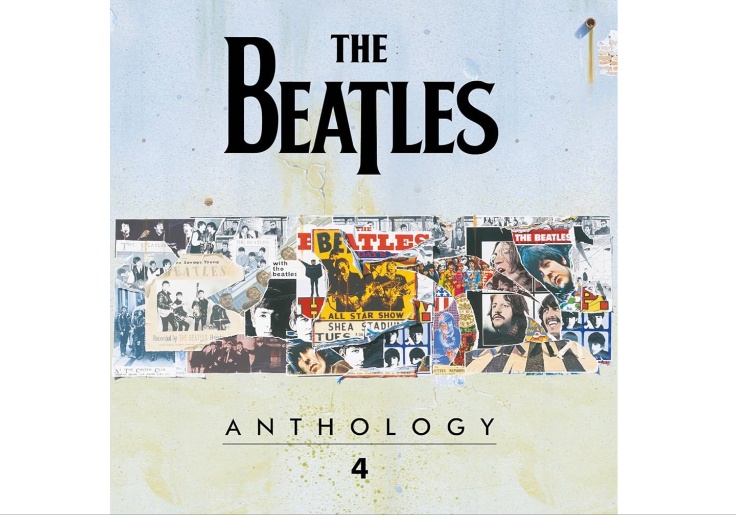
Of the 36 tracks on Anthology 4, 23 have been released already. The unreleased 13 tracks are early takes and instrumental versions. The early takes in particular are often fascinating, because they show how the band worked.
“You made a mistake, I know you did!” Paul says as George’s harmonies go sideways, and Take 4 of “Tell Me Why” crashes to nervous laughter. George fixes the pitch of the single note of his harmony in a sullen tone. Take 5 is better, though it lacks the towering vocal overlays and glossy guitars of the final version. There are a few tracks here like that, works in progress with John cracking jokes and Paul cracking the whip. George redeems himself on an early take of “Nowhere Man,” feeling his way toward the florid cascades of the full 12-string part with innocently understated fills.
The first take of “In My Life” captures the band’s artless sophistication: Ringo’s deceptively simple patterns, the dovetailing of McCartney’s harmony with Lennon’s lead. The instrumental section lacks the mock-baroque of George Martin’s sped-up piano. Instead of this top-heavy novelty, the band runs through the chords. Rather than sounding like self-conscious avant-gardists, they now could be any band in any rehearsal, feeling their way through some tricky changes—except they are no normal band. We hear an even greater sense of self-discovery and auditory revelation on Take 26 of “Strawberry Fields Forever.” This is the almost-finished track that came out of a two-day session on December 8 and 9, 1966. After George Martin created the final rhythm track by splicing together parts of two earlier, the band added the key sonic signatures on the final version: Ringo’s heavy drums (“Calm down, Ringo,” John says), George’s swarmandal (an Indian zither), the reversed Mellotron flutes, and McCartney’s guitar solo.
These are the major attractions. The minor ones are often interesting because they show how final versions were selected. Take 2 of “I Saw Her Standing There” has a Shadows-like reverb on George’s guitar and his solo is livelier than Take 1’s, but Lennon flubbed his first line when he came in on the first chorus, so Take 1 it is. The first rooftop performance of “Don’t Let Me Down” is looser than the official version, and fresher because of it, but the official one is tidier. Take 17 of “Helter Skelter” is fantastic: slower and harder than the album take. “Keep that one, mark it ‘Fab,'” Paul orders, switching from psychedelic orgiast to self-ironizing producer.
The vocal-free finished instrumental tracks fall flat. “Got to Get You Into My Life” without horns sounds bare, and exposing the strings for “Something” emphasizes the song’s fundamental schlockiness. A false start on “Hey Bulldog” (John: “Didn’t like the rhythm, actually”) leads to a pre-vocal version that, minus Lennon’s demented lyrics and vocal, sounds like the soundtrack for a documentary about the making of “Hey Bulldog.” The instrumental “Fool on the Hill” reminded me of Paul and George Martin’s overlooked film soundtrack for The Family Way (1966). Nice instrumentation, nice melody, but the digital enhancement cannot quite mask the sound of someone scraping the barrel.
“Want to get in tune, George?” Paul asks as Take 11 of “Baby You’re a Rich Man” falters. George asks for some Cokes to be brought in. Paul asks for some “cannabis resin.” George struggles to tune his guitar. Paul suggests they do the take without him. It’s brutal stuff.
“Alright, let’s hear some rhythm and soul from London now,” Lennon rallies the lads in a mock-posh radio voice. And then they hit the groove. It sounds great, but also ragged, as though they are tuning into the flickering radio wave of an arrangement.
“How did you feel about that, boys?” Lennon asks afterwards, now parodying George Martin.
“Well, you know, John, I mean, we thought swinging,” McCartney says in ingenuous Liverpudlian, but doubly so.
“Do you want to hear it back, yeah?” Lennon asks, sounding treble-Liverpudlian.
“Yes, yes,” McCartney says, hurriedly. You can hear the power struggle in their intimacy.
“Okay, come on lads, here it is, here it is, come on boys,” McCartney says as they prepare for Take 36 of “You Never Give Me Your Money” at “exactly half past 2” in the morning while Lennon impersonates Peter Cook and Ringo plays the small fills with which drummers tell guitarists that their patience is not infinite. The take is great, but I have no idea whether it is better than Take 35. Nor can we compare Take 17 of “Helter Skelter” with the legendary 27-minute Take 3, the group’s longest recording. That remains unreleased, along with “Carnival of Light,” the 14-minute psychedelic experiment recorded at McCartney’s instigation for a happening called the “Million Volt Light & Sound Rave,” which happened over two nights at the Roundhouse in London in early 1967.
“Carnival of Light” predated Lennon’s experimental “Revolution 9” experiment by more than a year. It was played once, at the rave, but the Beatles never heard it on the big speakers, because they were listening to the Four Tops at the Albert Hall that night. McCartney is said to have wanted to release it on Anthology 2—it would be the capstone of his campaign to prove that he, not Lennon, was King Beatle—but Ringo, George, and Yoko objected. It should have filled Side 6 of the six-disc vinyl set of Anthology 4. Instead we get AI-enhanced “new” mixes of the posthumous singles “Free as a Bird,” “Real Love,” and “Now and Then.”
“Only bold men go there,” Joe Strummer said of Side 6 of the Clash’s Sandinista!, which contains some of the worst dub reggae ever recorded. As to what is beyond Side 6 of Anthology 4, which is also Side 24 of the Anthology series, tomorrow never knows. But the “final” single “Now and Then” suggests what happens next. “Now and Then” was not “finished” with AI enhancement: It could not exist without it. It sounds unnatural, like the ghost of ELO in a padded cell. The accompanying video intercut digitally animated imagery of the dead Lennon and Harrison with the surviving McCartney and Starr: a ghoulish preview of the liberties that will be taken in the near future when all four Fabs have finally disembodied into pure copyright.
The Beatles, those survivors from the age of Sputnik and mono, have escorted us into the Uncanny Valley where nothing is real. Their digital resurrection may only have just begun. Soon there will be no need for scraps and leftovers. Tip the complete works and outtakes into AI, and the digital beast will spit out finished compositions and mixes, eight days a week. It will be awful.
The alternative is that Apple stop paring and slicing the archives, and issue them in whole chunks. The “Esher Tapes,” the demos of the material that became almost all of the White Album and also parts of Abbey Road, were drip-fed on Anthology 3 and reissued en masse with the White Album 50th anniversary set in 2018. Perhaps the most important single block of unreleased material, they had already been bootlegged at scale. But almost all of the White Album studio sessions remain unreleased. By 1968, EMI let the Beatles leave the tapes rolling all the time. The band worked up the songs in the studio, then picked a take that could be used as the rhythm track for multitrack development. Dozens and dozens of rejected takes are still unreleased.
Someday soon, you will be able to stream all 34 takes of “Glass Onion,” or even buy all of them on a heavy Japanese vinyl box set. You will listen to them in sequence. You will go back to the egg by listening to them in reverse sequence. You will hear all the false starts and banter, all the tuning ups and dressings down. You will hear nothing that sounds as good as Take 33—the choice of rhythm track for overdubbing usually came down to two or three takes, and the best of them often required “punching in” to smooth out the glitches—but you will hear something equally precious.
When you listen to a Beethoven string quartet, you can hear thought unfolding. The Beatles were never Beethoven, but when you hear the flow of takes, you hear the quartet’s feelings unfolding. You hear the bouncing around of ideas and the related interaction of personalities that was always vital to their appeal. The Beatles are revenants from the Romantic age. They are the sound of fun and friendship in the age when babies were booming, the young had hope and dope, and the future was still a thing.
Anthology 4 is the end of one Beatles’ afterlife, and the beginning of another. We cannot escape them, and life would be duller if we did. The most we can ask is that Apple release better material, such as the full White Album sessions. I cannot be the only person who would listen to all 21 takes of “Helter Skelter,” or all 52 takes of “Sexy Sadie.” (Take 52 was used for overdubs, but on the slower Take 6, released on Anthology 3, you can hear Paul’s wheezy chording on the Lowrey Heritage organ, which is masked in the released version by his heavily reverbed piano overdub.) There is a market for this, so no doubt Apple will oblige. In the end, the money they make is equal to the product we buy.
Dominic Green is a Wall Street Journal contributor and a fellow of the Royal Historical Society.
The post The Long and Winding Remix appeared first on .